


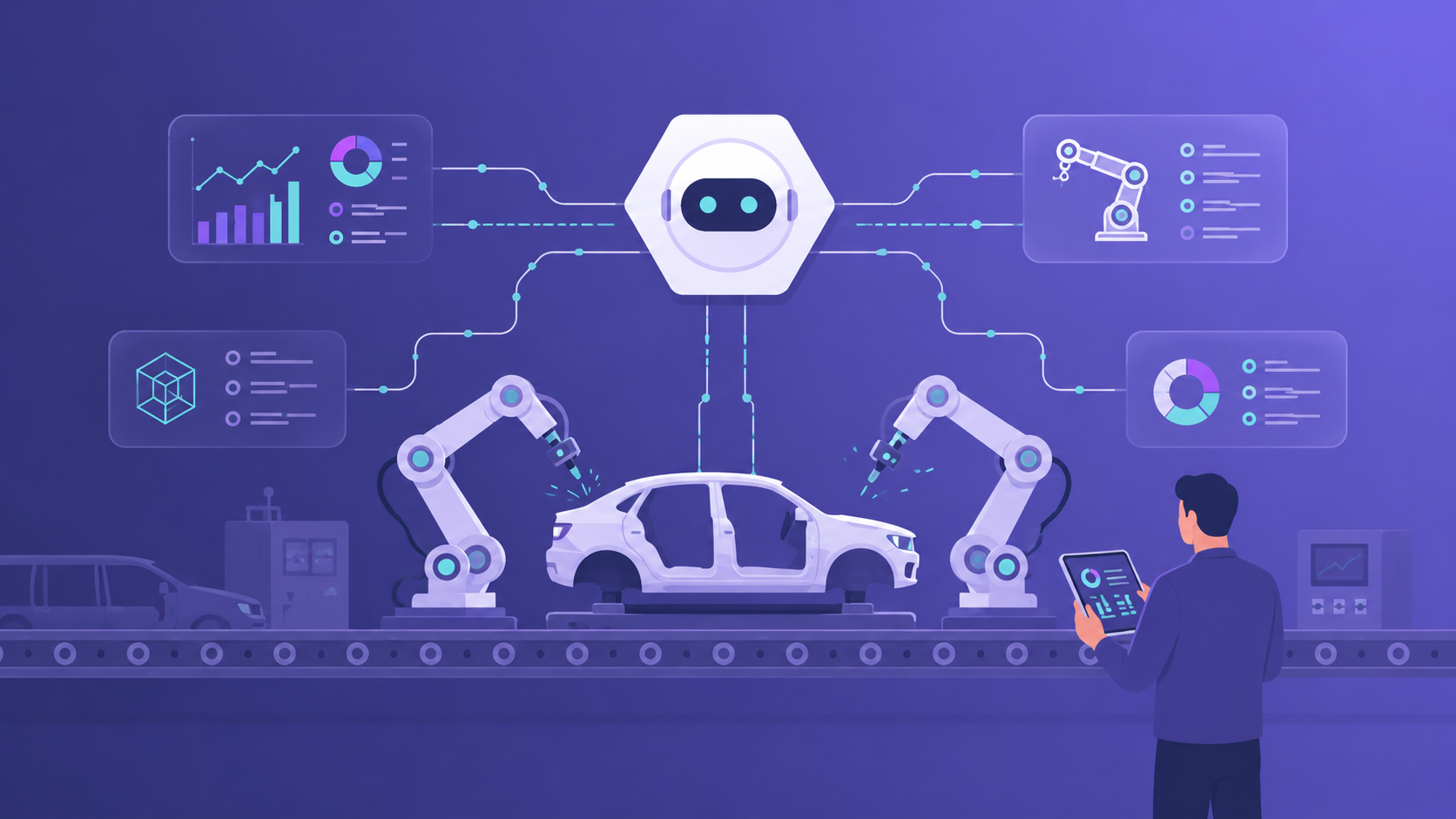
The automotive industry has always led on automation. Robotic assembly lines in the 1960s. Computer-aided design in the 1980s. Connected diagnostics and telematics in the 2000s. Each wave delivered measurable efficiency gains — and each eventually became the baseline every manufacturer had to match just to compete.
Agentic AI is the next wave. And it operates differently from everything that came before it.
Previous automation handled defined, repetitive physical tasks within fixed parameters. Agentic AI handles decision-making — continuously, across complex multi-step workflows, in real time, without waiting for a human to initiate each action. It monitors conditions, detects signals, evaluates options, and acts within guardrails that the business defines.
For automotive manufacturers managing global supply chains, dealer networks spanning thousands of touchpoints, and service ecosystems running millions of job cards annually, the implications are substantial — and the window to move from pilot to production is narrowing.
The Scale of the Opportunity
The numbers frame the urgency clearly.
McKinsey estimates that AI-driven transformation could unlock up to $400 billion in value across the automotive sector globally — spanning manufacturing operations, supply chain efficiency, dealer sales, and after-sales service. ¹
Gartner projects that by 2027, over 50% of manufacturers will have deployed AI agents in at least one core operational workflow, up from under 10% in 2024. ² The manufacturers moving now are not just gaining an efficiency advantage — they are building institutional knowledge about agentic deployment that will be very difficult for late movers to replicate quickly.
The question for automotive leaders is no longer whether agentic AI is relevant to their operations. It is which workflows to prioritise first, and what architecture is required to move beyond the pilot stage.
1. Supply Chain: From Reactive to Predictive Decision-Making
Automotive supply chains rank among the most complex in any industry. A single commercial vehicle requires upward of 30,000 components sourced from hundreds of suppliers across multiple geographies. A disruption at any point in that network — a quality deviation, a logistics delay, a raw material shortage — can halt a production line within days.
The traditional response is reactive. A report surfaces the problem. A team meets to evaluate options. Decisions are made with information that is already hours or days old. By the time a mitigation is in motion, the cost of disruption has already begun accumulating.
Agentic AI deployed in supply chain operations fundamentally changes this dynamic. Agents monitor supplier performance signals continuously — on-time delivery rates, quality rejection trends, logistics partner data, financial health indicators available through external feeds. When a defined threshold is breached, the agent does not generate a report. It evaluates alternative suppliers against current inventory buffers, models the margin impact of each option, checks compliance and vendor approval criteria, and surfaces a decision-ready recommendation — often before the operations team has opened their laptops.
A 2024 Deloitte study found that manufacturers using AI-driven supply chain monitoring reduced the cost of unplanned disruptions by an average of 23% within 18 months of deployment. ³ The saving is not primarily from the AI making better decisions. It is from the AI making decisions faster — before a recoverable situation becomes an unrecoverable one.
2. Manufacturing Operations: Closing the Loop Between Insight and Action
Predictive maintenance is the most widely cited AI use case on the factory floor — and for good reason. Unplanned downtime in automotive assembly costs an estimated $50,000 per minute at major OEM facilities. ⁴ Any technology that meaningfully reduces unplanned stoppages delivers a return that is immediate and measurable.
The limitation of most predictive maintenance deployments today is that they stop at insight. A sensor detects an anomaly. A dashboard flags it. A human reads the flag, decides what to do, and initiates the response. The AI has improved detection. The response loop is still manual.
Industrial AI agents close that loop. When a vibration anomaly is detected on a stamping press, an agent does not alert someone and wait. It checks the maintenance schedule, identifies the nearest qualified technician with the relevant certification, verifies spare part availability in the warehouse management system, raises a purchase order if stock is below the required threshold, and schedules the intervention — the human is notified with a resolution already in motion, not a problem waiting for a response.
This is the distinction between AI as an insight tool and agentic AI as an execution system. The underlying intelligence may be similar. The operational outcome is categorically different.
3. Dealer Operations: Bringing Intelligence to the Last Mile
For most automotive OEMs, the dealer network is simultaneously the most commercially critical and the least digitally connected part of the business. Thousands of independent touchpoints. Highly variable performance across regions. Limited real-time data flowing back to the manufacturer in a usable form.
The friction is visible in everyday dealer operations. Dealers call for order status because the portal does not reflect live inventory. Finance approvals take days because the workflow runs on email. Inventory targets are set quarterly against data that was already stale when the targets were published.
Agentic AI applied to dealer and commerce operations addresses these gaps at multiple levels simultaneously. Agents monitoring dealer order velocity can detect a slowdown in a specific model or geography and trigger a targeted commercial intervention weeks before it surfaces in a monthly report. Agents connected to finance platforms can process dealer credit applications in hours. Agents embedded in parts inventory management can flag overstock and understock conditions in real time, recommend rebalancing actions between dealer locations, and trigger fulfilment workflows automatically.
Vishleshan's work in automotive dealer platforms has demonstrated what this looks like at scale — 13,000 vehicles sold digitally, representing 27% of retail, and a parts platform delivering a 93% fill rate across a $322M revenue base. The foundation in both cases was real-time data connectivity between the OEM and the dealer network — the same foundation that agentic AI requires to operate effectively at the last mile.
4. After-Sales Service: Where the Margin Lives
After-sales service — warranty management, spare parts, field service, customer support — consistently contributes the highest margin in automotive operations. It is also among the most operationally fragmented.
Job cards, parts orders, technician scheduling, warranty claims, and customer communications run simultaneously across thousands of service centres, often on systems that do not share data in real time. The service manager's day is largely spent on coordination that does not require human judgment — it requires human availability, which is a different and more expensive thing.
AI agents deployed in service and field operations take over the orchestration layer. Routing job cards to the right technician based on skills, certification, and current availability. Confirming parts availability before a service appointment is locked. Flagging clusters of warranty claims that suggest a systemic quality issue requiring escalation. Updating the customer automatically at each stage of the service workflow without requiring a service advisor to make a call.
The human service team handles what genuinely requires judgment — complex diagnostics, escalated customer situations, exceptions that fall outside defined parameters. The agent handles the coordination and execution that currently consumes the majority of a service manager's working day. Vishleshan's service platform deployments have processed over 5.7 million job cards, generating $35M in platform revenue — demonstrating the scale at which these workflows operate in production.
5. The Architecture Every Automotive CIO Is Now Facing
The use cases above are deployable today. The constraint holding most automotive manufacturers at the pilot stage is not AI capability — it is the architecture required to govern it at enterprise scale.
Automotive manufacturers run on layered, heterogeneous technology estates. SAP and Oracle for ERP. Legacy MES on the shop floor. Multiple CRM platforms across regional markets. Dealer management systems that vary by geography. Regulatory and compliance frameworks that differ by country.
Deploying agents into this environment without a governed architecture layer creates new risk proportional to the capability being unlocked. Agents operating without business context make expensive mistakes. Agents without cost governance create variable P&L exposure at scale. Agents without security controls create compliance exposure in regulated markets.
The manufacturers moving successfully from pilot to production share a consistent architectural approach. A single governed gateway through which all agent access is authenticated and routed. A context layer that carries business rules, approval hierarchies, and compliance constraints into every agent interaction. A real-time control plane that provides visibility, auditability, and cost governance across the entire agent workforce.
This is the infrastructure that Vidura is built to provide — and it is what separates agentic AI that scales from agentic AI that stalls at the integration boundary.
Where to Start: Three High-ROI Entry Points
For automotive manufacturers evaluating where to begin, three workflows offer the fastest path to measurable return with manageable implementation complexity:
Vendor and supplier onboarding automation: delivers immediate time-to-value. Document types are defined, validation rules are clear, and the manual effort being replaced is high. Deployment does not require touching core ERP systems. Results are visible within weeks.
Dealer intelligence and order management: addresses a high-volume, high-visibility problem with clear operational metrics. Agents monitoring dealer performance and automating order workflows can be deployed against existing dealer portal infrastructure without a platform rebuild.
Predictive maintenance with agentic resolution: leverages sensor infrastructure that most manufacturing facilities already have in place. The upgrade from alert-generation to resolution-execution is an architectural change, not a hardware investment — and the cost of inaction is measurable in downtime minutes.
Each of these can be deployed as a contained agentic workflow without disrupting core manufacturing systems. The value is visible in the first quarter, not the first year.
Agentic AI is not the next version of the automation automotive manufacturers have deployed before. It operates at the decision layer — monitoring signals, reasoning within defined constraints, and executing outcomes across complex enterprise workflows.
The manufacturers that build the governance architecture and move from isolated pilots to production deployments in the next 12 to 18 months will accumulate an operational advantage that compounds. Those still running disconnected experiments will find the gap difficult to close quickly.
The question for every automotive leader in 2026 is not whether agentic AI belongs in their operations. It is whether their architecture is ready to make it work at scale.
Vishleshan builds agentic AI platforms for automotive manufacturers — from supplier onboarding to dealer intelligence to service operations. Book a Demo.