


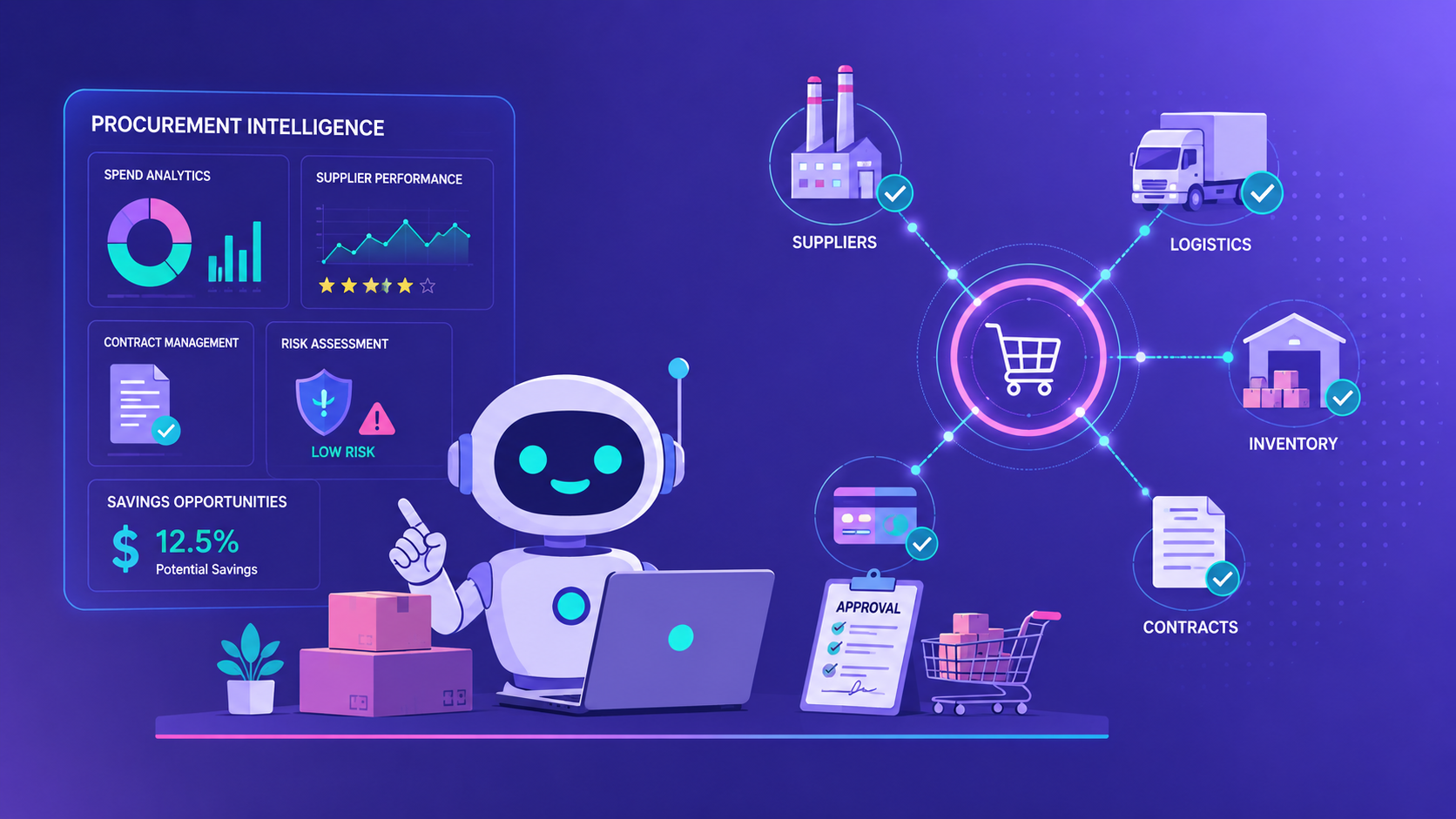
Procurement is one of the most document-heavy, approval-dependent, and manually intensive functions in any large enterprise. It is also one of the most consequential — directly impacting cost structure, supplier relationships, supply chain resilience, and working capital.
Yet for most organisations, the core procurement workflow in 2026 looks remarkably similar to what it looked like a decade ago. Requests raised by email. Documents verified by hand. Data re-entered into ERP systems. Approvals chased through chains that were never designed for speed. The technology around the edges has improved. The process underneath it largely has not.
Agentic AI is changing that — not by digitising the existing process, but by redesigning it from the outcome backwards. Here is what that shift looks like in practice, and why the enterprises moving now are building a compounding cost and efficiency advantage.
Why Procurement Has Been Slow to Transform
The barriers to procurement transformation have been structural, not technological.
Procurement sits at the intersection of finance, operations, legal, and supplier relationships — meaning any process change requires alignment across multiple functions with different priorities, different systems, and often different definitions of what "good" looks like. Legacy ERP systems hold transactional data that is difficult to extract and contextualise. Supplier data is distributed across onboarding forms, emails, contracts, and government verification platforms that do not talk to each other.
Add to this the compliance and audit requirements that govern procurement in regulated industries — financial services, automotive, manufacturing — and the case for incremental improvement over fundamental redesign has historically been compelling.
What has changed is the availability of AI agents capable of operating across these systems simultaneously — reading documents, verifying data against external sources, routing approvals, and updating enterprise systems — without touching the underlying ERP architecture that procurement teams rely on.
The rip-and-replace barrier, which has protected manual procurement processes for years, no longer applies.
The Scale of What Is at Stake
The financial case for procurement transformation is well established.
McKinsey estimates that AI-enabled procurement can reduce processing costs by 40 to 60% and cut cycle times by up to 70% across sourcing, vendor management, and purchase order workflows. ¹ Hackett Group research found that top-performing procurement organisations — those with the highest levels of digital and AI adoption — operate at approximately 29% lower cost per invoice processed compared to their peers. ²
For a large enterprise processing tens of thousands of purchase orders and managing hundreds of active suppliers, those percentages translate into significant and measurable working capital impact.
The more important shift, however, is qualitative. Procurement teams freed from document processing and approval chasing can focus on strategic sourcing, supplier relationship management, and risk mitigation — the work that actually requires human judgment and directly impacts the P&L.
Where Agentic AI Is Creating the Most Immediate Impact
Vendor Onboarding and Validation
Vendor onboarding is the entry point where most procurement inefficiency begins. A new supplier submits documents. Someone checks each one manually — PAN, GSTIN, bank details, director information, registration certificates. The same data gets keyed into the ERP. Mismatches get caught late, if at all. The whole process takes days or weeks when it should take hours.
Agentic AI applied to compliance and workflow automation restructures this entirely. Agents read submitted documents, extract structured data, cross-validate it across documents, and verify it against government platforms — GSTN, MCA, NSDL — in real time. Mismatches are flagged before a human reviews the file. The onboarding form fills itself. The approval workflow triggers automatically with the right people in the right sequence and a full audit trail throughout.
What previously required multiple handoffs over days now completes in hours — without any change to the existing ERP system.
Purchase Order Processing and Approval Routing
Purchase order processing is high-volume, rule-bound, and heavily dependent on human availability at each approval step. An agent can validate a purchase request against budget availability, procurement policy, and supplier approval status simultaneously — routing it to the correct approver with full context attached, escalating automatically if the approval window is breached, and updating the ERP once the approval is confirmed.
The human approver's role does not change. The time that request spends waiting for a human to initiate the next step is eliminated. At scale, across thousands of monthly POs, that waiting time represents a material working capital opportunity.
Spend Analytics and Strategic Sourcing
Most enterprise spend analytics programmes suffer from the same problem: the data is available, but extracting and contextualising it requires significant manual effort. By the time a category manager has a clear picture of spend patterns, the window to act on it has often passed.
AI agents deployed in supply chain and operations can monitor spend continuously — flagging maverick spend against category policies, identifying consolidation opportunities across supplier relationships, detecting pricing anomalies against contracted rates, and surfacing demand signals from operational systems that inform sourcing decisions before a formal review cycle begins.
The shift is from procurement intelligence as a periodic reporting exercise to procurement intelligence as a continuous operational signal — one that agents act on rather than humans discover.
Contract and Compliance Management
Contract compliance is a persistent gap in large enterprise procurement. Contracts define pricing, delivery terms, quality standards, and penalty clauses — but the operational systems that process transactions rarely check actively against what was agreed.
Agents connected to both contract repositories and transactional systems can monitor delivery performance against SLA terms, flag invoices that do not match contracted pricing, trigger penalty clause processes where warranted, and alert category managers to supplier performance degradation before it reaches a material threshold.
The compliance layer that previously required manual reconciliation between contract and transaction data becomes an automated, continuous audit that runs without human initiation.
The Governance Architecture Procurement Cannot Skip
The procurement function operates under significant compliance, audit, and financial control requirements. Any AI deployment that introduces ungoverned decision-making into this environment creates risk that can quickly outweigh the efficiency gains.
Three architectural components are non-negotiable for agentic AI in enterprise procurement.
A governed gateway that authenticates every agent interaction with enterprise systems — ERP, supplier portals, government verification platforms — and maintains a complete audit trail of every access and action. No direct agent-to-system connections outside this layer.
A context layer that carries procurement policy, approval hierarchies, budget constraints, and compliance rules into every agent decision. An agent approving a purchase order without access to current budget availability and policy thresholds is not a controlled process. It is an uncontrolled one that happens to use AI.
A governance and cost control layer that manages the variable cost of AI inference across procurement workflows and provides real-time visibility into what agents are doing, what decisions they are making, and where human review is required.
This is the architecture that Vidura is built around — enabling enterprises to deploy agentic procurement workflows with the auditability and control that finance and compliance functions require.
What Implementation Actually Looks Like
The most common concern from procurement and IT leaders evaluating agentic AI is the integration question — specifically, whether deployment requires changes to the ERP systems that procurement runs on.
In most cases it does not. The agentic layer sits above existing systems, accessing them through governed API connections rather than modifying the underlying architecture. The ERP remains the system of record. The agent layer handles the workflow orchestration, document processing, and routing that currently runs on email and manual effort.
For manufacturing and industrial enterprises, where ERP stability is a hard constraint and change management cycles are long, this is the deployment model that makes agentic procurement viable without a platform migration.
A realistic implementation sequence for a large enterprise looks like this: vendor onboarding automation in the first phase — high manual effort, defined document types, fast time-to-value. PO processing and approval routing in the second phase — high volume, clear rule structure, measurable cycle time reduction. Spend analytics and contract compliance monitoring in the third phase — requires data integration across more systems but delivers strategic sourcing value that compounds over time.
Procurement automation is not a new idea. What is new is the capability to deploy AI agents that handle the full workflow — document reading, data validation, cross-system verification, approval routing, ERP updating — without human intervention at each step, and without replacing the enterprise systems already in place.
The agentic AI transformation of procurement is not primarily a cost story, though the cost case is strong. It is a capability story — freeing procurement teams from the transactional work that consumes most of their time so they can focus on the strategic work that actually differentiates supply chain performance.
The enterprises building this capability now are not just processing invoices faster. They are creating a procurement function that operates at a fundamentally different level of intelligence and responsiveness — one that compounds as the agent workforce grows and the operational data behind it deepens.
Vishleshan builds agentic AI solutions for enterprise procurement — from vendor onboarding to PO automation to spend analytics. Book a Demo.