


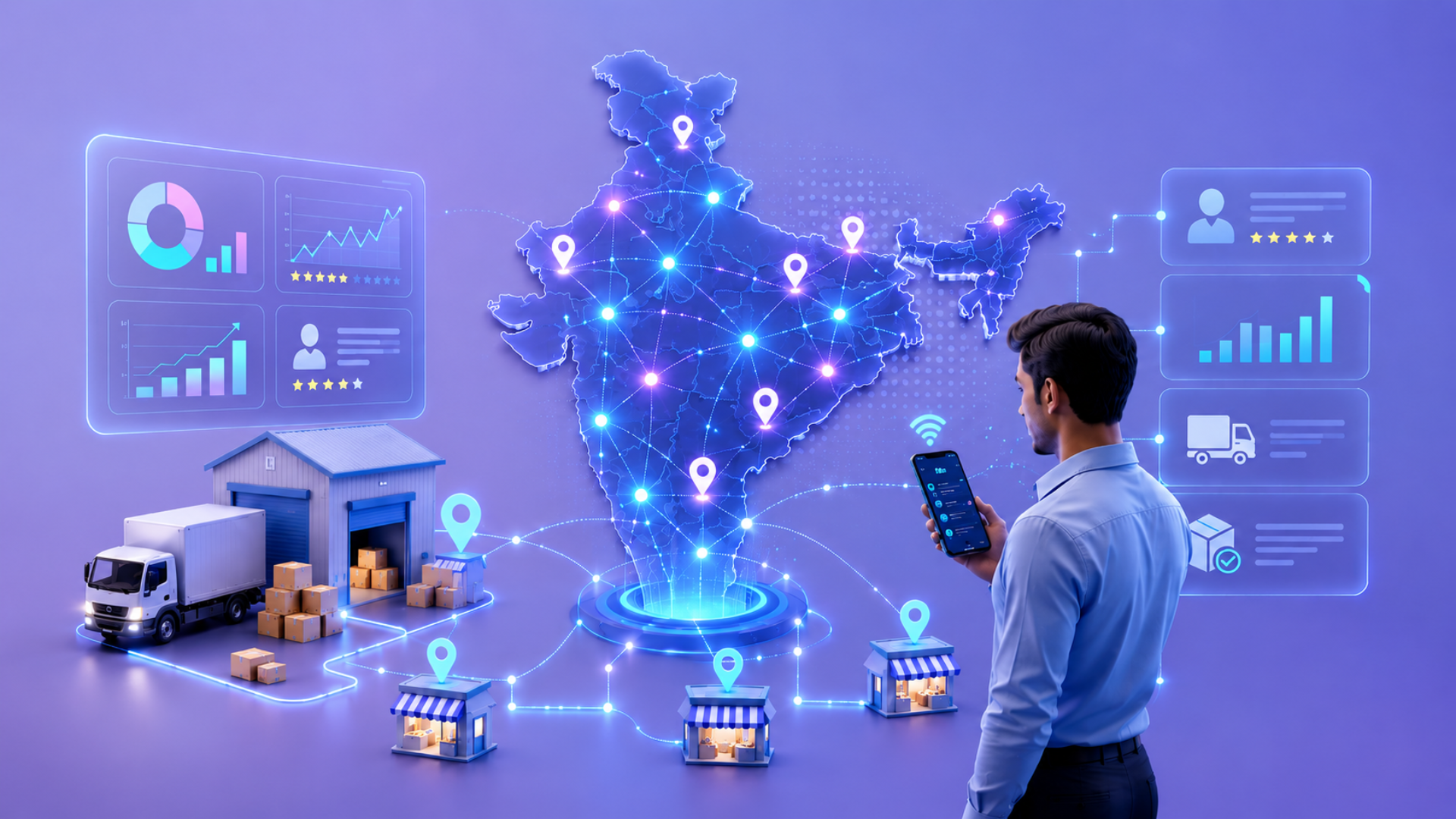
India's Fast Moving Electrical Goods sector moves at extraordinary scale. The largest players distribute across hundreds of thousands of retail touchpoints — electricians, contractors, project buyers, retail outlets — through layered networks of distributors, sub-distributors, dealers, and channel partners that span every geography from metro cities to tier-3 towns.
The complexity of that network is a competitive moat. It is also, for most FMEG companies, a visibility problem that has resisted every previous attempt to solve it cleanly.
What is actually selling at the dealer level, in real time? Where is inventory building up? Which distributor is underperforming against potential, and why? Which SKUs are being substituted by a competitor at the point of sale? For most large FMEG organisations, the honest answer to each of these questions is: we find out weeks later, from data that has been aggregated, delayed, and partially lost in the journey from outlet to headquarters.
Agentic AI is changing that equation — not by asking dealers to change how they operate, but by embedding intelligence into the channel infrastructure that already exists. Here is what that shift looks like, and why the FMEG companies moving now are pulling ahead on channel performance.
The Dealer Visibility Problem in FMEG
The structural challenge in FMEG distribution is that the data generated at the point of sale rarely travels back to the manufacturer in a usable form, at a useful speed.
Dealers and sub-distributors operate on their own systems — tally software, spreadsheets, or increasingly basic dealer management apps — that are not integrated with the manufacturer's ERP or CRM. Secondary sales data, where it is collected at all, arrives through manual uploads or field sales team reports that are periodic, incomplete, and subject to the natural optimism of a channel team reporting upward.
The result is a manufacturer making inventory, pricing, and channel incentive decisions based on primary sales data — what left the warehouse — rather than secondary sales data — what actually reached the end customer. The gap between the two is where channel health problems hide until they are large enough to affect revenue.
A 2024 Bain & Company study of Indian consumer goods distribution found that companies with real-time secondary sales visibility outperformed peers on revenue growth by an average of 8 percentage points annually — a gap driven almost entirely by faster response to channel signals. ¹
What AI-Driven Channel Intelligence Actually Looks Like
Real-Time Secondary Sales Visibility
The first and most foundational shift is moving from periodic secondary sales reporting to continuous, real-time visibility across the dealer network.
AI agents deployed in commerce and revenue operations connect to dealer-facing platforms — mobile apps, order portals, field sales tools — and aggregate transaction signals as they occur. When a dealer in Pune places an order, adjusts a SKU quantity, or reports a competitor substitution, that signal is visible to the manufacturer in real time — not in a weekly upload.
Agents monitoring this data stream do not just collect it. They analyse it — detecting unusual patterns in order frequency, identifying dealers whose ordering behaviour suggests inventory stress or competitive pressure, and surfacing channel anomalies that warrant a targeted intervention before they compound into a broader distribution problem.
Vishleshan's work with large FMEG channel networks has demonstrated what this visibility looks like at scale — 1,000 distributors connected on a single platform with real-time channel visibility, transforming what was previously a fragmented reporting exercise into a live operational intelligence layer.
Inventory Intelligence Across the Channel
Inventory misalignment is one of the most persistent and expensive problems in FMEG distribution. Overstocked distributors discount aggressively, creating channel conflict. Understocked dealers lose sales to competitors. Both situations damage brand and margin — and both are largely preventable with the right visibility.
AI agents applied to supply chain and operations can monitor inventory positions across the channel continuously — tracking stock levels at distributor warehouses, flagging SKUs at risk of stockout before the dealer runs dry, identifying overstock positions that need to be rebalanced, and recommending replenishment actions that account for demand signals, seasonal patterns, and promotional calendars simultaneously.
The manufacturer no longer needs to wait for a field team visit or a distributor call to understand what is happening to inventory at the second and third tier. The agents are watching it continuously and acting on the signals.
Field Sales Productivity and Territory Intelligence
India's FMEG sector relies heavily on field sales teams — thousands of territory sales managers and sales representatives whose productivity directly determines channel development outcomes. Their time is the most valuable and most poorly tracked resource in the go-to-market model.
The typical field sales manager in a large FMEG company spends a disproportionate share of their week on administrative tasks — logging visit reports, updating order status, following up on scheme activations, chasing credit approvals. Time that could be spent on dealer development and competitive response is absorbed by operational coordination.
Conversational AI and agentic tools deployed for field teams change this balance significantly. A field sales manager can check live dealer order status, flag a credit issue, submit a visit report, and query competitive scheme information through a mobile-first interface — in the time it previously took to navigate a desktop portal. The administrative overhead moves to an agent. The field manager focuses on the conversation in front of them.
The territory intelligence layer compounds this further. Agents analysing order history, dealer visit frequency, and performance against targets can surface the three dealers in a territory that represent the highest growth opportunity this week — and the two that are showing early signs of competitive attrition and need immediate attention. The field manager's judgment on which conversations to prioritise is now informed by real data rather than experience alone.
Scheme and Incentive Activation
Channel schemes and trade incentives are among the largest discretionary spends in FMEG — and among the hardest to track for actual return on investment.
Schemes are launched centrally. Activation at the dealer level is tracked through field reports that arrive periodically and incompletely. The correlation between scheme investment and secondary sales uplift is rarely established with any precision, because the data to do so arrives too late and in too fragmented a form.
Agents monitoring dealer commerce data in real time can track scheme activation rates as they happen — identifying which geographies and dealer segments are responding, which are not, and where reallocation of scheme investment would generate better return. A channel marketing team that previously made scheme investment decisions on quarterly data can now make them on weekly or even daily signals.
The compound effect, across a large FMEG network operating hundreds of schemes simultaneously, is a significantly more efficient allocation of one of the largest controllable cost lines in the go-to-market model.
The Architecture That Makes This Work Without Disrupting Existing Systems
The FMEG channel intelligence challenge is not primarily a data availability problem — most large players have more data than they can usefully process. It is a data integration and real-time processing problem.
Dealer data lives in multiple systems that do not share a common format or update frequency. ERP data is clean but lagged. Field sales data is current but incomplete. Distributor data is intermittent and manually submitted.
Agentic AI deployed through a governed platform can connect to all of these sources simultaneously — through the Intelligent Gateway that authenticates and routes agent access to each system — and produce a unified, real-time picture of channel health without requiring any of the underlying systems to change.
The ERP remains the system of record. The dealer apps remain the dealer-facing interface. The context layer carries the business rules — credit limits, scheme eligibility, territory assignments, inventory thresholds — that give agents the information they need to act within defined boundaries rather than in a vacuum.
The result is channel intelligence that is genuinely real-time, genuinely actionable, and genuinely governed — without the multi-year ERP migration that FMEG IT teams have historically been asked to undertake before any of this becomes possible.
What Leading FMEG Companies Are Prioritising First
For FMEG organisations evaluating where to begin, three entry points offer the clearest path from current state to measurable channel impact:
Dealer onboarding and KYC automation eliminates the manual document processing that delays new dealer activation — the same pattern that creates competitive disadvantage when a new territory or product line requires rapid channel expansion.
Real-time secondary sales and inventory visibility is the foundational layer that makes every subsequent AI application more valuable. Without it, agents are making decisions on incomplete signals. With it, the entire channel intelligence stack improves.
Field sales productivity tools deliver visible impact to the field organisation quickly — building adoption and generating the operational data that makes more sophisticated channel intelligence possible over time.
Each of these can be deployed incrementally, building toward a comprehensive channel intelligence and operations platform rather than requiring a single large-scale programme to deliver value.
Conclusion
The FMEG sector in India is at an inflection point. The companies that have built distribution scale over decades now have the technology available to match that scale with genuine real-time intelligence — and the ones moving first are turning their channel breadth from a complexity problem into a compounding data advantage.
Agentic AI does not replace the distributor relationships, field sales capability, and channel investment that FMEG leaders have built over decades. It makes all of those assets more productive — by ensuring that the intelligence flowing through the channel reaches the people who need to act on it, at the speed that competitive markets now require.
The visibility gap that has defined FMEG channel management for a generation is now closeable. The question is which companies close it first.
Vishleshan builds AI-native channel intelligence and dealer management platforms for large FMEG enterprises. See how we work Book a Demo.