


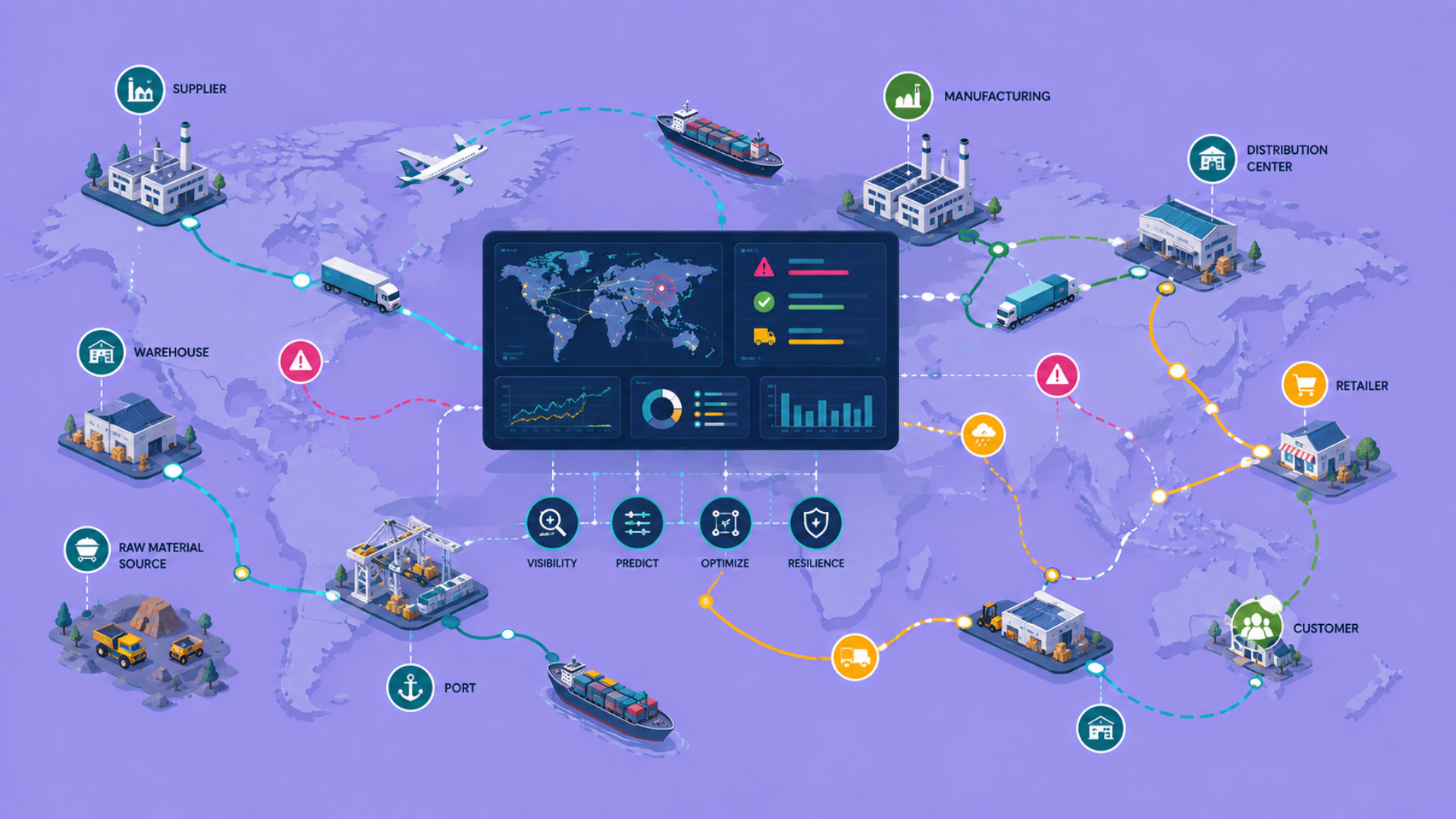
The global supply chain environment in 2026 is operating under conditions that make the pre-pandemic "just-in-time" model look not just fragile but structurally inadequate. Tariff uncertainty, geopolitical realignments, climate-driven logistics disruptions, aging infrastructure, and demand volatility are pressing simultaneously on supply chains that were built for a world that no longer exists.
Gartner projects that 60% of supply chain disruptions will be resolved without human involvement by 2031. That projection is not about replacing supply chain professionals. It is about how quickly disruptions now move, often faster than humans can respond. This creates a need for AI systems that can detect, assess, and respond to disruptions at machine speed.
The enterprises that are ahead in supply chain AI in 2026 are not the ones with the best forecasting tools. They are the ones that have rebuilt how supply chain decisions get made, with AI as an operational actor rather than an analytical assistant. This piece covers what is actually changing and what it requires.
The Shift From Reactive to Predictive to Agentic
Supply chain AI has passed through two discernible phases since 2020 and is entering a third.
The first phase was reactive analytics. AI systems processed historical data to produce better reports about what happened and why. The outputs were better than manual reporting. The decision-making was still human, still periodic, and still lagged behind the pace at which the supply chain was changing.
The second phase was predictive analytics. AI systems generated forward-looking forecasts, such as demand projections, risk scores, and supplier performance predictions. This gave human decision-makers better information earlier. Gartner research finds that 65% of supply chain management professionals now consider AI and generative AI capabilities important or very important for technology purchase decisions. The investments in this phase have been significant and the returns have been real, particularly in demand forecasting accuracy and inventory optimisation.
The third phase, now underway in the most advanced supply chain deployments, is agentic AI. AI agents can do more than analyse and recommend. They can detect a disruption, evaluate response options against current constraints, and initiate the appropriate action. This could mean raising an alternative purchase order, triggering an expedited shipment, or resequencing production, all within defined parameters and without waiting for human intervention.
Agentic AI is expected to dominate supply chain initiatives in 2026 as leaders forge a path to enterprise value through tangible applications that support decision makers and drive autonomy. The question for most enterprise supply chain leaders is not whether agentic AI is coming to their function. It is whether their data infrastructure and integration architecture are ready to support it when it arrives.
Where AI Is Generating Documented Supply Chain Returns
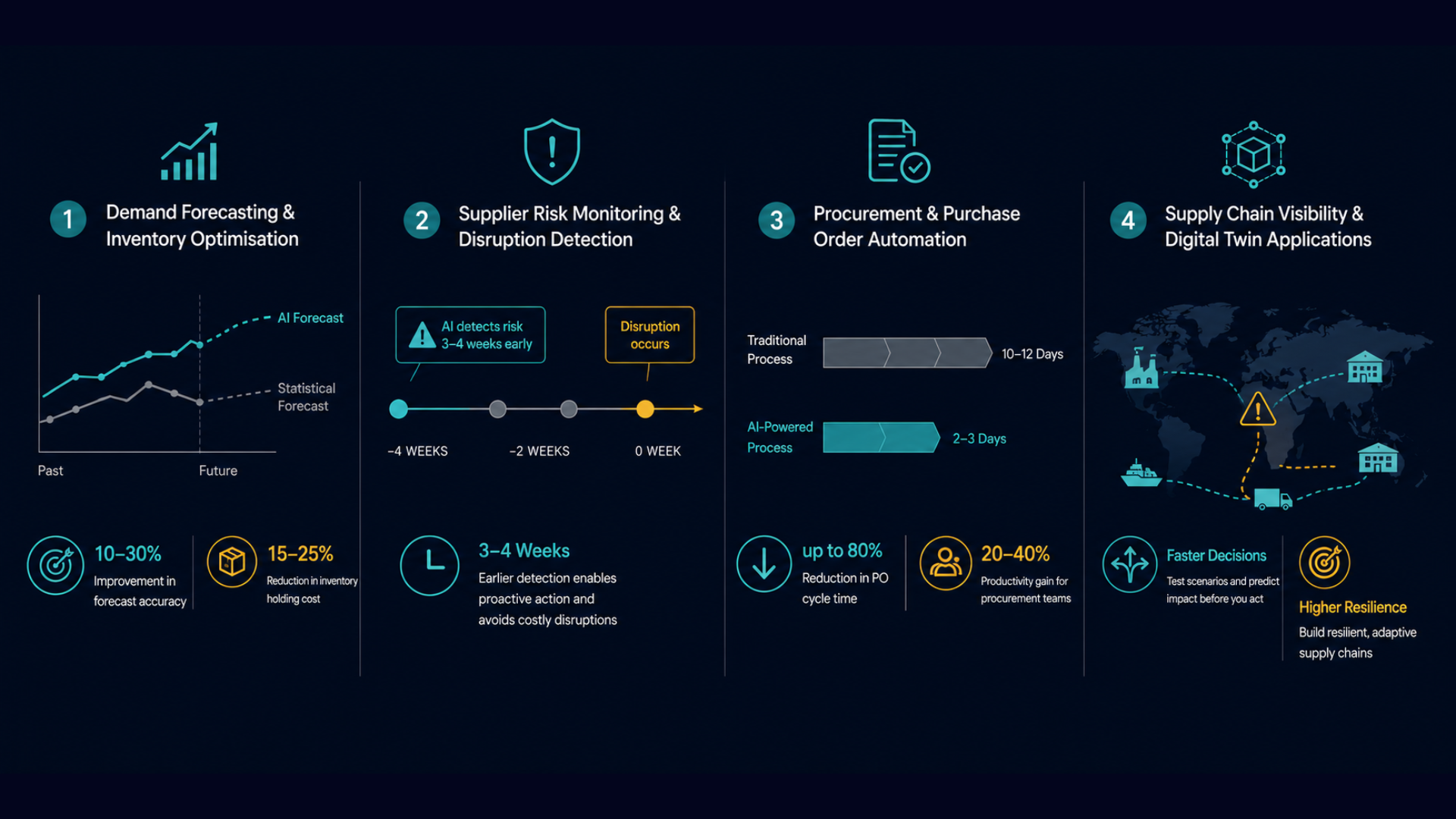
Demand forecasting and inventory optimisation
Demand forecasting was the first supply chain AI use case to generate consistent, measurable returns and remains the one with the most accumulated evidence. AI forecasting systems that use external signals such as economic indicators, competitor pricing, weather forecasts, and consumer sentiment alongside internal sales data consistently outperform models based on historical patterns alone.
The improvement is particularly significant in volatile conditions, which describes most markets in 2026. A statistical model trained on historical patterns struggles when those patterns break, which they do repeatedly in an environment of tariff changes, geopolitical disruptions, and demand shifts. AI systems that incorporate real-time signals can detect pattern breaks and adjust forecasts accordingly, which is the capability that matters most in the supply chain environment that currently exists.
The returns extend beyond forecast accuracy into inventory positioning. Better demand signals enable tighter inventory management without increasing stockout risk, a combination that has historically required choosing between service levels and working capital. AI-powered inventory optimisation at the network level, positioning stock across multiple locations simultaneously based on predicted demand and transfer costs, generates working capital improvements that are measurable in weeks rather than quarters.
Supplier risk monitoring and disruption detection
AI integration enables alerts to logistical shocks such as port congestion, rate spikes, and supplier shortages through what industry analysts call Cognitive Control Towers, which have gained significant traction as supply chain disruptions exposed their value.
The disruption detection use case has become the highest-urgency supply chain AI deployment in 2026 for enterprises whose supply chains span geographies with significant geopolitical or climate risk exposure. AI systems monitoring supplier financial health indicators, geopolitical risk signals along sourcing routes, port congestion data, and carrier performance metrics in real time are identifying developing disruptions three to four weeks before they appear in delivery failures.
The commercial value of that three to four week window is significant and specific. It is the difference between having options. Qualifying an alternative supplier, adjusting safety stock, repositioning inventory and managing a crisis with no good choices. Supply chain disruptions resolved with advance notice cost a fraction of disruptions managed after the fact. The AI is not preventing disruptions. It is giving procurement and supply chain teams the time they need to resolve them before they become operational emergencies.
Procurement and purchase order automation
PwC research finds that AI agents can reduce cycle times by up to 80% in purchase order transaction processing and matching. The purchase order automation use case is becoming standard in large enterprise supply chain deployments because the ROI case is straightforward, the integration requirements are well-understood, and the productivity improvement is immediately measurable.
AI agents can handle standard purchase order processing, from matching orders with contracts to verifying supplier terms, routing approvals, and generating documentation. This reduces administrative work and lets procurement teams focus on supplier relationships, contract negotiations, and strategic sourcing that require human judgment.
The procurement AI deployments that generate the largest returns are the ones integrated with ERP in real time, where purchase order data flows directly into and out of the system of record rather than through a parallel system that requires reconciliation. The integration architecture is the determinant of whether procurement AI generates the projected efficiency gains or creates a new set of reconciliation tasks that offsets them.
Supply chain visibility and digital twin applications
80% of companies now report greater resilience through digital initiatives, with the focus in 2026 shifting toward predictive analytics that turn global volatility into a real-time data variable. The digital twin concept is moving from an emerging capability to an operational standard in advanced supply chain organisations. It creates a continuously updated digital model of the supply chain for scenario planning and disruption simulation.
Digital twins powered by AI enable supply chain teams to model the impact of a proposed supplier switch, a logistics route change, or a production schedule adjustment before implementing it.The ability to evaluate complex, multi-variable decisions using a model that reflects the current state of the supply chain is changing how supply chain strategies are made. This is more useful than relying on snapshots that may already be weeks out of date.
The Operating Model Change That AI Requires
The supply chain AI deployments generating the largest returns in 2026 are not simply better tools deployed within unchanged operating models. They are enabling a fundamental change in how supply chain decisions get made, and that change requires deliberate operating model adaptation.
In a traditional supply chain operating model, humans make decisions and systems execute them. The planning team produces a demand forecast. The procurement team raises purchase orders. The logistics team schedules shipments. The planning cycle is weekly or monthly. The response to disruption is as fast as human attention and process allow, which is rarely fast enough in a supply chain environment where disruptions cascade in hours.
In an AI-augmented supply chain operating model, AI agents execute routine decisions within defined parameters and surface exceptions for human judgment. The demand forecast updates continuously. Purchase orders for standard transactions are raised automatically. Disruption responses are initiated by AI within governance boundaries, with human oversight for decisions that exceed defined thresholds.
This operating model change requires the same preparation that the AI-native versus AI-enabled transition requires in any enterprise function: defining what AI is authorised to do autonomously, what requires human approval, and how the human oversight function changes when AI is executing rather than recommending. Enterprises that deploy agentic supply chain AI without making these design decisions explicitly discover them as governance gaps after deployment, which is significantly more expensive than resolving them before.
The Data Foundation That Supply Chain AI Requires
The consistent finding across supply chain AI deployments that have underperformed their projections is that the data foundation was insufficient for the AI to perform as designed.
Reliable, harmonised data is essential for AI-driven supply chain decisions. The data quality problems that were manageable when AI was producing analytical outputs become operational problems when AI is making real-time decisions. An AI agent that decides to reorder from an alternative supplier based on inventory data that is 36 hours stale may be making a decision that was correct when the data was captured and wrong when it is executed.
The specific data requirements for supply chain AI that is operating at decision speed rather than reporting speed are more demanding than most enterprises initially anticipate. Real-time inventory data across the full network. Supplier delivery performance data that updates with each transaction rather than on a weekly reporting cycle. Contract terms that are machine-readable and query-able at decision time. Transportation capacity data that reflects current availability rather than historical averages.
Building this data foundation is the prerequisite work that supply chain AI leaders consistently identify as the investment they wish they had made earlier. It is unglamorous, it does not produce visible AI outputs while it is being built, and it is consistently the difference between supply chain AI that performs at scale and supply chain AI that performs in pilots.
This is the same data infrastructure challenge that enterprise AI deployment faces across every function. The data is the AI. Getting it right before the build is what separates deployments that work from deployments that require rebuilding.
What the Next 18 Months Look Like
The supply chain AI trajectory in 2026 points toward three developments that enterprise supply chain leaders should be preparing for now.
Tariff-driven supplier network redesign will accelerate AI investment. The current tariff uncertainty is forcing enterprises to evaluate supplier diversification, nearshoring, and multi-hub sourcing models simultaneously. AI scenario modelling and supplier risk analytics are the tools that make those evaluations tractable at the speed and complexity they require.
The EU Digital Product Passport will create new data requirements that AI is well-positioned to manage. Regulations transforming physical products into data-rich assets, tracking provenance, materials, and carbon footprint through the supply chain, create compliance requirements that are manageable at scale only with AI-powered data collection and reporting systems.
Autonomous supply chains will move from aspiration to operational standard in leading enterprises. The 60% disruption resolution without human involvement that Gartner projects for 2031 will be achieved by a subset of enterprises significantly earlier. The ones that will get there first are the ones investing now in the data infrastructure, integration architecture, and governance frameworks that agentic supply chain AI requires.
Supply chain AI in 2026 is not a planning improvement. It is an operating model transformation for the enterprises that are getting it right. The returns, from faster disruption response and better inventory efficiency to shorter procurement cycles and better decisions, are measurable. So are the requirements to achieve them: strong data infrastructure, deep integration, effective governance, and the right delivery model.
Vishleshan AI's forward deployed engineers work inside client supply chain environments across automotive, FMEG, and financial services, building the data infrastructure, ERP integration, and agentic AI architecture that supply chain transformation requires. Book a Consultation