


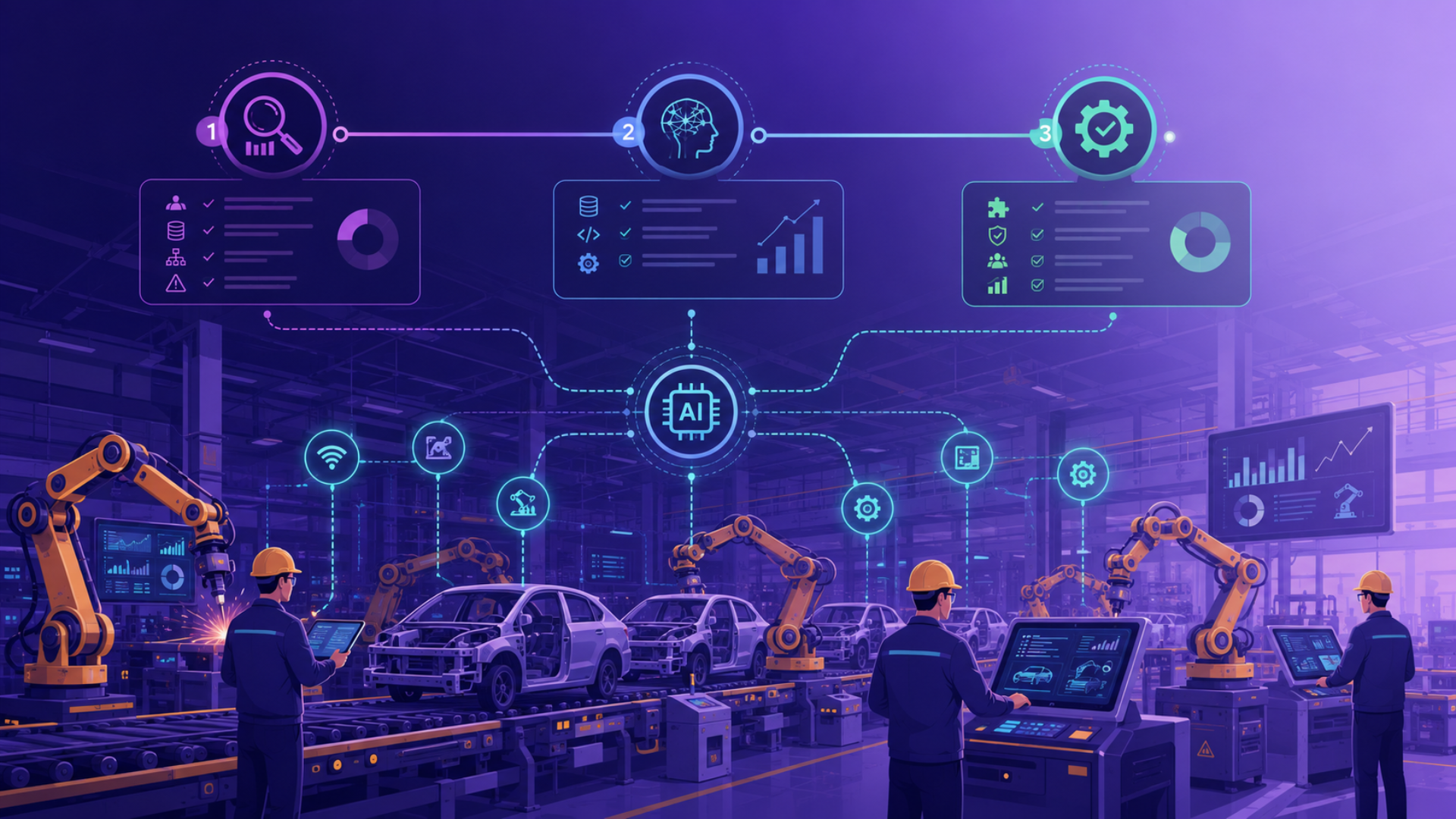
Automotive manufacturing is one of the most complex operating environments in any industry. Multi-tier supply chains spanning dozens of countries. Assembly lines where a single unplanned stoppage costs tens of thousands of dollars per minute. Dealer networks spread across thousands of touchpoints with inconsistent data flowing back to the manufacturer. Quality and safety obligations that make the cost of an AI error significantly higher than in most other sectors.
It is also one of the environments where AI can deliver the clearest, most measurable operational improvements, precisely because the data is rich, the constraints are specific, and the cost of inefficiency is well-understood and quantified.
This guide covers how to move from AI initiative to production deployment in 90 days in an automotive manufacturing environment. Not a pilot. Not a proof of concept. A system that is genuinely running in production, being used by the people it was built for, and generating a measurable improvement in a named business metric.
Before Day One: Getting the Preconditions Right
The 90-day clock does not start when the contract is signed. It starts when three preconditions are in place. Organisations that try to start the clock without these in place consistently take longer than 90 days and frequently do not reach production at all.
A named, specific business constraint:
Not "improve supply chain efficiency" or "explore predictive maintenance opportunities." A named constraint that has a number attached to it. Fill rate currently at 78 percent against a target of 91 percent. Unplanned downtime averaging 340 minutes per month in the stamping plant. Dealer order status queries consuming 35 percent of the regional sales team's working hours. The more specific the constraint, the faster the deployment, because every architecture and integration decision has a clear answer: does this help close the gap on the named metric or not?
Access to the actual production environment:
The engineers doing the build need to work inside the actual systems the solution will run on, against actual production data, not a sanitised subset prepared for a demonstration. Forward deployed engineers working inside the client's environment from day one discover the integration constraints that would otherwise surface at week eight of a remote build, when they are expensive and disruptive to address.
Aligned business and technology ownership:
The head of manufacturing operations, the supply chain director, or whoever owns the business metric the deployment is being evaluated against needs to be an active participant in the programme, not a recipient of status updates. And the technology team responsible for the ERP, MES, and integration infrastructure needs to be engaged as a delivery partner, not a gating function that reviews outputs at the end. When business and technology ownership are misaligned, every decision takes longer and every integration issue creates escalation rather than resolution.
Days 1 to 20: Discovery Inside the Environment
The first phase of a 90-day automotive AI deployment is not about building anything. It is about understanding the actual environment the solution will run in.
This sounds obvious. In practice, most enterprise AI programmes spend the first phase producing documentation rather than gaining understanding. A discovery report based on interviews and workshops describes the environment as participants can articulate it, which is not the same as the environment as it actually operates.
A forward deployed engineering team working inside the client's environment in this phase is doing several things simultaneously.
Mapping the actual data flows, not the documented ones. In most automotive manufacturing environments, there is an official data architecture and an actual one. The actual one has manual steps, workarounds, and informal data sources that the official diagram does not capture. The AI solution needs to work with the actual one.
Identifying the integration constraints that will affect the build. Every automotive manufacturer runs an ERP, often heavily customised over many years. The specific customisations, the data quality issues in specific fields, and the API behaviours under production load are things that only become visible from inside the environment.
Validating the named constraint against real data. The business constraint identified before the programme started is sometimes reframed once the data is examined directly. The fill rate issue turns out to be driven by a single product category rather than the full catalogue. The unplanned downtime is concentrated in two machines rather than distributed across the line. This reframing, done in week one, saves weeks of misaligned build effort later.
Establishing the write-back requirements. AI that generates a recommendation but cannot write the resulting action back into the ERP or MES has done half the job. Identifying which actions need to be reflected in which systems, through which integration pathway, before the build starts prevents the most expensive category of late-stage rework.
Days 20 to 60: Build Against the Named Constraint
The build phase in an automotive AI deployment has a discipline at its centre that distinguishes successful deployments from ones that drift: every technical decision is evaluated against the named business constraint, not against technical elegance or capability breadth.
An agent that monitors supplier performance and surfaces a decision-ready recommendation when a threshold is breached gets built. A capability that would be impressive in a demo but does not move the named metric does not. This discipline is harder to maintain than it sounds, particularly in technically sophisticated teams where the temptation to build the most capable solution is strong. The most capable solution is rarely the fastest path to production.
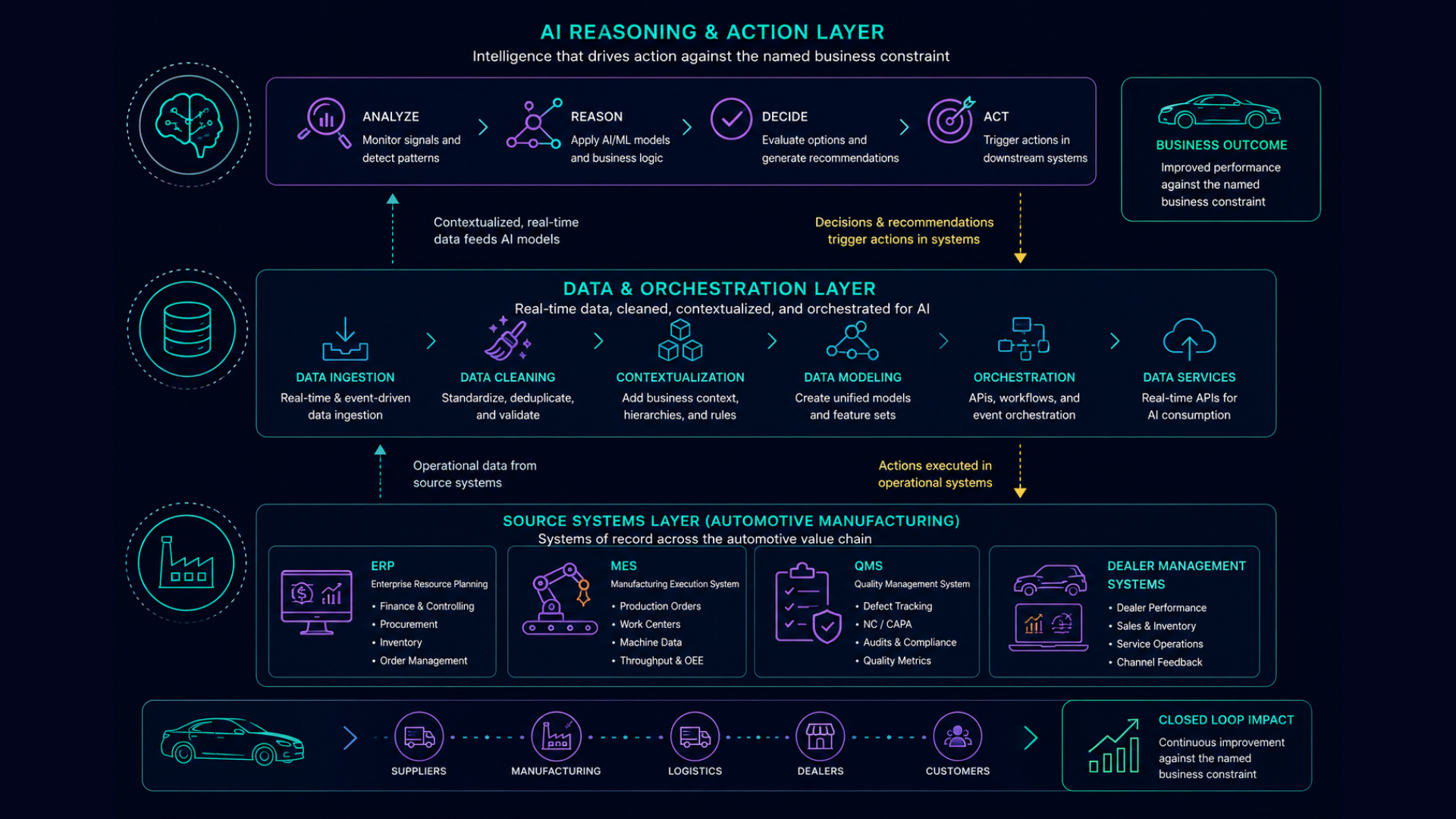
The build in an automotive context typically covers three layers simultaneously.
The data layer connects to the source systems, which in automotive manufacturing means ERP for transactional data, MES for production operations data, quality management systems for defect and compliance data, and dealer management systems for channel data. The data layer cleans, contextualises, and makes this data available to the AI layer in real time rather than in batch. Without this layer working reliably, the AI layer is making decisions on incomplete or delayed information.
The AI reasoning layer takes the contextualised data and applies the logic required to close the gap on the named constraint. In a predictive maintenance deployment this is anomaly detection and failure prediction. In a supply chain disruption deployment this is pattern recognition, alternative evaluation, and recommendation generation. In a dealer operations deployment this is performance monitoring, exception identification, and intervention triggering. The specific AI approach is determined by the constraint, not by what is technically impressive.
The integration layer connects the AI output back to the systems where action needs to happen. A purchase order recommendation that cannot be raised in the ERP. A maintenance intervention that cannot be scheduled in the field service system. A dealer alert that cannot be surfaced in the channel management platform. These are not AI failures. They are integration failures that prevent AI from delivering the operational outcome it was built to produce.
Days 60 to 90: Integration, Testing, and Production Readiness
The final phase of a 90-day deployment is where most programmes either complete successfully or stall indefinitely. The technical build is largely done. The work remaining is proving that the system performs reliably in the production environment and ensuring that the people it was built for will actually use it.
Production environment testing in automotive manufacturing is meaningfully different from testing in a controlled environment. Production data volumes are higher. Edge cases that never appear in test datasets appear constantly in production. Integration behaviours that were stable in testing sometimes behave differently under production load. The only way to discover these things is to run the system against production data, in the production environment, before go-live. Programmes that skip this step discover the issues after go-live, which is significantly more disruptive and expensive.
Governance and compliance review in automotive manufacturing typically involves quality management, IT security, and in some cases regulatory compliance functions depending on the market and the nature of the AI system. The enterprises that clear this fastest are the ones that engaged these functions during the build rather than presenting the completed system for review at the end. A security review of an AI system's data access patterns is faster when the architecture was designed with the security team's requirements in mind than when it needs to be retrofitted.
Adoption preparation is the step that most technical delivery teams underestimate. The plant manager whose team will use the system every day, the procurement manager who will act on the supplier performance recommendations, the regional sales leader who will respond to the dealer alerts: these are the people whose adoption determines whether the deployment succeeds or whether it becomes a technically live but operationally unused system. Engaging them in the testing phase, incorporating their feedback on how outputs are presented and what actions they trigger, and ensuring they understand what the system does and does not do before go-live is what converts technical readiness into operational adoption.
The Use Cases With the Fastest Path to Production
Not all automotive AI use cases are equally accessible in 90 days. Three consistently offer the fastest path from initiative to production.
Supplier performance monitoring and disruption detection sits at the intersection of rich data availability and high operational value. Most automotive manufacturers have the supplier delivery and quality data required to train the models. The integration points with ERP and procurement systems are well-understood. And the business value of earlier disruption detection is quantifiable against existing data on the cost of supply chain disruptions.
Predictive maintenance with agentic resolution builds on sensor infrastructure that most automotive manufacturing facilities already have. The upgrade from alert generation to resolution execution, as covered in why agentic AI is different from traditional automation, is an architectural change rather than a hardware investment. The ROI case is straightforward to build from existing downtime data.
Dealer order intelligence and channel visibility addresses a high-volume, high-visibility problem with clear operational metrics. Agents monitoring dealer order velocity, flagging underperformance against targets, and triggering intervention workflows can be deployed against existing dealer portal infrastructure without a platform rebuild.
Each of these can reach production in 90 days in a well-prepared environment. Each requires the preconditions described at the start of this guide to be in place before the clock starts.
A Note on Scale
A 90-day deployment produces a production system for one use case in one part of the business, not an enterprise-wide AI transformation. That is intentional.
The value of the first deployment is not just the operational improvement it generates in the named metric. It is the institutional knowledge that the organisation accumulates about what AI deployment actually requires in its specific environment, the integration patterns that get established and can be reused for subsequent deployments, and the organisational confidence that comes from having AI in production rather than in a pilot.
Each subsequent deployment in an automotive manufacturing environment is faster than the first, because the data infrastructure, integration patterns, and governance frameworks established in the first deployment do not need to be rebuilt from scratch. The 90-day timeline for a first deployment typically compresses to 60 days or fewer for a second deployment in the same environment.
This is the compounding dynamic that separates automotive manufacturers who have moved AI into production from those still running pilots. The first deployment is the hardest. Everything that follows builds on it.
Vishleshan AI's forward deployed engineers have deployed AI in production across automotive manufacturing environments globally, working inside client ERP and MES systems to take AI from a named use case to production in 90 days. Book a Consultation