


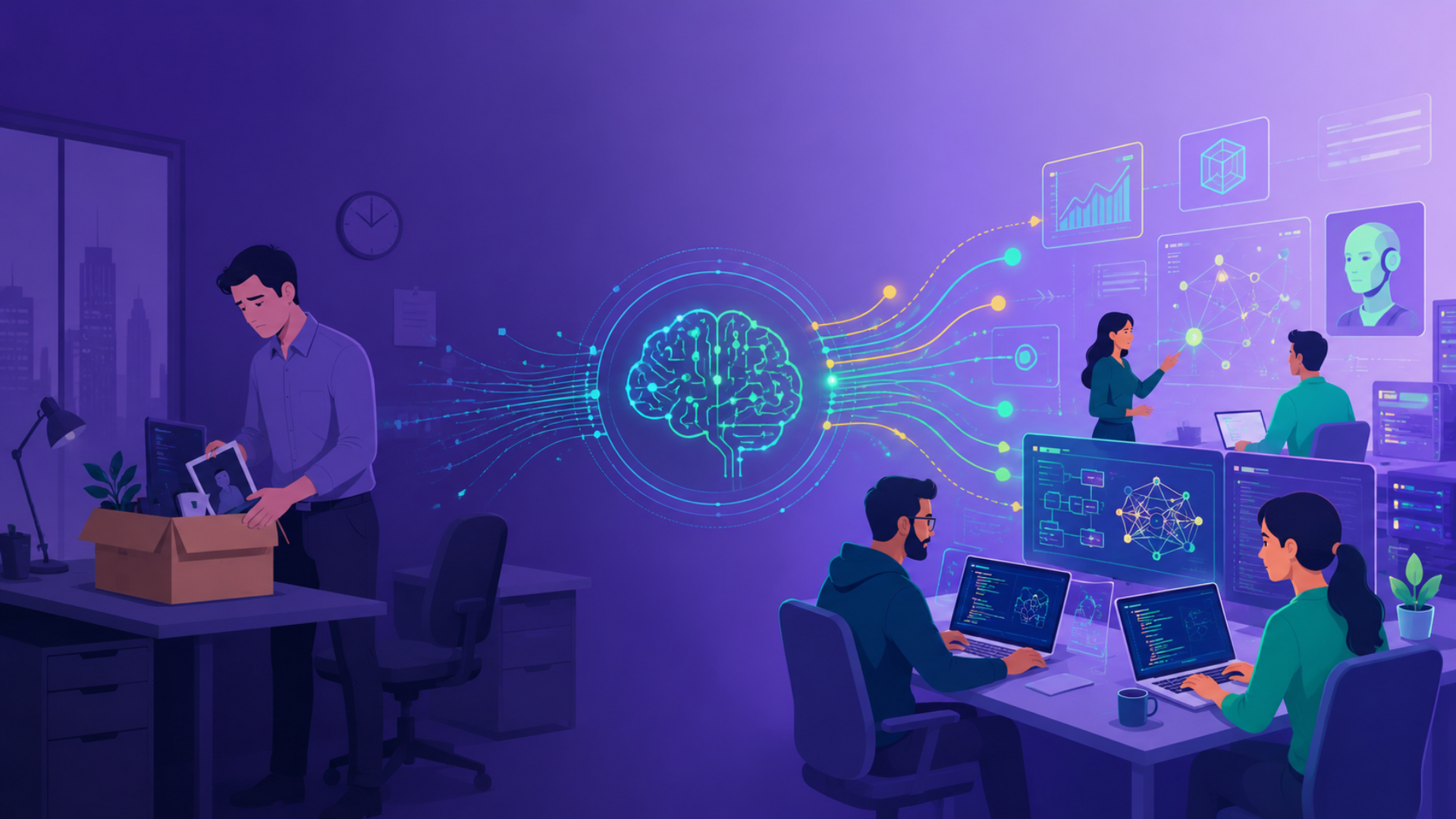
The numbers are striking. As of mid-July 2026, there have been 267 layoff events impacting 185,894 workers, averaging approximately 963 job losses per day. Of these, 56% of layoff events explicitly cite AI, automation, or machine learning as a driving force.
The individual announcements have been equally dramatic. Oracle cut approximately 21,000 employees over 12 months. Meta laid off around 8,000 workers, roughly 10% of its workforce, while simultaneously moving 7,000 employees into new AI-focused roles. Block eliminated 4,000 jobs, nearly half its total workforce.
The coverage of these events has been uniformly alarming. But the data, read carefully rather than selectively, tells a more complicated story. One that is worth understanding clearly if you are an enterprise leader making decisions about AI investment, workforce strategy, or how to communicate about AI to your teams.
What the Data Actually Shows
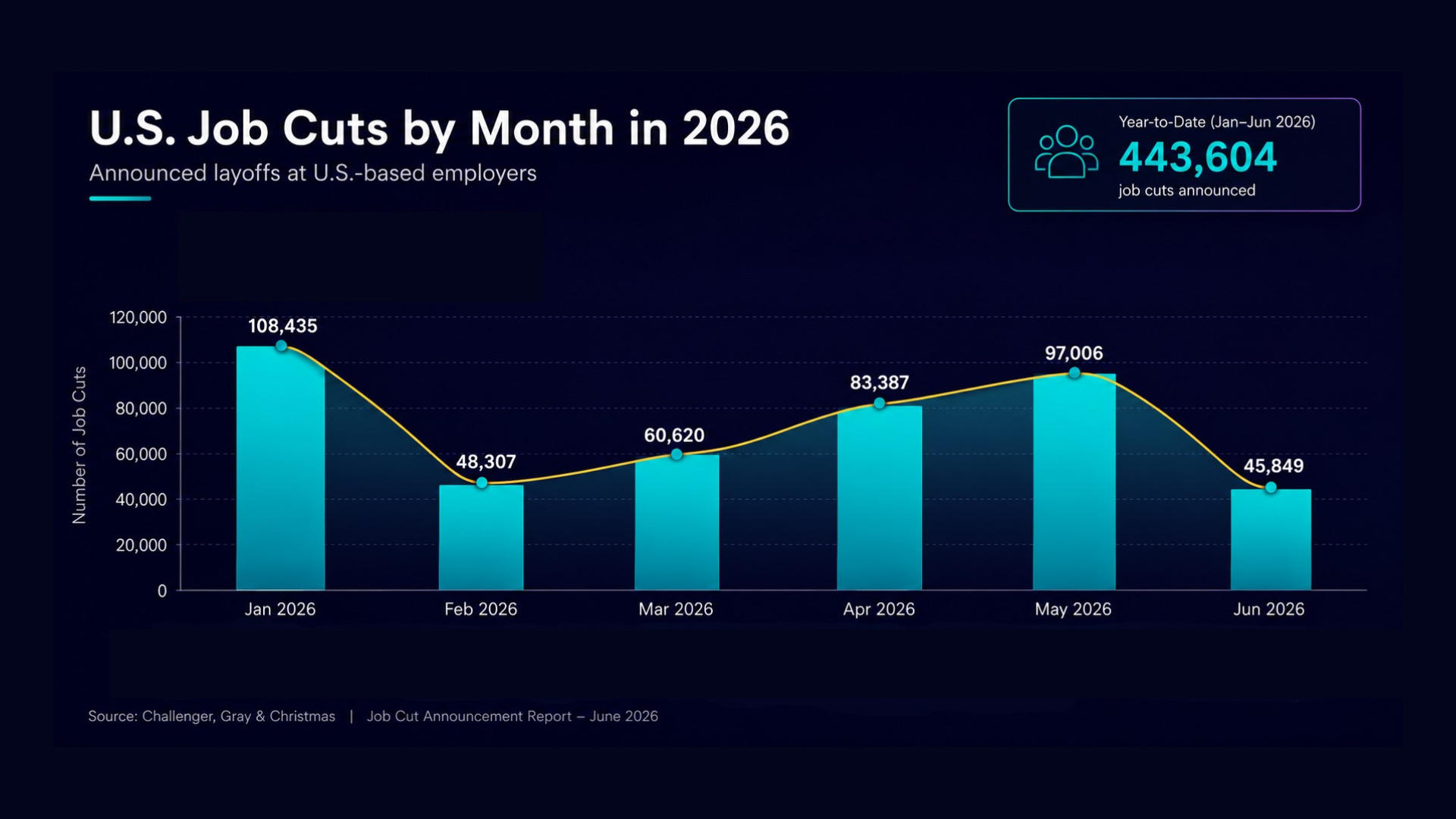
AI has become the single most common reason employers give for cutting jobs, accounting for 40% of announced cuts in May 2026, up from just 7% in January. The 38,579 roles attributed to automation in May alone are the most logged since tracking began in 2023.
But three important qualifications are consistently under reported alongside these figures.
First, the cuts are concentrated in specific roles and industries, not distributed evenly across the economy. Roles most at risk include computer programmers, customer service representatives, data entry workers, content writers, and marketing roles that show the highest overlap with current AI capabilities. Meanwhile, roles in machine learning infrastructure, AI safety, applied research, healthcare, and skilled trades remain in strong demand.
Second, the same companies cutting jobs are simultaneously investing at record levels. Google, Amazon, Microsoft, and Meta collectively plan $725 billion in AI capital expenditure in 2026, up 77% from the prior year. Amazon cut approximately 16,000 corporate roles in Q1 while reporting AWS growth of 24%, its fastest in 13 quarters. The capital is not disappearing. It is being reallocated from headcount to infrastructure.
Third, total employment is not collapsing. US payrolls rose by 172,000 in May, with March and April revised upward, suggesting AI's impact is concentrated in technology rather than spread across the broader economy. The anxiety is real. The apocalypse is not, at least not yet and not at the pace most headlines imply.
The Pattern Underneath the Headlines
Bloomberg data suggests roughly half of AI-attributed layoffs will result in the same roles being rehired offshore or at lower salaries, which is a labour repricing story, not purely a labour reduction story.
This is an important distinction for enterprise leaders to hold onto. The 2026 layoff wave is not primarily a story about machines replacing humans. It is a story about three things happening simultaneously.
Cost and over-hiring correction. Many of the companies announcing AI-attributed cuts significantly over hired during the 2020 to 2022 growth period. The AI justification is, in some cases, a more palatable framing for a workforce correction that would have happened anyway. The "AI washing" debate is real: not every AI-attributed layoff is genuinely caused by AI.
Structural role elimination in specific functions. Some roles are genuinely being eliminated rather than repriced or relocated. Customer service representatives whose work has been absorbed by AI agents, content writers whose output has been partially replaced by generative AI tools, data entry workers whose function has been automated. These are real displacements, concentrated in roles where AI capability most directly overlaps with the task structure of the work.
Skill reallocation within the same organisations. Meta's approach is instructive: alongside 8,000 cuts, 7,000 employees were moved into new AI-focused roles. Atlassian cut 1,600 jobs explicitly to "self-fund further investment in AI," with its CEO noting that "people and AI create the best outcomes." The narrative of pure replacement misses the concurrent investment in new capability.
What This Means for Enterprise Leaders Outside Technology
The 2026 layoff wave has been concentrated in technology companies. But the pattern is spreading.
AI-driven layoffs have spread into finance, logistics, consulting, media, retail, and manufacturing. General Motors laid off between 500 and 600 IT workers, with reports suggesting the company plans to replace some roles with employees carrying AI skill sets. Consulting firm McKinsey laid off around 200 internal technology and support employees after automating non-client-facing work with AI systems.
For enterprise leaders in automotive, consumer electricals, financial services, and industrial manufacturing, this is the signal worth paying attention to. The technology sector is typically 18 to 24 months ahead of other industries in adopting AI capabilities. The structural changes visible in technology companies today will arrive in other sectors on a similar lag.
The question for enterprise leaders is not whether this shift will reach their industry. It is how deliberately they choose to manage it when it does.
The Skills Gap the Data Reveals
Alongside the displacement data, a different and equally significant story is visible. 275,000 AI jobs sit open while laid-off workers cannot cross the skills divide to fill them.
This is the genuine crisis in the 2026 labour market data, and it receives significantly less coverage than the layoff numbers. The jobs being created by AI investment are not the jobs being eliminated. They require different skills, different mental models, and often different educational backgrounds. The gap between them is where the real disruption lives.
Senior engineers who lost jobs at major technology companies are searching for new roles at the highest rates since the 2022 wave, with median time-to-hire stretching from 38 days in Q3 2025 to 67 days in Q1 2026. These are not junior workers with limited options. They are experienced professionals whose specific skills are no longer in demand at the scale they once were.
For enterprises thinking about how to manage the AI transition within their own organisations, this skills gap has a direct implication. Reskilling existing employees toward AI-adjacent capabilities is not just the ethical approach to workforce transition. It is likely faster and less expensive than trying to hire into a labour market where the roles that matter most are already significantly oversubscribed.
The Enterprise Framing That Actually Serves Leaders Well
The framing that has served enterprise leaders least well in this debate is the binary one. AI replaces workers, or AI augments workers. The data does not support either version cleanly.
What the data supports is a more granular picture. AI is replacing specific tasks within roles, not roles wholesale. The roles that survive are the ones where the human contribution is concentrated in judgment, relationship management, contextual reasoning, and accountability for outcomes. The roles that are most at risk are the ones where the majority of the work is task-execution that AI can now perform faster, cheaper, and more consistently.
This is the framing that allows for honest communication with workforces, realistic planning of how roles will evolve, and deliberate investment in the skills that remain valuable alongside AI rather than the skills it is replacing.
The forward deployed engineering model is itself an example of this dynamic. The roles it creates combine deep technical capability with contextual business judgment and the ability to operate inside complex, ambiguous environments. These are precisely the capabilities that AI augments rather than replaces. The AI handles the data processing, pattern recognition, and routine decision-making. The human handles the judgment calls that require understanding a specific organisation's constraints, culture, and strategic context.
What Comes Next
At the current rate, analysts project the full-year total of AI-attributed layoffs could reach approximately 264,730 globally, potentially exceeding 2025's total of 245,000. The pace is not slowing.
But the trajectory beyond 2026 is less clear than the current data implies. The structural displacement currently concentrated in technology will spread to other sectors, but at what pace and at what scale depends heavily on how quickly AI capability advances in domains that are currently more protected, and how effectively enterprises invest in workforce adaptation rather than just workforce reduction.
The enterprises that will emerge from this transition best positioned are not the ones that move fastest to replace human labour with AI. They are the ones that most deliberately redesign work around the combination of human and AI capability, investing in the skills and roles that compound rather than the ones that are being repriced away.
That is a harder management challenge than either the displacement narrative or the augmentation narrative acknowledges. It requires being honest about which roles are genuinely at risk, which are genuinely more valuable alongside AI, and how to bridge the gap between the two in a workforce that is watching the layoff headlines with understandable anxiety.
Vishleshan AI helps enterprises navigate the workforce transition that AI creates by redesigning workflows around human and AI capability, and deploying AI into production in a way that amplifies what your people do rather than simply replacing it. Book a Consultation