


Ask an AI vendor how long deployment takes and the answer is almost always optimistic. Eight weeks for a pilot. Twelve weeks to production. Ninety days end to end.
Ask a CIO who has been through it and the answer is usually different. Not because the vendors were lying, but because the timeline question is being answered from a different starting point. The vendor is counting from the day the contract is signed. The CIO is counting from the day the organisation first decided it needed AI.
Those two starting points are separated by months of groundwork that rarely shows up in a vendor's project plan.
This piece covers what the timeline actually looks like, where time is genuinely lost, and what determines whether a manufacturing enterprise gets to production in 90 days or 18 months.
Why the Question Is Harder Than It Looks
Deployment timelines in manufacturing vary enormously, and not primarily because of AI complexity. The variance comes from three factors that have nothing to do with the model being deployed.
The first is how clearly the use case is defined before the engagement starts. A manufacturing company that comes to an AI partner with a specific, named business constraint — a fill rate stuck at 78% against a target of 91%, a predictive maintenance gap costing an estimated number of unplanned downtime hours per quarter — will move faster than one that comes with "we want to explore what AI can do for our operations."
The second is the state of the data infrastructure the AI system needs to connect to. Manufacturing environments typically run on a combination of ERP, MES, SCADA systems, and decades of operational data accumulated across plant locations in formats that were never designed to be machine-readable at scale. How accessible, clean, and connected that data is at the start of the engagement directly determines how much of the deployment timeline is spent building the AI and how much is spent preparing the environment for it.
The third is organisational readiness. AI deployment in manufacturing is not a technology project with a business stakeholder. It is a business transformation that requires technology. The enterprises that move fastest are the ones where the business owner of the outcome and the technology team responsible for the infrastructure are aligned from day one, not sequentially involved.
What a 90-Day Deployment Actually Looks Like
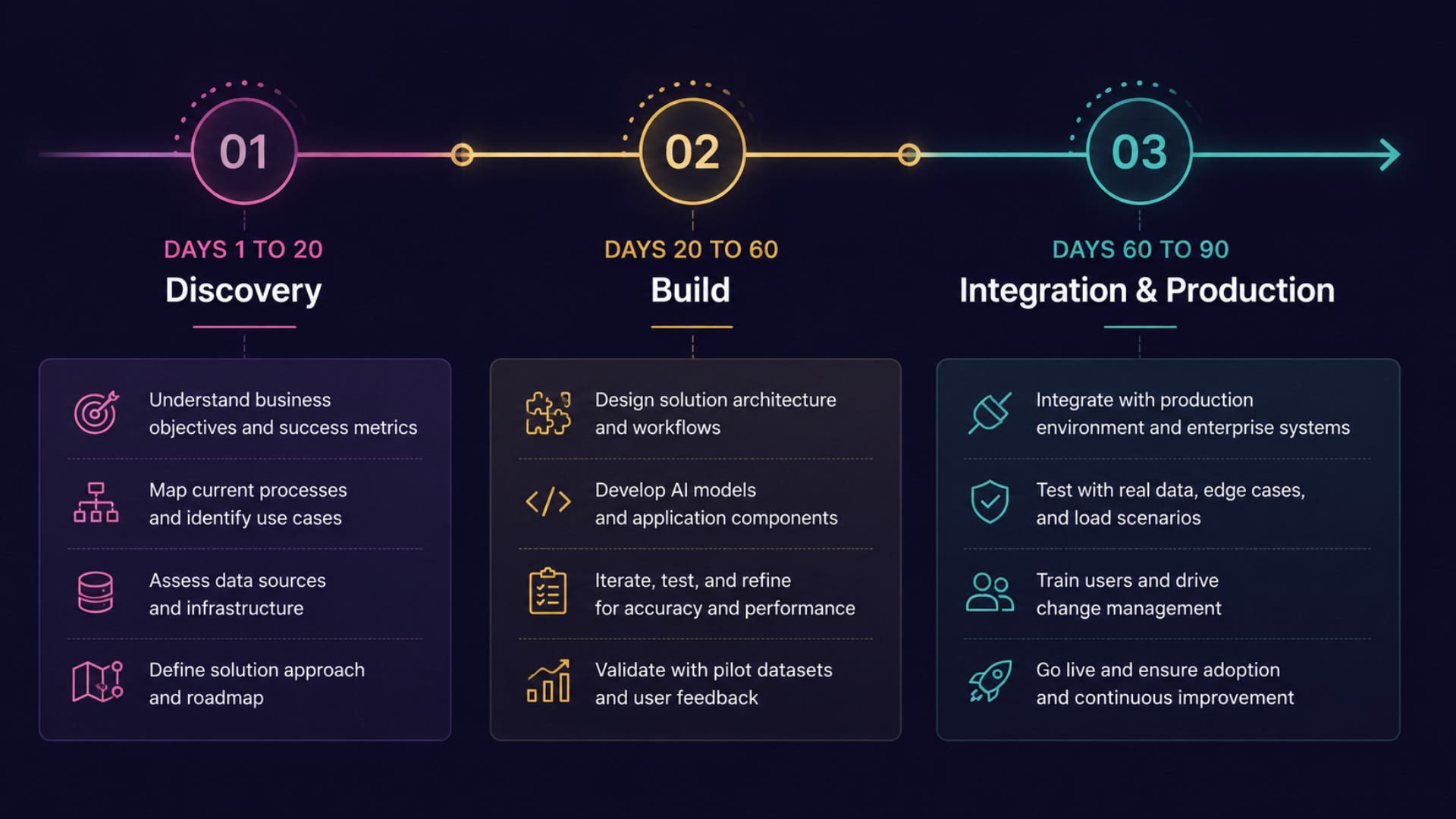
Ninety days is achievable. Vishleshan AI's forward deployed engineers operate to this timeline consistently across automotive and industrial manufacturing environments. But 90 days assumes specific conditions at the start of the engagement.
Here is what happens across each phase.
Days 1 to 20 — Discovery inside the environment
The forward deployed engineer is embedded inside the client's actual operating environment from day one. Not conducting remote interviews or reviewing documentation, but working inside the plant, the ERP, the MES, and the operational systems that the AI solution will need to connect to.
This phase exists to surface the constraints that no requirements document ever fully captures. The data field that looks clean in the schema and is actually populated inconsistently across plant locations. The approval workflow that is documented one way and practiced another. The integration point that the IT team thought was straightforward and turns out to require a middleware layer nobody had accounted for.
Discovering these things in day two of the engagement is manageable. Discovering them in day 60 is expensive.
Days 20 to 60 — Build against the named constraint
Once the integration environment is understood and the named business constraint is confirmed, the build begins. Against the actual systems. Against actual data. Not a synthetic dataset prepared for a proof of concept.
This is where the build vs buy vs embed decision made earlier in the programme directly affects pace. A team building inside the client's environment with access to the actual systems and the authority to make integration decisions moves significantly faster than a remote team coordinating through a project manager and a change request process.
Days 60 to 90 — Integration, testing, and production readiness
The final phase covers the integration work that connects the AI system to the production environment, the testing that validates behaviour against real transaction volumes and edge cases, and the change management work that determines whether the system is actually adopted by the people it was built for.
That last element is where many deployments that are technically complete on day 90 fail to reach genuine production for another 30 to 60 days. A system that is live but not being used is not in production in any meaningful sense. The forward deployed engineering model treats adoption as part of the deployment scope, not a separate workstream someone else owns.
Where Time Is Actually Lost
The 90-day timeline assumes the conditions described above are in place at the start. When they are not, here is where the time goes.
Use case ambiguity adds 4 to 8 weeks. When the brief is exploratory rather than specific, the early weeks of an engagement are spent narrowing the problem rather than solving it. This is not wasted time exactly, but it is time that could have been spent before the engagement started, through internal alignment and use case prioritisation, rather than during it.
Data preparation adds 6 to 12 weeks in unprepared environments. Manufacturing environments with fragmented data across plant locations, inconsistent master data in the ERP, or operational systems that do not expose usable APIs are not ready for AI deployment without a data preparation phase. This work is necessary and it is not fast. Enterprises that have invested in data engineering infrastructure ahead of AI deployment move significantly faster than those that encounter the data problem for the first time during the AI engagement.
Governance and security review adds 3 to 6 weeks in regulated environments. Automotive and industrial manufacturing companies operating under ISO, IATF, or sector-specific compliance frameworks need AI systems to pass security and governance review before production deployment. Enterprises that build governance into the architecture from the start, rather than preparing for a review at the end of the build, consistently clear this faster.
Change management adds 4 to 8 weeks when it starts late. The plant manager whose team will use the AI system every day is the single most important person in determining how quickly the system moves from technically live to genuinely adopted. Engaging that person in the design and testing phase rather than the go-live announcement phase reduces adoption friction significantly.
The Realistic Timeline Across Maturity Levels
Not every manufacturing enterprise starts from the same place. Here is an honest assessment of what deployment timelines look like across different levels of readiness.
Well-prepared environment: Named use case, accessible data, aligned business and technology stakeholders, governance framework in place. Realistic timeline: 60 to 90 days to production.
Moderately prepared environment: Use case identified but not fully scoped, data accessible but requiring cleaning and consolidation, business and technology alignment in progress. Realistic timeline: 90 to 150 days to production.
Complex legacy environment: Multiple plant locations with inconsistent data, ERP customisations that require custom integration work, governance framework not yet defined. Realistic timeline: 5 to 9 months to production for the first use case, significantly faster for subsequent ones once the foundation is established.
The second and third timelines are not failures. They reflect the actual complexity of deploying AI in large manufacturing organisations that have been operating for decades. The mistake is planning for the first timeline when the organisation is actually in the third situation.
What Shortens the Timeline More Than Anything Else
Three things consistently separate the fastest deployments from the slowest ones, and none of them are about the AI technology itself.
A named, specific business constraint from day one. The enterprises that move fastest can answer the question "what exactly is broken and what does fixed look like?" before the engagement starts. This sounds like a low bar. In practice it is the single biggest predictor of deployment speed.
Engineers embedded inside the actual environment. The difference between a forward deployed engineer working inside the client's systems from day one and a remote team building against documentation is typically four to six weeks of discovery and rework time that the embedded engineer avoids by being present when the real constraints surface.
Business ownership of the outcome. When the head of manufacturing operations, not the IT department, owns the AI deployment outcome and measures it against the same business metrics they are already accountable for, the organisational momentum behind the deployment is qualitatively different. The blockers that slow down IT-owned programmes, budget reallocations, competing priorities, and governance queues are resolved faster when the business owner has a direct stake in the result.
The honest answer to how long AI deployment takes in manufacturing is: 90 days if the conditions are right, and significantly longer if they are not. The conditions that matter most are not technical. They are organisational — the clarity of the use case, the state of the data infrastructure, and the alignment between business and technology from the first day of the engagement.
The enterprises that get to production fastest are not the ones with the simplest environments. They are the ones that have done the organisational groundwork before the technical work begins, and partnered with a team that works inside their environment rather than building against a description of it.
Vishleshan AI's forward deployed engineers take AI from use case to production in 90 days, inside your environment, against your actual systems. Book a Consultation