


Manufacturing AI adoption has reached 73% among enterprise manufacturers in 2026.
That number suggests the transformation is largely underway. The operating results suggest something different.
Most manufacturers using AI are using it for analysis. They are producing better reports. Getting faster answers to data questions. Forecasting demand more accurately. These are real improvements. They are not operational transformation.
The manufacturers pulling ahead are using AI differently. They are embedding it in how operations actually run. Not as a tool people use to get information. As a layer that monitors, decides, and acts within defined boundaries without waiting for a human to approve every step.
That is the gap. And it is widening.
Three Phases of Manufacturing AI
Manufacturing AI has moved through three distinct phases. Most enterprises are still in the second.
Phase one: analytics. AI processes historical data and produces better reports. Dashboards replace spreadsheets. Analysis that took days takes minutes. Decisions are still made by people, using AI-generated insight. This is where most manufacturers started between 2020 and 2023.
Phase two: prediction. AI forecasts what will happen before it does. Demand forecasting, predictive maintenance, quality defect prediction. The outputs are still recommendations. Humans review them and decide what to do. This is where most manufacturers are today.
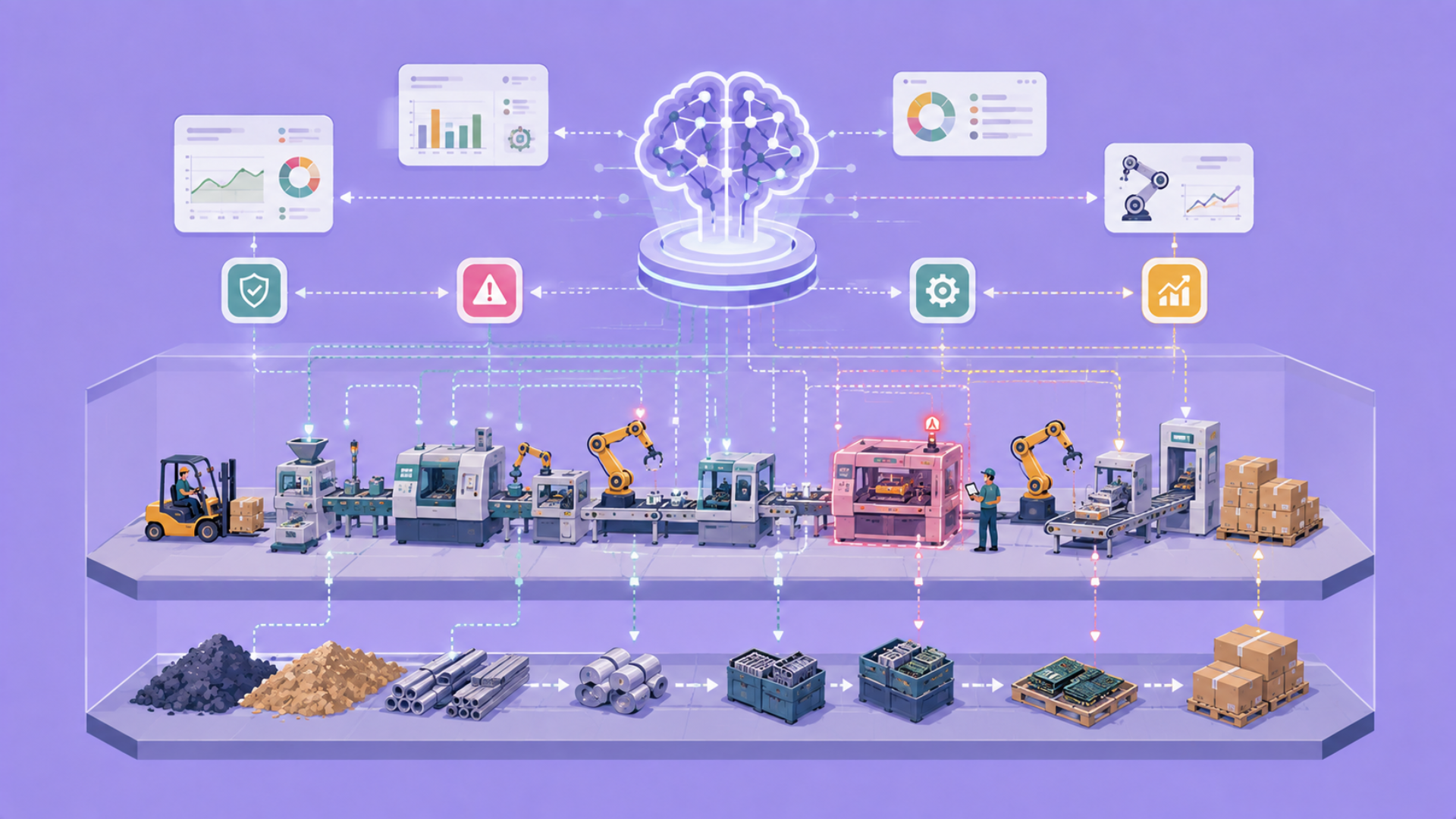
Phase three: agentic operations. AI agents detect conditions, evaluate options, and take action within defined parameters. A production schedule deviation triggers an automatic resequencing recommendation that the system implements unless a human overrides it. A supplier delivery risk triggers an automatic check of alternative sources and a draft purchase order for approval. A quality anomaly triggers a line speed adjustment before a batch is affected.
Deloitte's 2026 State of AI in the Enterprise report puts the phase three adoption number clearly. Agentic AI adoption in manufacturing is projected to quadruple this year from 6% to 24%. That growth rate is happening because phase three is where the returns are.
Companies implementing comprehensive AI strategies report average productivity gains of 28% and quality improvements of 35%. Companies still in phase one and two report more modest improvements. The difference is not in which AI tools they use. It is in how deeply those tools are connected to how the operation actually runs.
What the Missing Layer Actually Is
Every large manufacturer has layers of technology already in place.
ERP systems manage production planning, procurement, and finance. Manufacturing execution systems track what is happening on the floor in real time. Quality management systems record inspection results and non-conformances. IoT sensors generate continuous data from equipment and production lines.
These systems work. They have been in place for years. In many cases they have been heavily customised for specific production environments.
What they do not do is reason across all of this data simultaneously and take coordinated action.
The ERP knows the production plan. The MES knows the actual production status. The quality system knows about the defect that was detected twenty minutes ago. The procurement system knows that a key component is delayed. None of these systems is talking to the others fast enough to coordinate a response.
AI is the layer that connects them. Not by replacing any of them. By sitting above them, reading from all of them, identifying what each piece of data means in the context of the others, and either surfacing a coordinated response for human decision or, within defined boundaries, initiating one automatically.
This is what enterprise AI working alongside legacy systems means in a manufacturing context. The ERP is not replaced. The MES is not replaced. The AI layer connects them in ways they were never designed to connect themselves.
Where the Returns Are Largest
Four operational areas in manufacturing are generating the most consistent AI returns in 2026.
Predictive maintenance and asset health:
This was the earliest manufacturing AI use case and still generates some of the most reliable returns. AI systems monitoring equipment sensor data identify developing failures weeks before they become unplanned downtime. The return is direct and measurable: avoided repair costs, avoided lost production, extended asset life.
Early adopters report AI agents drafting maintenance repair plans from sensor and schedule data, coordinating multi-step workflows across planning and execution systems, and delivering measurable maintenance cost and uptime improvements in production environments.
Production planning and scheduling:
Planning has historically been one of the most manual areas in manufacturing. AI is changing this. Production schedules that took planning teams days to produce are being generated and continuously updated in real time as conditions change. When a machine goes down, a material runs short, or a customer order is expedited, the AI recalculates the optimal schedule across all constraints simultaneously. Human planners review and approve. But the analytical work that consumed most of their time is done by the AI.
Quality control and defect detection:
Computer vision AI inspecting production output in real time is one of the fastest-growing AI applications in manufacturing. It does not get tired. It does not have good days and bad days. It applies the same inspection criteria consistently to every unit passing through the line. Defect detection rates improve. False positives decline. And because the AI is logging every inspection result, the data quality for subsequent analysis improves as well.
Supply chain coordination:
Manufacturing supply chains face more volatility in 2026 than at any point in the last decade. Tariff changes, logistics disruptions, and supplier reliability issues are compressing the time available to respond to disruption. AI systems that monitor supplier performance signals, logistics data, and inventory positions in real time are giving procurement teams earlier warning of developing problems. Earlier warning means more response options. More response options mean lower disruption cost.
The Integration Barrier That Slows Phase Three
Moving from AI-as-analysis to AI-as-operational-layer requires something that most manufacturers underestimate: deep integration with the systems where operations actually happen.
An AI that reads from the ERP but cannot write back to it cannot close the loop. It can identify that a production schedule needs to change. It cannot make that change. A human has to take the AI's recommendation and re-enter it into the ERP manually. This creates delay, introduces error, and limits how much of the AI's potential value is captured.
Phase three AI requires bidirectional integration. The AI reads from production systems, procurement systems, quality systems, and logistics systems. It also writes back to them. Within defined governance boundaries, it takes action in those systems directly.
This integration is harder to build than it appears. Enterprise systems are complex, partially documented, and behave differently in production than in testing. The integration work that connects AI to these systems reliably at production scale requires engineers who understand both the AI and the specific systems being integrated. Working inside the client's environment rather than from the outside. Discovering the real constraints rather than building against a specification.
This is the forward deployed engineering (FDE) principle applied to manufacturing AI. The FDE model does not just deploy software. It builds the integration that makes the software actually work in the specific operational environment where it needs to run.
What Manufacturing Leaders Should Do Now
The direction of travel is clear. AI is moving from the analytics layer into the operational layer. The manufacturers who make this transition well will widen the gap between themselves and those who do not.
Three things separate manufacturers making this transition effectively from those who are not.
They start with the operational problem, not the AI capability:
The question is not "what can we do with AI?" It is "which operational bottleneck, if resolved, would generate the most significant and most measurable business improvement?" Starting with the operational problem produces a use case with a clear success metric. Starting with the AI capability produces a pilot with impressive outputs and unclear business value.
They build the data foundation before the AI layer:
AI is only as good as the data it can access. Manufacturers with clean, real-time, integrated data from their production systems, supplier networks, and quality management processes can deploy AI that acts on reliable information. Manufacturers without this foundation can deploy AI, but the outputs will be unreliable. Getting the data right first is not preparation for AI. It is the enabling condition for AI that actually works.
They treat integration as the core work, not the final step:
The integration between AI and operational systems is where most manufacturing AI projects succeed or fail. Treating it as a technical afterthought rather than the core engineering challenge is the most consistent reason that manufacturing AI generates impressive pilots and disappointing production outcomes.
Vishleshan AI has deployed production AI across automotive manufacturing, industrial operations, and supply chain environments. Our forward deployed engineering (FDE) approach embeds engineers directly inside manufacturing client environments. They build the integration architecture that connects AI to ERP, MES, and quality systems in production, not just in a proof of concept. Book a Consultation