


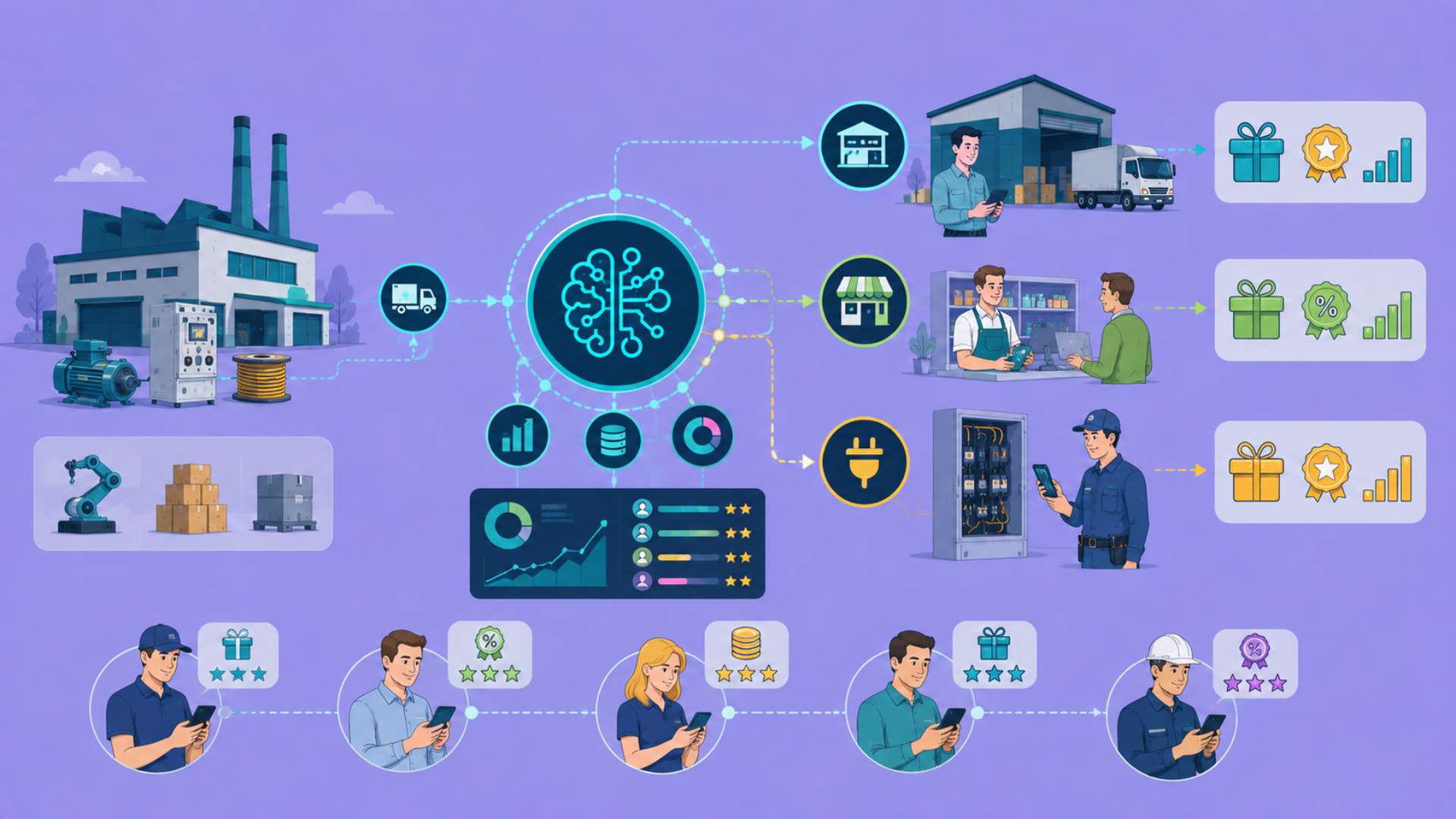
Channel loyalty programmes have a problem that most OEMs and large consumer electricals manufacturers know about but rarely address directly. The problem is not participation. It is engagement.
The Channel Loyalty Report 2026 puts a specific number on the problem: 51% of channel partners are enrolled in six or more loyalty programmes but actively engage with only a few. The average retailer, electrician, or dealer is not ignoring loyalty programmes because loyalty does not matter to them. They are ignoring specific programmes because those programmes are not giving them a reason to pay attention.
The reason most channel loyalty programmes fail to generate sustained engagement is structural. They are built as transactional systems for points for purchases, rewards for targets rather than as intelligent engagement platforms that understand each partner's behaviour, anticipate their needs, and personalise the programme experience in ways that make engagement feel worthwhile rather than administrative.
AI is changing this. Not by adding complexity to existing programme structures but by making the intelligence that good key account managers have always applied to their most important relationships available at scale, across every partner in the network, continuously.
See how Loyalty Plus works in practice across a live dealer and retailer network.
Why Transactional Loyalty Programmes Stop Working
A transactional loyalty programme operates on a simple logic: do more of what we want you to do, and we will reward you. Buy more product, earn more points. Hit your monthly target, receive a bonus. Refer a new customer, get a voucher.
This logic works as a short-term behaviour change mechanism. It works less well as a sustained engagement mechanism, for two reasons that the data now makes clear.
First, the reward is not differentiated enough to drive preference. When a retailer is enrolled in six or more programmes offering variations on the same points-for-purchases mechanic, no single programme creates enough pull to change where that retailer prioritises their attention or their orders. The programme is one of many. The reward is incremental. The behaviour change is marginal.
Second, the programme does not know enough about the partner to be genuinely useful to them. A generic scheme that offers the same incentives to every retailer regardless of their product mix, their sales patterns, their geography, or their business maturity is a programme that is relevant to the average retailer and personally meaningful to very few. The most engaged channel partners are not the ones who value points most. They are the ones who feel the programme understands their business.
AI addresses both problems. It makes the programme differentiated by using each partner's behavioural data to personalise the incentive structure. And it makes the programme genuinely useful by surfacing the right scheme, the right product focus, and the right communication to each partner at the moment when it is most likely to influence their behaviour.
What AI Actually Does in a Channel Loyalty Programme
The specific capabilities that AI brings to channel loyalty are distinct from the generic analytics that most loyalty platforms already offer. Understanding the difference matters for evaluating whether a loyalty platform is genuinely AI-powered or is using the label to describe rule-based personalisation.
Behavioural segmentation that updates continuously:
A traditional loyalty platform segments partners based on static criteria such as their region, their tier, their average monthly order value. AI-powered segmentation updates continuously based on actual behaviour: how a partner's ordering patterns are changing week on week, which product categories they are growing versus contracting, how their engagement with the programme is trending relative to their peer group. A retailer who has historically been a mid-tier buyer but whose behaviour over the last three weeks suggests they are about to make a significant stocking decision gets a different engagement approach than one whose behaviour is stable. The static tier does not reveal this. The behavioural signal does.
Churn prediction before it shows up in orders:
The most expensive loyalty problem is not the partner who complains and asks to leave. It is the partner who quietly reduces their engagement and their orders without any explicit signal that the relationship is deteriorating. AI systems trained on historical behaviour can identify early signs of partner disengagement. These include declining login frequency, reduced code scanning, slower redemption, and changes in product mix that may indicate engagement with alternative suppliers. These signals can appear weeks before they show up in order data. The intervention that retains a partner at the point of early disengagement is significantly less expensive than the one required after the relationship has effectively ended.
Personalised scheme activation at the right moment:
A large OEM or consumer electricals manufacturer typically runs multiple schemes simultaneously. These include product-specific schemes, seasonal schemes, geography-specific schemes, new product launch schemes. Managing which scheme is most relevant for which partner at which point in the programme cycle is, in a large network, operationally impossible to do manually with any granularity. AI systems that understand each partner's product mix, their historical scheme responsiveness, and their current position in their purchase cycle can recommend the scheme activation most likely to generate incremental behaviour for each specific partner, rather than pushing all schemes to all partners and measuring what sticks.
Fraud detection in real time:
Code-based point accumulation systems, where partners scan product codes or enter them manually to claim points, are susceptible to fraud patterns that are difficult to detect manually across large networks. Bulk code entry that does not match the partner's order history. Unusual timing patterns that suggest automated entry rather than genuine product movement. Geographic anomalies that suggest codes are being transferred rather than organically accumulated. AI systems monitoring transaction patterns in real time can flag these patterns for review before they result in fraudulent redemptions, rather than identifying them in a monthly audit after the points have been paid out.
What This Looks Like in a Deployed Consumer Electricals Channel Loyalty Programme
A leading consumer electrical goods manufacturer deployed an AI-powered channel loyalty platform across its retailer and electrician network in India. The programme serves over 500,000 active users across the country, processing more than 2 million code scans annually and handling over 100,000 monthly redemptions.
Before deployment, the programme had participation but limited engagement. Registration processes were manual, creating friction that reduced the quality of partner data collected at onboarding. Point crediting was not real-time, which created disputes and eroded trust in the programme. Redemption took weeks rather than minutes, which reduced the perceived value of accumulated points. Programme administrators had limited visibility into which partners were genuinely engaged and which were nominally enrolled but inactive.
After deployment, self-service registration through a mobile app dramatically reduced onboarding friction and improved the quality of partner data from the start. Real-time point crediting eliminated the crediting disputes that had been a consistent source of partner dissatisfaction. OTP-secured redemptions processed in minutes rather than weeks, which fundamentally changed how partners perceived the value of their points. And a full admin panel with fraud monitoring, scheme configuration, and partner-level visibility gave programme administrators the operational control they needed to manage a network at this scale.
The result was a programme with 4.5+ app rating on both Android and iOS. A direct measure of partner satisfaction with the programme experience, and the operational infrastructure to support continued growth as the network expands.
The Three Capabilities That Separate AI-Powered Loyalty From Points-Management Software
Most channel loyalty platforms in the market today are, in practical terms, points management systems with a mobile interface. They handle registration, code scanning, point accumulation, and redemption. They generate reports. They run schemes.
What they do not do is use the data they are generating to improve the programme's effectiveness for each individual partner. That is the capability that AI adds. And it is the capability that determines whether a loyalty programme generates genuine engagement or just manages participation.
Real-time intelligence rather than periodic reporting:
A points management system tells you what happened in the last reporting period. An AI-powered loyalty platform tells you what is happening now and what is likely to happen next. The difference is operational: the first produces reports for review, the second produces signals for action.
Personalisation at partner level rather than tier level:
A points management system treats all partners in a tier the same way. An AI-powered platform treats each partner as an individual, using their specific behavioural history to determine what engagement approach is most likely to be effective for them specifically. At 500,000 partners, this personalisation is only possible with AI. No human team can manage this level of individual engagement at this scale.
Integration with channel data beyond the loyalty programme itself:
The most valuable loyalty intelligence comes from combining programme data with broader channel data: order history from the distributor management system, product registration data, service call history, and market data that reveals how each partner's position is changing in their local market. AI systems that can integrate and reason across these data sources produce significantly richer partner intelligence than systems that can only see what happens within the loyalty programme itself.
This is the same integration principle that makes enterprise AI effective across other business functions: layering intelligence on top of existing data rather than creating a separate data environment that only sees part of the picture.
The Business Case for AI-Powered Channel Loyalty
The business case for moving from a transactional loyalty programme to an AI-powered one is not primarily about reducing programme costs. It is about improving the return on the loyalty investment that most large OEMs and consumer electricals manufacturers are already making.
Most large channel loyalty programmes represent significant ongoing investment. The question is not whether to invest in channel loyalty. In most OEM and consumer electrical markets, strong channel engagement is a commercial necessity. The real question is whether that investment is changing partner behaviour in the way it was intended to.
A programme that generates enrolment without engagement is spending money to maintain a database of nominally loyal partners. A programme that generates sustained engagement by making itself genuinely useful to each partner is spending money to build a competitive advantage in channel relationships that is difficult for competitors to replicate quickly.
The AI-native versus AI-enabled distinction applies directly to channel loyalty programmes. A transactional programme with AI analytics added on top is AI-enabled. An AI-powered programme where personalisation, behavioural intelligence, and real-time engagement are built into the core of how the programme operates is a different class of competitive asset.
What Enterprise Loyalty Leaders Should Evaluate
For large OEMs and consumer electricals manufacturers evaluating channel loyalty platforms, three questions separate genuinely AI-powered platforms from points management systems with modern interfaces.
1. How does the platform personalise incentives at the individual partner level?
If the answer describes rule-based tier structures and scheme assignments, the personalisation is manual and static. If the answer describes behavioural models that update continuously based on each partner's actions, the personalisation is genuinely AI-powered.
2. What churn prediction capability does the platform offer?
A platform that can only tell you which partners have already churned — measured by declining activity in the platform — is describing historical reporting. A platform that identifies early disengagement signals weeks before they become order-level impacts is describing predictive intelligence.
3. How does the platform integrate with channel data beyond the loyalty programme?
A programme that only sees what happens within its own interface cannot generate the full partner intelligence that drives meaningful personalisation. A platform that integrates with distributor management systems, product registration data, and service history is generating intelligence that is genuinely actionable.
The 51% of channel partners who are enrolled in six or more programmes but engaged with few are telling OEMs and consumer electricals manufacturers something important: participation is not the metric that matters. Engagement is. And engagement is generated by programmes that make themselves useful to each partner as an individual, not programmes that offer the same transactional mechanic to everyone.
Vishleshan AI's Loyalty Plus is built for OEM and consumer electricals channel loyalty at enterprise scale, combining real-time point accumulation, AI-powered personalisation, fraud detection, and full programme visibility across retailer, distributor, and electrician networks. Book a Consultation