


Twelve months ago, most enterprise technology leaders were evaluating their first AI agent deployments. Today, many of those same organisations are managing five, ten, or twenty agents — across procurement, customer service, supply chain, finance, and field operations — with more in the pipeline.
That progression from one agent to many is where a new and underappreciated architectural problem emerges.
A single agent connecting directly to your ERP is manageable. You know what it accesses, what it does, and what it costs. Ten agents connecting directly to ten different enterprise systems — each with its own authentication, its own data access scope, its own cost profile, and no unified visibility across any of them — is a governance problem at scale.
This is the problem an AI gateway solves. And as enterprises move from AI experimentation to AI operations in 2026, it is rapidly becoming the piece of infrastructure that determines whether agentic deployment scales safely or creates compounding risk.
What an AI Gateway Actually Is
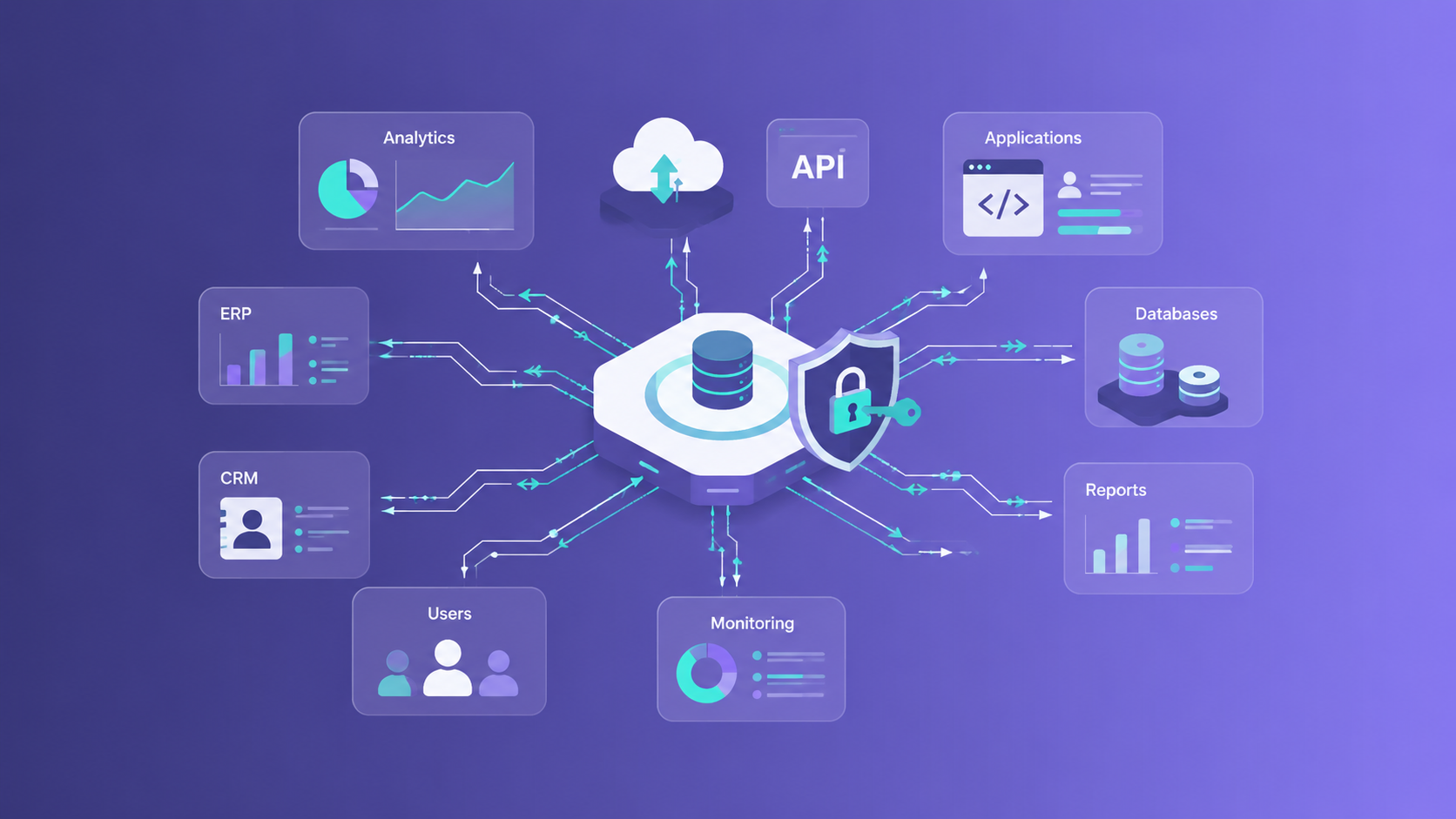
An AI gateway is the governed entry point through which every AI agent in your enterprise accesses your systems, data, and workflows.
Think of it as the equivalent of a corporate network firewall — but designed for the agent era. Just as a firewall controls which users and applications can access which network resources, an AI gateway controls which agents can access which enterprise systems, under what conditions, with what permissions, and with a complete audit trail of every interaction.
Without a gateway, agents connect directly to enterprise systems — ERP, CRM, supply chain platforms, financial databases — through individual integrations that are built, managed, and monitored separately. Each integration is a potential security gap. Each agent operates with whatever access was configured at deployment, with no centralised mechanism to adjust, monitor, or revoke that access as circumstances change.
With a gateway, every agent interaction with every enterprise system passes through a single, governed layer that enforces authentication, manages permissions, controls costs, and maintains auditability in real time.
Why This Matters More as Agent Deployment Scales
The risk profile of ungoverned agent access is not linear — it compounds with the number of agents deployed.
A single procurement agent with overly broad access to your financial system creates a containable risk. A hundred agents across procurement, finance, operations, and customer service — each with its own direct integrations and its own access scope — creates an attack surface and a governance gap that security and compliance teams cannot manage manually.
Three specific failure modes emerge consistently in enterprises that scale agents without a gateway architecture.
Security exposure through ungoverned access: Agents that connect directly to enterprise systems inherit whatever permissions were configured at setup. As agent capabilities expand and workflows evolve, those permissions are rarely reviewed and updated systematically. An agent that was initially scoped to read supplier records may, over time, have write access to financial systems that nobody explicitly authorised. Without a gateway enforcing zero-trust access — where every agent gets exactly what it needs for each specific interaction and nothing more — access creep becomes inevitable at scale.
Compliance failure through incomplete auditability: Regulatory frameworks in financial services, automotive, and industrial manufacturing increasingly require organisations to demonstrate what decisions were made, by whom or what, on the basis of what information, at what time. An agent operating through a direct system integration produces a transaction record. It does not produce the reasoning chain, the context accessed, and the decision logic that a compliance audit requires. A gateway captures all of this — making every agent interaction auditable in the way that regulated industries now demand.
Cost explosion through unmanaged inference: AI agents generate variable inference costs every time they reason through a task. Without centralised cost visibility and control, those costs accumulate across an agent workforce with no mechanism to detect waste, enforce budgets, or route tasks to appropriately priced models. A gateway with embedded cost governance — routing routine tasks to smaller, cheaper models and reserving frontier model access for high-complexity decisions — is what keeps AI economics manageable as the agent workforce grows.
The Five Core Functions of an Enterprise AI Gateway
Understanding what a gateway does in practice clarifies why it is architectural infrastructure rather than an optional enhancement.
1. Unified Authentication and Identity Management
Every agent that wants to access an enterprise system must authenticate through the gateway — presenting credentials, having its identity verified, and receiving a scoped access token for the specific interaction it is requesting. No agent connects to any system without passing through this layer.
This single function eliminates the most common entry point for AI-related security incidents — ungoverned direct connections that bypass the authentication and access control frameworks the enterprise has spent years building.
2. Intelligent Routing and Protocol Translation
Enterprise systems speak different languages. SAP uses one API protocol. A legacy CRM uses another. A modern cloud-based supply chain platform uses a third. Agents built on different frameworks have their own interaction patterns.
The Intelligent Gateway handles protocol translation — ensuring that every agent can interact with every enterprise system regardless of the technical standards each was built on. It also handles routing — directing each agent request to the right system, with the right protocol, through the most efficient path. This is what makes it possible to connect agents to legacy systems without rebuilding either the agent or the system.
3. Zero-Trust Access Enforcement
Zero-trust is the security principle that no user, system, or agent should be trusted by default — even if it has authenticated successfully. Every access request should be verified against the minimum permissions required for that specific action.
In practice this means an agent handling invoice validation gets read access to the vendor master and the purchase order — and nothing else. An agent managing dealer order routing gets access to the order management system and inventory data — not to financial records or HR systems. Access is granted per interaction, not per agent identity. The gateway enforces this at every request, making it structurally impossible for an agent to exceed its intended scope.
4. Real-Time Cost Governance
Token costs — the variable inference costs generated every time an agent reasons through a task — are managed at the gateway layer. Routine tasks are routed to smaller, cost-efficient models. Complex reasoning requests that genuinely require frontier model capability are routed accordingly. Budget thresholds per agent, per workflow, and per department are enforced in real time — with alerts triggered before costs exceed defined limits rather than after the billing cycle closes.
This is the function that makes enterprise AI economics sustainable as agent deployment scales from tens to hundreds of agents across the organisation.
5. Complete Audit Trail and Compliance Logging
Every agent interaction — the trigger, the systems accessed, the data retrieved, the reasoning applied, the action taken, and the cost incurred — is logged through the gateway in a structured, queryable format. This audit trail is available to compliance teams, security teams, and operational managers without requiring access to individual agent systems or integration logs.
For compliance and workflow automation use cases in particular — where regulatory requirements mandate demonstrable human oversight of AI-influenced decisions — this audit capability is not a nice-to-have. It is the condition under which deployment is permissible.
The Role of MCP in Modern AI Gateways
The Model Context Protocol — MCP — has emerged as the standard through which AI agents communicate with external systems and data sources. Every major enterprise software vendor is building MCP servers to make their systems agent-accessible.
This is creating a new architectural reality: enterprises will soon have multiple vendor-built MCP servers — one for their ERP, one for their CRM, one for their ITSM platform — each providing governed access to that vendor's system.
The challenge is that each vendor's MCP server is a governed door into one room. An enterprise with ten vendor MCP servers does not have a secure building — it has ten separately managed entry points with no unified access control, no consolidated cost visibility, and no single compliance log.
An AI gateway sits above all of these MCP servers — providing the unified authentication, routing, and governance layer that consolidates them into a coherent enterprise architecture. Agents do not need to know which MCP server to call for which system. The gateway handles that routing. And every interaction, regardless of which underlying MCP server it traverses, passes through the same governance and audit layer.
What Vidura's Intelligent Gateway Delivers
Vishleshan's Vidura Agentic Platform is built around the gateway architecture described above. The Intelligent Gateway provides unified authentication and routing for every agent in your enterprise — connecting to existing ERP, CRM, and operational systems through governed API integrations without requiring changes to the underlying platforms.
The Context Manager works alongside the gateway to ensure that every agent interaction is informed by the business rules, approval hierarchies, and operational context that define how your enterprise operates. The Governor provides the cost governance and real-time oversight layer that makes AI economics manageable at scale.
Together these components provide the infrastructure that allows enterprises to scale agentic AI deployment across operations, supply chain, and service workflows — with the security, auditability, and cost control that enterprise deployment requires.
How to Evaluate Whether You Need a Gateway Now
If your organisation has deployed more than two or three AI agents touching production systems, the gateway question is already relevant. A practical evaluation framework covers four questions.
Do you have a consolidated view of every agent accessing every enterprise system, and the permissions each holds? If not, you have an access governance gap that grows with every new agent deployed.
Can you produce a complete audit trail of any agent decision — the context it accessed, the reasoning it applied, the action it took — within hours of a compliance request? If not, you have an auditability gap that creates regulatory exposure.
Do you have real-time visibility into AI inference costs across your agent workforce, with the ability to enforce budgets and route by complexity? If not, you have a cost governance gap that will become a CFO conversation at some point.
Can you revoke or modify an agent's system access centrally, immediately, without touching the agent's code or the systems it connects to? If not, you have a security response gap that creates incident management risk.
If the answer to any of these is no, the gateway is not a future-state consideration. It is a current-state gap.
The shift from running a few AI agents to managing an enterprise agent workforce is not just a change in scale. It is a change in the category of infrastructure required to govern that workforce safely and cost-effectively.
An AI gateway is to the agentic enterprise what network infrastructure is to the digital enterprise — the foundational layer without which everything built on top of it operates at higher risk, higher cost, and lower auditability than the business should accept.
The enterprises building this architecture now are not just managing today's agent deployments better. They are building the infrastructure that makes tomorrow's deployments possible — at the scale, speed, and governance standard that enterprise AI operations will require.
Vishleshan's Intelligent Gateway is the governed entry point for every AI agent in your enterprise — authentication, routing, cost control, and auditability in one platform. Book a Demo.