


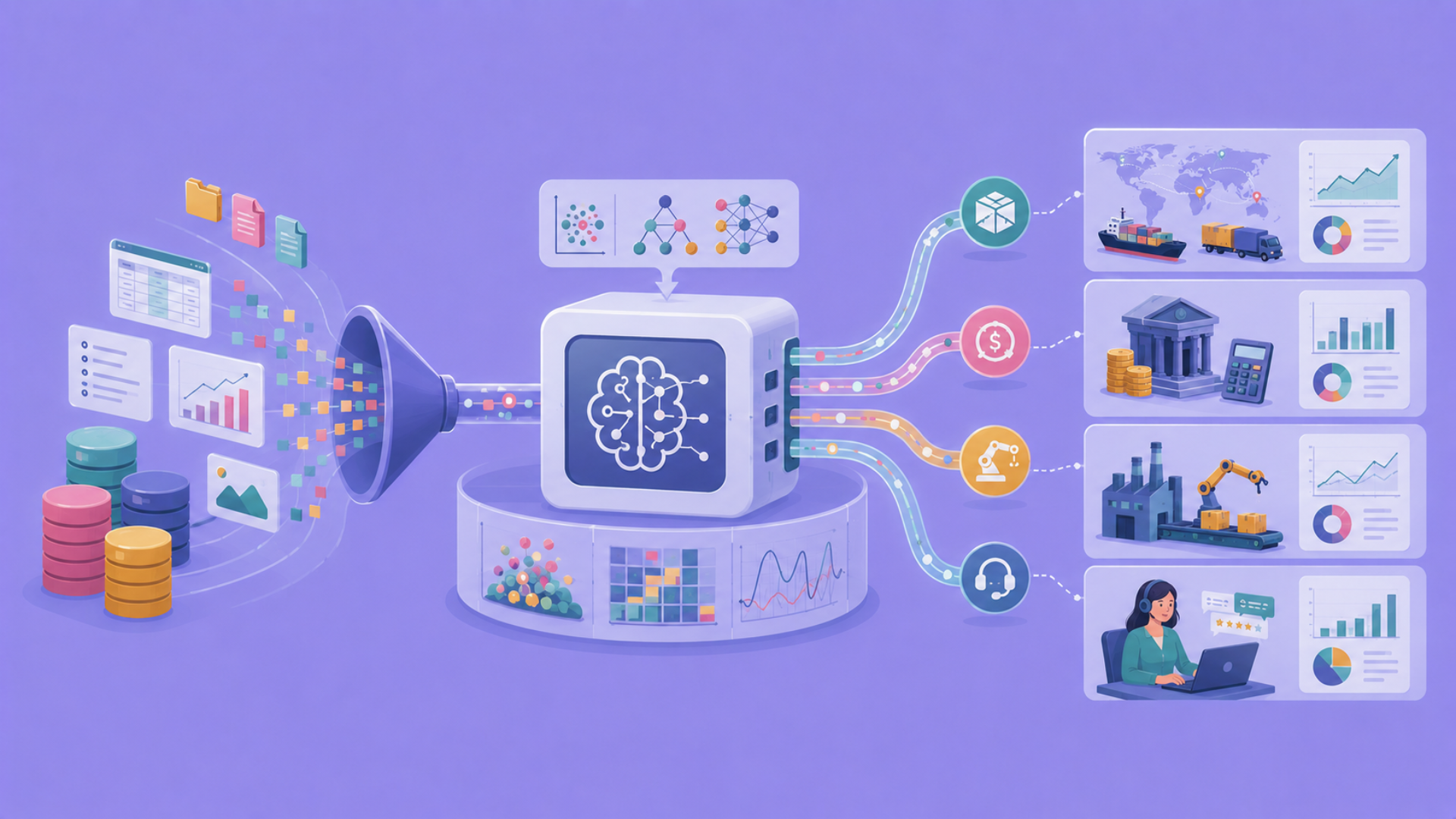
Every AI system that makes a prediction or a decision in a live enterprise environment is running on machine learning.
The demand forecast that tells your procurement team what to order next week. The fraud detection system that flags a suspicious transaction before it settles. The quality inspection system that identifies a defect on the production line. The recommendation engine that decides which product to show which customer. All of these are machine learning in production.
Machine learning is not a single technology. It is a method of building AI systems. Understanding what that method is, and where it works best, is the foundation for making good decisions about where to invest in AI and how to evaluate whether it is working.
What Machine Learning Actually Is
Traditional software is programmed. A developer writes rules. The system follows them. If a transaction amount exceeds a threshold and the country is flagged, decline it. The rules are explicit. They cover the situations the developer anticipated.
Machine learning is different. Instead of writing rules, you show the system examples. You give it thousands of past transactions, labelled as fraudulent or legitimate. The system analyses those examples and learns the patterns that distinguish one from the other. Then it applies those patterns to new transactions it has never seen before.
The system is not following rules someone wrote. It is applying patterns it learned from data.
This distinction matters because real-world problems are too complex for explicit rules. Fraud does not follow a fixed pattern. Demand does not follow a fixed formula. Quality defects do not look identical every time. Machine learning handles complexity and variability in ways that rule-based systems cannot.
How Machine Learning Learns
The learning process has three components. Data, an algorithm, and a target.
Data is what the system learns from. Historical sales records for demand forecasting. Past transaction data for fraud detection. Sensor readings and failure records for predictive maintenance. The quality of the data determines the quality of what the system learns. This is why 73% of ML deployment failures are caused by bad data, not bad models.
The algorithm is the mathematical method the system uses to find patterns in the data. Different algorithms work better for different types of problems. Some are better at classification, sorting inputs into categories. Some are better at regression, predicting a continuous value like a sales figure. Some are better at anomaly detection, identifying the unusual observation in a large dataset.
The target is what you want the system to predict or decide. Will this transaction be fraudulent? How many units will we sell next week? Is this component about to fail? The target determines what the system learns to do.
Once trained, the system takes new inputs and applies what it learned to generate a prediction or decision. This is inference. Every time the fraud detection system checks a transaction, it is doing inference. Every time the demand forecasting system generates a projection, it is doing inference.
The Types of Machine Learning Worth Knowing
Not all machine learning works the same way. Three types are most commonly deployed in enterprise environments.
Supervised learning is the most common. The system learns from labelled examples. Each training example has an input and a correct answer. The system learns to map inputs to correct answers. Fraud detection, credit scoring, demand forecasting, and quality classification are all typically supervised learning problems.
Unsupervised learning finds patterns in data without labelled examples. There is no predefined correct answer. The system identifies structure in the data on its own. Customer segmentation is a common use case. You give the system customer data and it finds groups of customers that behave similarly, without you telling it in advance what those groups should be.
Reinforcement learning trains systems by rewarding them for good outcomes and penalising them for bad ones. The system learns through trial and error. It is less common in standard enterprise deployments but is increasingly relevant for AI agents that need to learn optimal sequences of actions.
Where Machine Learning Generates the Most Consistent Returns in Large Enterprises
Machine learning performs best when four conditions are present. There is enough historical data to learn from. The patterns in the past data are relevant to future situations. The problem has a clear measurable target. And the output of the system connects to a decision or action that changes a business outcome.
Five enterprise use cases consistently meet these conditions.
Demand forecasting and inventory optimisation:
Historical sales data, seasonal patterns, and external signals like weather and economic indicators all feed into machine learning models that predict future demand. The improvement in forecast accuracy over statistical methods is measurable and directly reduces both stockouts and excess inventory. This is one of the highest-ROI machine learning applications available to manufacturers, distributors, and retailers.
Fraud detection and financial crime prevention:
Transaction data contains patterns that distinguish legitimate from fraudulent activity. Machine learning systems trained on historical fraud data identify these patterns and apply them to new transactions in real time. The improvement over rule-based systems is significant, particularly for sophisticated fraud patterns that evolve as fraudsters adapt to known rules.
Predictive maintenance:
Equipment sensor data contains signals that precede failure. Machine learning systems trained on historical sensor data and failure records learn to identify these signals early. The result is maintenance interventions scheduled before failures occur rather than after them. In manufacturing environments, this consistently produces measurable reductions in unplanned downtime and maintenance cost.
Credit risk assessment:
Financial services organisations use machine learning to assess creditworthiness from a combination of financial data, behavioural signals, and alternative data sources. ML-based credit models typically outperform scorecard-based approaches on accuracy while processing applications faster and at lower cost. Explainability requirements mean that credit ML models need to be designed with regulatory compliance in mind from the start.
Customer churn prediction:
Machine learning systems trained on historical customer behaviour identify patterns that precede churn. They score current customers by churn risk. This enables proactive retention actions targeting the customers most likely to leave, rather than broad retention programmes applied uniformly. In channel loyalty applications like Loyalty Plus, churn prediction is the mechanism that enables proactive partner engagement before disengagement becomes visible in order data.
Why 73% of ML Deployments Fail
The single most important fact about machine learning in enterprise environments is one that most vendor conversations obscure. 73% of ML deployment failures are caused by bad data, not bad models.
This has a direct practical implication. The decision to invest in machine learning is also, necessarily, a decision to invest in data quality. A machine learning model is only as good as the data it learns from. A model trained on incomplete, inconsistent, or biased data will produce incomplete, inconsistent, or biased outputs. And it will produce them with the same confidence it would produce correct outputs from good data.
Most enterprise data environments have significant quality issues. Not because organisations are careless about data, but because enterprise systems were built for operational purposes, not for machine learning. Data that is accurate enough for a human to work with may not be structured, consistent, or complete enough for a machine learning system to learn from reliably.
This is why the data foundation work that precedes machine learning deployment is not optional preparation. It is the work that determines whether the machine learning investment produces the result that was projected or joins the 73%.
Machine Learning vs AI: What Is the Difference
This question comes up consistently in enterprise conversations and the answer is simple.
AI is the broad field. It includes any system that performs tasks that would require intelligence if done by a human. Machine learning is one method of building AI systems. It is the most widely used method in production enterprise systems today.
Generative AI, including large language models, is also built on machine learning techniques. The models that power AI assistants, document processing systems, and conversational interfaces are trained using machine learning. They are a specific and increasingly prominent type of machine learning system.
When enterprise leaders talk about deploying AI, they are almost always talking about deploying machine learning in some form. Understanding machine learning is understanding the foundation of what they are actually building.
What to Check Before Commissioning a Machine Learning Project
Four questions reveal whether a proposed machine learning project is ready to proceed or needs more groundwork first.
Do we have enough relevant historical data?
Most machine learning systems need hundreds of thousands of labelled examples to learn reliably. Rare events like specific failure modes or fraud types may need even more. If the historical data is thin, the model will be unreliable.
Is the data clean and consistent?
Not just whether the data exists, but whether it is accurate, complete, and consistently structured across time periods and sources. If significant cleaning is required before training, build that into the timeline and cost.
Is there a clear measurable target?
The system needs to know what it is learning to predict. If the target cannot be precisely defined, the system cannot learn to predict it reliably.
Does the output connect to a decision that changes a business outcome?
A prediction that nobody acts on generates no business value. The machine learning system needs to be connected to a workflow or decision process where its output changes what happens next.
Vishleshan AI's forward deployed engineering (FDE) approach builds machine learning systems inside client environments across automotive, consumer electricals, financial services, and supply chain. We start with the data quality work that makes the model reliable, not with the model selection that looks impressive in a demo. Book a Consultation