


Model Context Protocol went from a specification almost nobody had heard of to the connective tissue of enterprise AI in under 18 months. Anthropic open-sourced it in November 2024. By March 2025, OpenAI had adopted it, with Google DeepMind and Microsoft following. By mid-2025 the ecosystem had grown into thousands of community and vendor servers. By July 2026, a major new specification had shipped with contributions from AWS, Google Cloud, and Cloudflare, describing MCP as the foundation for enterprise-grade agentic AI at scale.
Protocols do not usually spread that fast. Understanding why this one did, and what it means for how enterprises build and deploy AI, is worth the attention of any leader evaluating, deploying, or scaling AI.
The Problem MCP Was Built to Solve
To understand why MCP matters, it helps to understand the problem it was designed to address.
Before MCP, connecting an AI application to an enterprise system required custom integration work for every combination of AI and system. A procurement AI that needed to read from an ERP, query a supplier database, and write to a contract management system required three separate custom connectors. Each connector was built specifically for that AI application and system, with no reuse across other AI applications or system versions.
The scale of this problem in a real enterprise environment becomes clear quickly. If you have 20 AI models or applications and 20 enterprise systems you want to connect them to, you potentially need up to 400 custom connectors. That is the combinatorial problem that MCP is designed to solve.
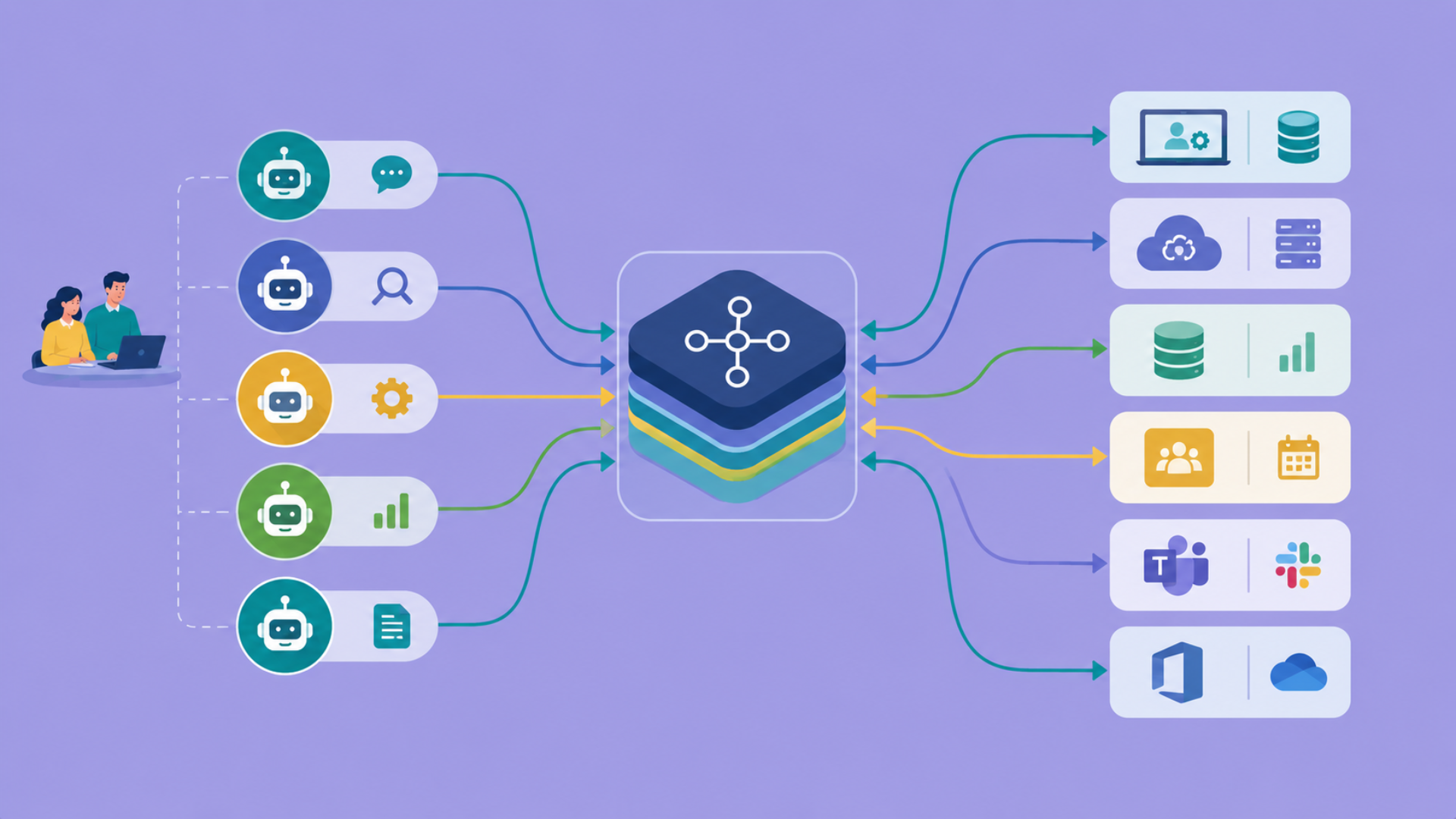
MCP creates a standard that both sides of the connection implement once. Enterprise systems expose their capabilities through an MCP server, defining what data they can provide and what actions they can perform. AI applications connect to those capabilities through an MCP client. When a new AI application arrives, it connects to existing MCP servers without requiring new custom integration work. When a new enterprise system is added, it publishes an MCP server that every existing AI application can immediately use.
The analogy that most people find clearest: MCP is doing for AI-to-system connections roughly what USB-C did for device connections, replacing a drawer full of proprietary cables with one standard port. The connection standard becomes invisible infrastructure that everyone takes for granted, which is how you know it has succeeded.
What MCP Actually Does in an Enterprise Environment
The practical effect of MCP in an enterprise AI deployment is that AI agents can interact with enterprise systems as a first-class capability rather than as a special-case integration effort.
An AI agent in procurement can use MCP to read purchase order history from the ERP, check supplier performance, query contract terms, and write an approved purchase order back to the ERP. These connections are standardised and can be reused across AI applications.
An AI agent in field service can check warranty status in the CRM, verify parts availability, access technical documentation, and update job status in the field service platform. It can do this through MCP servers exposed by those systems, rather than through custom connectors built for a specific agent.
This is what makes the agentic AI that is being deployed across enterprise operations actually function in practice. An agent needs to be able to read from and act on enterprise systems to generate operational value. MCP is the infrastructure standard that makes that connection work without requiring custom integration for every agent-system combination.
Block, the financial technology company, reported a 98.7% token reduction company-wide after implementing MCP across their AI infrastructure. The reduction came from AI systems having direct, structured access to the data they needed through MCP rather than having to process large amounts of context to find the relevant information. That efficiency improvement directly reduces inference costs, which matters at scale.
The July 2026 Specification Update and What It Changes
On July 28, 2026, a major new MCP specification shipped. This is worth understanding specifically because it represents a significant architectural shift that affects how MCP is deployed in enterprise environments.
The 2026 specification moves MCP to a stateless architecture. In the previous specification, MCP connections maintained state — each session required a persistent connection between the AI client and the MCP server. This created infrastructure complexity for enterprise deployments that needed to scale: managing sessions, persistent connections, and the failure modes that come with stateful distributed systems.
The stateless architecture removes this complexity. MCP servers in the 2026 specification can be deployed on standard scalable infrastructure without session management. AWS describes this as making MCP work like the rest of the web: stateless, cacheable, routable, and globally scalable. For enterprises deploying MCP across large environments, this significantly reduces the operational overhead of running MCP infrastructure at production scale.
The 2026 specification also introduced Tasks, an official MCP extension contributed by AWS that brings support for reliable, long-running agents. This addresses a specific limitation of the previous specification: it was well-suited to discrete, short-duration agent interactions but less suited to the multi-step, long-running workflows that enterprise AI increasingly requires. Tasks provides the infrastructure for agents that need to execute workflows over extended time periods, be it hours or days with reliable state management and the ability to recover from interruptions.
Why 28% Fortune 500 Adoption in 18 Months Is Significant
MCP adoption has been unusually fast for an infrastructure protocol, with 28% of Fortune 500 companies implementing it within 18 months of its open-source release. Most enterprise standards take five or more years to reach this level of adoption. Understanding why MCP moved faster reveals something important about where enterprise AI is heading.
The adoption is not primarily driven by enterprise IT departments making architectural decisions about integration standards. It is driven by the practical reality that building agentic AI that actually works in enterprise environments requires connecting AI to enterprise data and systems, and the custom integration approach is unworkable at the scale of enterprise AI deployment in 2026.
Every enterprise that has moved past early AI experimentation into serious agentic AI deployment has encountered the integration problem. MCP is the practical solution that the market has converged on, rather than a standard adopted through governance processes. The adoption of MCP by major AI providers, including Anthropic, OpenAI, Google, Microsoft, and Amazon, means that the AI tools enterprises are evaluating can use a common integration standard. That removes the integration fragmentation that has historically made enterprise software standardisation slow.
Gartner projects that 75% of API gateway vendors will have MCP features by end of 2026. CData estimates 30% of enterprise application vendors will launch MCP servers in 2026. The ecosystem growth means that the range of enterprise systems enterprises can connect AI to through MCP is expanding rapidly, which increases the return on the MCP investment made by enterprises deploying it.
The Security Dimension That Enterprise Leaders Cannot Ignore
MCP makes connecting AI to enterprise systems significantly easier. It also makes the attack surface for AI infrastructure significantly larger, in ways that enterprise security teams need to understand.
The same vulnerability class exposed in the LiteLLM supply chain breach applies to MCP infrastructure. An MCP server with access to sensitive enterprise systems, including ERP credentials, customer data, and financial records, becomes a high-value asset if compromised. The MCP ecosystem's rapid growth, with over 10,000 public MCP servers and community-contributed implementations, creates the same dependency trust chain vulnerability that makes supply chain attacks on AI infrastructure effective.
The security concerns that enterprise leaders need to address in MCP deployments are specific. Which MCP servers are running in the environment, and what enterprise systems do they have access to? How are the credentials that MCP servers use to access enterprise systems managed and rotated? What governance controls define which AI agents are authorised to connect to which MCP servers, and how are those authorisations audited?
The 2026 MCP specification includes authorization hardening as a specific architectural component, addressing the criticism that earlier versions of the protocol left authentication and authorisation implementation largely to individual server implementations with no standard approach. Enterprise MCP deployments built on the 2026 specification have a stronger security foundation than those built on earlier versions. Enterprises that deployed MCP before the 2026 specification should review their authorization architecture against the new standard.
The AI governance architecture that good enterprise AI deployments require includes MCP governance specifically: inventory of MCP servers, access controls on what those servers can connect to, credential management with appropriate rotation schedules, and audit logging of agent-to-system interactions through MCP.
What MCP Means for How Enterprise AI Gets Built
For enterprise leaders evaluating AI programmes and AI partners, MCP has three practical implications.
It changes the integration cost calculation for agentic AI:
Before MCP, integrating an AI agent with enterprise systems was a significant custom engineering effort for every new agent-system combination. With MCP, enterprise systems that have published MCP servers can be connected to new AI agents without new custom integration work. The integration investment made for the first agent is partially reused for every subsequent one. This changes the economics of scaling agentic AI across enterprise functions.
It raises the bar for what enterprise-grade AI deployment means:
An AI deployment that uses MCP-connected enterprise systems can read real-time data, take governed actions within defined parameters, and maintain an audit trail of every interaction. This is fundamentally different from AI that only generates recommendations for humans to implement. Enterprise leaders evaluating AI partners should ask specifically how their AI architecture uses MCP and how they govern the access that MCP connections provide.
It creates a new category of technical due diligence:
Enterprise leaders approving AI programmes now need to understand not just what the AI does but how it connects to enterprise systems — which MCP servers it uses, what those servers can access, how that access is governed, and what the audit trail of agent actions looks like. The who owns AI accountability question extends to the MCP infrastructure that enterprise AI operates through.
A Note on Vishleshan AI and MCP
Vishleshan AI is a member of the Anthropic Claude Partner Network, the organisation that created and maintains the Model Context Protocol. Enterprise leaders approving AI programmes need to understand more than what the AI does. They also need to know how it connects to enterprise systems, which MCP servers it uses, what those servers can access, how that access is governed, and how agent actions are tracked.
This is not incidental to how Vishleshan AI deploys AI. It is the architectural foundation that makes the AI agents Vishleshan deploys across automotive, consumer electricals, financial services, and supply chain environments able to act on enterprise data in real time while maintaining the governance and auditability that enterprise operations require.
Model Context Protocol is infrastructure. Like all good infrastructure, it will become invisible as it matures, the thing that makes everything else work without anyone thinking about it. The enterprises that understand it now, while it is still becoming standard rather than assumed, are the ones that will make the architectural decisions that allow their AI programmes to scale efficiently rather than discovering the integration complexity after significant investment has been made.
Vishleshan AI's forward deployed engineers build enterprise AI deployments with MCP-based integration architecture from day one, connecting AI agents to enterprise systems through governed interfaces that are auditable, scalable, and secure. Book a Consultation