


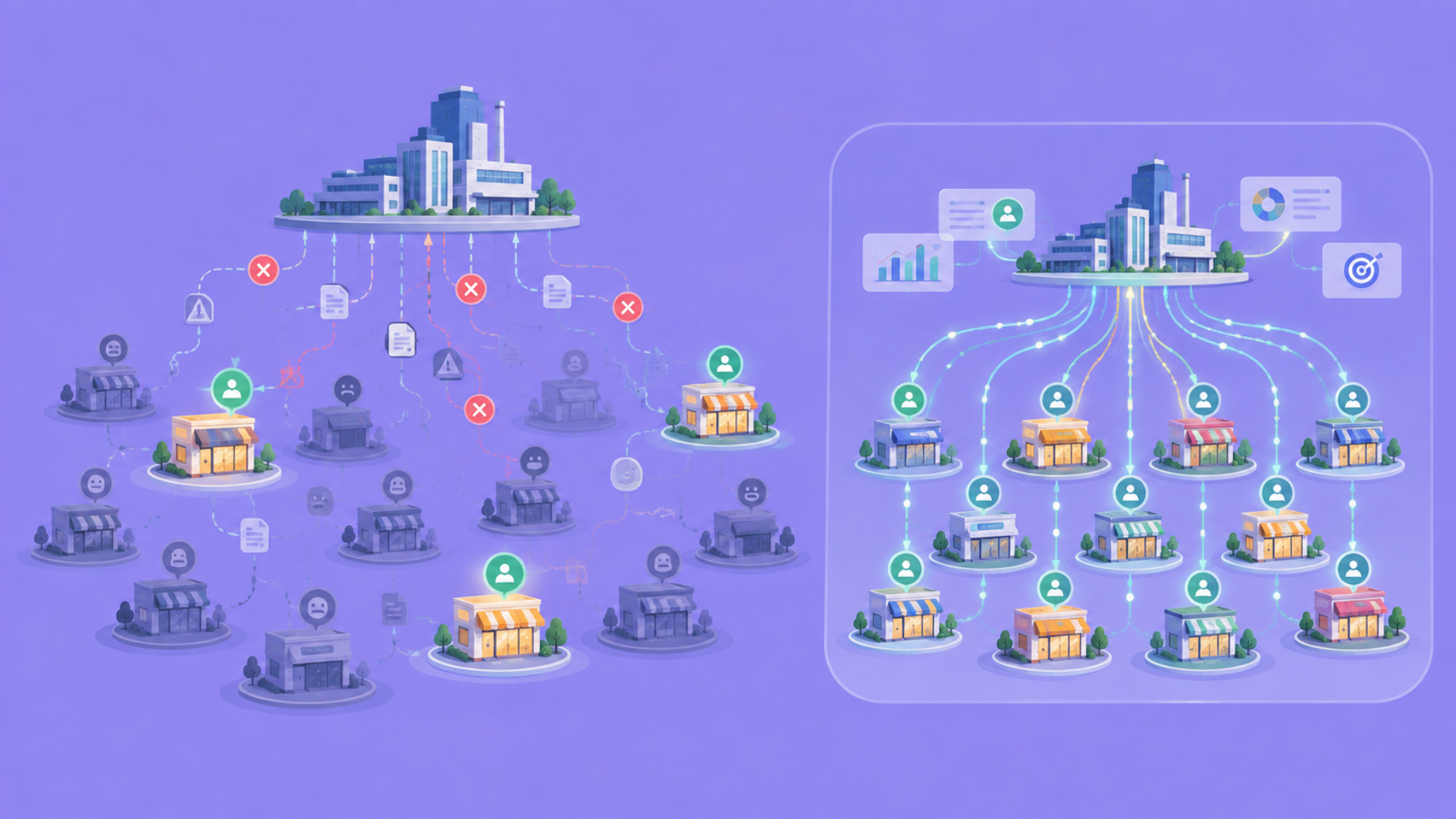
Walk into any regional sales review for a large manufacturer and you will hear the same complaint. Our dealers are enrolled in the loyalty programme, but half of them are not participating.
The data confirms it. 51% of channel partners are enrolled in six or more loyalty programmes but actively engage with only a few. Enrolment is not the problem. Most channel loyalty programmes can generate enrolment. The problem is what happens after enrolment.
Most channel partners collect enough points to feel they are participating. They redeem occasionally. But they do not change which products they push first, how much shelf space they allocate, or how enthusiastically they recommend your brand when a customer asks. The programme exists. The behaviour it was supposed to change has not changed.
This is channel loyalty failure. And the cause is almost always the same.
Here is what a channel loyalty programme built for scale actually looks like.
<embed video>
The Core Problem: B2C Logic Applied to a B2B Context
The most expensive and most common mistake in channel loyalty design is starting with a consumer loyalty platform and configuring it for a B2B channel.
Consumer loyalty programmes are built around individual shoppers. One identity. One purchase journey. Frequent, low-value transactions. Rewards that appeal to personal preferences. A earn-and-burn points mechanic that motivates repeat visits.
Channel loyalty programmes serve a fundamentally different commercial relationship. The channel partner, a dealer, a distributor, a retailer, or an electrician, is not a consumer. They are a business with their own customers, their own economics, and their own reasons for choosing which brands to push.
Their purchasing cycles are monthly or quarterly, not daily. Their decisions are made by multiple stakeholders, not a single individual. The sales rep who makes the recommendation to the customer is a different person from the owner who places the purchase order. The company earns the points. The individual drives the behaviour. A programme that only addresses one of these misses the other.
The transaction is not automatically detected. In a consumer programme, the purchase registers at the point of sale and updates the loyalty account instantly. In a channel programme, purchases flow through an ERP system that may or may not be integrated with the loyalty platform. Point crediting is delayed. Sometimes by days, sometimes by weeks. Partners who do not see their points credited quickly stop believing the programme works.
The rewards that motivate a consumer shopper, vouchers, entertainment, lifestyle rewards, do not automatically motivate a dealer who is running a business. What motivates a dealer is business support, co-marketing funds, training and certification, priority access to new products, and preferential commercial terms. A consumer rewards catalogue mapped onto a dealer network produces a programme that nobody finds compelling.
The Three Structural Failures That Undermine Channel Loyalty at Scale
1. Rewarding transactions rather than behaviours
A transaction-based programme rewards the dealer for what they bought. It does not reward them for what they sold, how they presented the product, whether they trained their staff on it, or how they handled a customer complaint about it.
The manufacturer cares about behaviour, not just purchase volume. A dealer who buys a large order and stores it in a back room has not advanced the manufacturer's commercial objective. A dealer who actively recommends the product, displays it prominently, and converts enquiries into sales has. The transaction looks the same in both cases.
Behaviour-based loyalty programmes reward the actions that actually drive commercial outcomes. Scan-based verification that confirms a sale reached an end customer. Training completions that demonstrate product knowledge. New customer acquisitions. Service quality scores. These behaviours connect to the manufacturer's actual objective in a way that purchase volume alone does not.
2. Treating all partners the same
A large channel network is not a homogeneous group. It spans partners of different sizes, in different markets, at different stages of their relationship with the manufacturer, selling to different customer types, and facing different competitive dynamics.
A programme that applies the same structure, the same targets, the same rewards, and the same communication to every partner regardless of these differences is a programme that is relevant to the average partner and personally compelling to almost none of them.
The dealer running a small shop in a tier-three market has different targets, different resource constraints, and different motivations from the dealer managing a large showroom in a metro city. A single programme structure cannot serve both well. It will be too demanding for one and too easy for the other. Both will disengage for different reasons.
Channel loyalty at scale requires segmentation. Not the segmentation of grouping partners into tiers by revenue and applying slightly different reward levels. Genuine segmentation that recognises different partner profiles and designs programme elements that are relevant to each.
3. Operating on data that arrives too late
Most channel loyalty programmes operate on data that is days or weeks old. Purchase records arrive after the order is processed. Sales data arrives after the monthly close. Performance reports arrive after the regional review.
By the time the programme knows a partner is disengaging, the disengagement has been happening for weeks. By the time it identifies a partner who is ready for a higher-tier scheme, the opportunity to offer it proactively has passed. By the time it detects a fraud pattern in code scanning, significant points have already been paid out.
Data latency is not a technical inconvenience. It is a commercial problem. A programme that cannot see what is happening in the channel in near real time cannot respond to what is happening. It can only report on what happened.
What Happens When Scale Makes These Problems Worse
A channel loyalty programme with these structural problems at 500 partners is a programme that underperforms. At 50,000 partners it becomes a liability.
At scale, the transaction-only reward structure generates redemption behaviour that does not connect to commercial outcomes. Partners optimise for point accumulation rather than the behaviours the programme was designed to encourage. The point cost is real. The commercial return is not.
At scale, uniform programme structures create a two-tier reality. Larger partners who can hit standard targets engage. Smaller partners who cannot do not. The programme concentrates reward investment in partners who would have been active regardless, and fails to activate the long tail of smaller partners whose collective volume is often larger than the top tier.
At scale, delayed data creates fraud exposure that manual monitoring cannot contain. Code scanning fraud, where programme codes are collected and submitted without genuine product movement, becomes organised at scale. By the time a monthly audit identifies the pattern, the payout has happened.
What Works Instead
The channel loyalty programmes generating commercial returns at scale share three characteristics that distinguish them from generic transaction-based programmes.
They reward behaviours, not just purchases:
The programme design starts with the specific behaviours that drive commercial outcomes for this manufacturer in this channel. Product recommendations. Display compliance. New customer acquisition. Service quality. Training completion. These become the primary reward triggers. Purchase volume remains a factor but it is one input, not the entire programme mechanic.
They personalise by partner profile, not by tier:
The programme uses partner data to understand what each partner needs from the relationship and what incentive structure is most likely to change their behaviour. A partner who has not engaged with training content receives a different offer from one who has completed all available certifications. A partner in a competitive market receives different support from one in a captive market. The programme feels relevant because it reflects what the manufacturer knows about each partner specifically.
They operate on real-time data:
Point crediting happens at the point of scan or the point of sale, not at the end of the month. Fraud detection runs continuously against live transaction data, not monthly against batch exports. Partner engagement signals are visible as they happen, so the programme can respond to early disengagement before it becomes permanent. This real-time data capability is not a feature enhancement. It is the operational foundation that makes behaviour-based personalisation possible.
The Integration That Makes Real-Time Channel Loyalty Work
Real-time channel loyalty requires integration between the loyalty platform and the systems where channel activity actually occurs. The dealer management system. The distributor's ordering platform. The manufacturer's ERP. The product registration system. The service management platform.
Without these integrations, the loyalty programme sees what is reported to it. With them, it sees what is actually happening.
This integration challenge is identical to the one that makes AI effective in any enterprise context. The intelligence is only as good as the data it can access, and that data only becomes available through genuine integration with the operational systems where the channel runs. A loyalty platform that sits alongside these systems and receives periodic data exports will always be operating on yesterday's channel reality.
Loyalty Plus is built on this integration principle. Real-time point crediting, live fraud monitoring, and partner-level intelligence that connects to the data the channel actually generates, rather than the data that the channel reports.
What This Means for Manufacturers Evaluating Channel Loyalty
The question to ask before evaluating any channel loyalty platform is not "what features does it have?" It is "what failure mode has cost us the most money in our current programme?"
If the answer is low engagement despite high enrolment, the problem is relevance. The programme is not compelling to the partners it is supposed to motivate.
If the answer is point redemption without commercial return, the problem is programme mechanics. The rewards are being earned for behaviours that do not connect to the commercial objective.
If the answer is fraud or data integrity issues, the problem is data architecture. The programme is operating on data that arrives too late and is too easy to game.
Each failure mode points to a different root cause. Understanding the root cause before selecting a platform is what prevents the same failure from recurring on new technology.
Vishleshan AI's Loyalty Plus is built for channel loyalty at enterprise scale. It addresses the structural failures described in this piece through real-time data integration, behaviour-based reward mechanics, and partner-level personalisation. It is deployed by forward deployed engineers (FDE) who work inside client channel environments to build the data connections that make the programme reflect what is actually happening in the channel. Book a Consultation