



Most enterprises have worked with software consultants. Far fewer have worked with a forward deployed engineer. The two roles are often described in similar terms, embedded expertise, technical delivery, client-facing engineering, but they operate on fundamentally different principles, and the difference between them largely determines whether an enterprise AI initiative reaches production or stalls somewhere between a working pilot and a usable system.
This piece sets out exactly what separates the two models, across the dimensions that matter most for an enterprise evaluating how to resource an AI initiative.
The Core Distinction in One Sentence
A software consultant delivers a system. A forward deployed engineer stays until the system is genuinely being used.
That single distinction cascades into differences in how the engagement is structured, where the engineer works, what they are accountable for, and what happens when the real world turns out to be more complicated than the specification assumed.
A Direct Comparison
Traditional Software Consultant | Forward Deployed Engineer | |
|---|---|---|
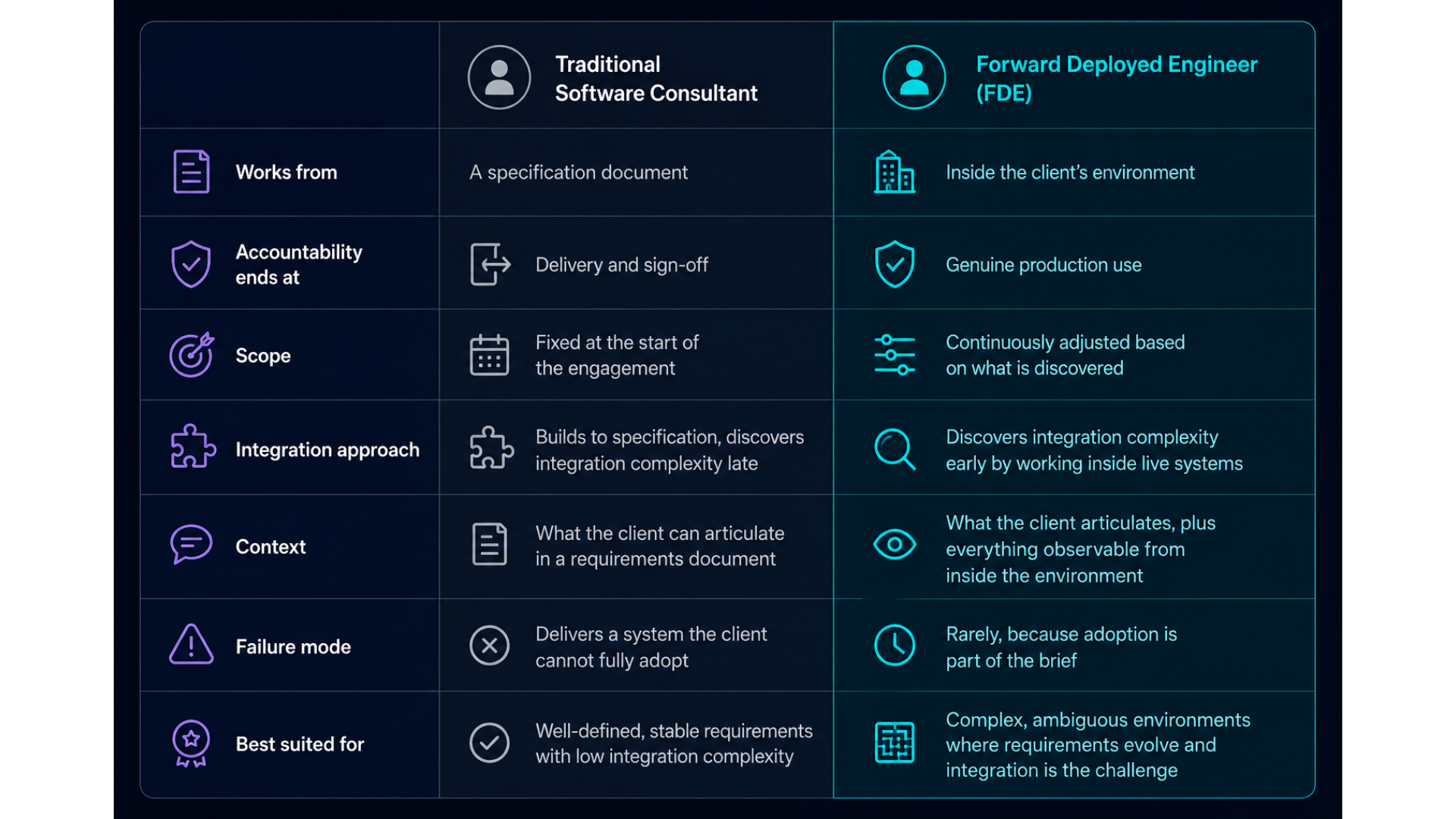
Works from | A specification document | Inside the client's environment |
Accountability ends at | Delivery and sign-off | Genuine production use |
Scope | Fixed at the start of the engagement | Continuously adjusted based on what is discovered |
Integration approach | Builds to specification, discovers integration complexity late | Discovers integration complexity early by working inside live systems |
Context | What the client can articulate in a requirements document | What the client articulates, plus everything observable from inside the environment |
Failure mode | Delivers a system the client cannot fully adopt | Rarely, because adoption is part of the brief |
Best suited for | Well-defined, stable requirements with low integration complexity | Complex, ambiguous environments where requirements evolve and integration is the challenge |
Where the Work Happens
This is the most visible operational difference between the two models.
A traditional software consultant typically works from their own organisation's environment. They attend client meetings, conduct interviews, gather requirements, and then return to their own team to build. The client's environment is something they visit. Their delivery environment is somewhere else.
A forward deployed engineer works inside the client's environment as the primary working context. Not visiting, not attending scheduled touchpoints, but actually present, day to day, in the operational environment where the system being built will eventually run.
This difference sounds administrative. It is not. The things that determine whether an enterprise AI deployment succeeds are almost never fully captured in a requirements document. They are discovered by being present when an exception occurs that nobody anticipated, or when a process that looks straightforward on paper turns out to have a workaround built into it that three teams depend on without realising it.
A consultant working remotely from a specification will discover these things at integration time, which is the most expensive time to discover them. A forward deployed engineer working inside the environment discovers them before the build has committed to a direction that needs to be reversed.
What Each Role Is Accountable For
Accountability structures are where the two models diverge most sharply in practice.
A traditional consultant is accountable for delivery against the agreed specification. When the system is built, tested, and handed over, the engagement is complete. What happens after handover, whether the system is adopted, whether it performs as expected in production conditions, whether the teams using it find it usable, is outside the scope of the engagement.
A forward deployed engineer is accountable for production outcomes, not delivery milestones. The engagement does not conclude when the system is handed over. It concludes when the system is genuinely operating in the business, being used by the people it was built for, and generating the outcome it was designed to produce.
This matters enormously in the context of enterprise AI. An MIT NANDA study examining 300 public enterprise AI projects found that 95 percent produced little or no measurable impact on profit and loss. The failure was not at delivery. Systems were built and handed over. The failure was in the gap between delivery and production adoption, the gap that forward deployed engineering exists to close.
How Each Model Handles Scope Change
Enterprise environments are not stable. Requirements that were accurate at the start of an engagement regularly turn out to be incomplete or incorrect once the build is underway and real constraints surface.
A traditional consulting engagement handles this through change control, a formal process for documenting, evaluating, and pricing scope changes. Change control exists for legitimate reasons, it protects both parties from unbounded scope expansion. But it also creates friction at exactly the moments when rapid adjustment is most valuable, when something discovered in the real environment requires a quick change of direction.
A forward deployed engineer adjusts scope continuously as part of the normal operating rhythm, because they are inside the environment where those adjustments become necessary. The process for handling a discovered constraint is not a change request and a timeline negotiation. It is a conversation and a revised approach, sometimes the same day.
This does not mean forward deployed engagements have no boundaries. They do. But the mechanism for handling change is calibrated for an environment where discovering unexpected complexity is the norm, not the exception.
How Each Model Handles Integration
Integration is where most enterprise AI deployments encounter their most serious problems, and it is where the difference between the two models has the most practical consequence.
A traditional software consultant building to a specification typically integrates against documented APIs and system interfaces, working from whatever the client's technical teams have provided as the authoritative description of how the systems work. This is often accurate as far as it goes. It rarely captures the full picture of how systems actually behave in production, under real data loads, with the edge cases that only surface when real transactions are running through them.
A forward deployed engineer working inside the client's environment integrates against the actual systems, running actual data, and discovers the edge cases before the system is deployed rather than after. This is not a methodological preference. It is a direct consequence of working inside the environment rather than building against a description of it.
For enterprise AI applications in particular, where the system needs to connect to ERP, CRM, operational databases, and workflow tools simultaneously, this difference in integration approach has a direct bearing on whether the deployed system works reliably or requires significant post-deployment remediation.
When to Use Each Model
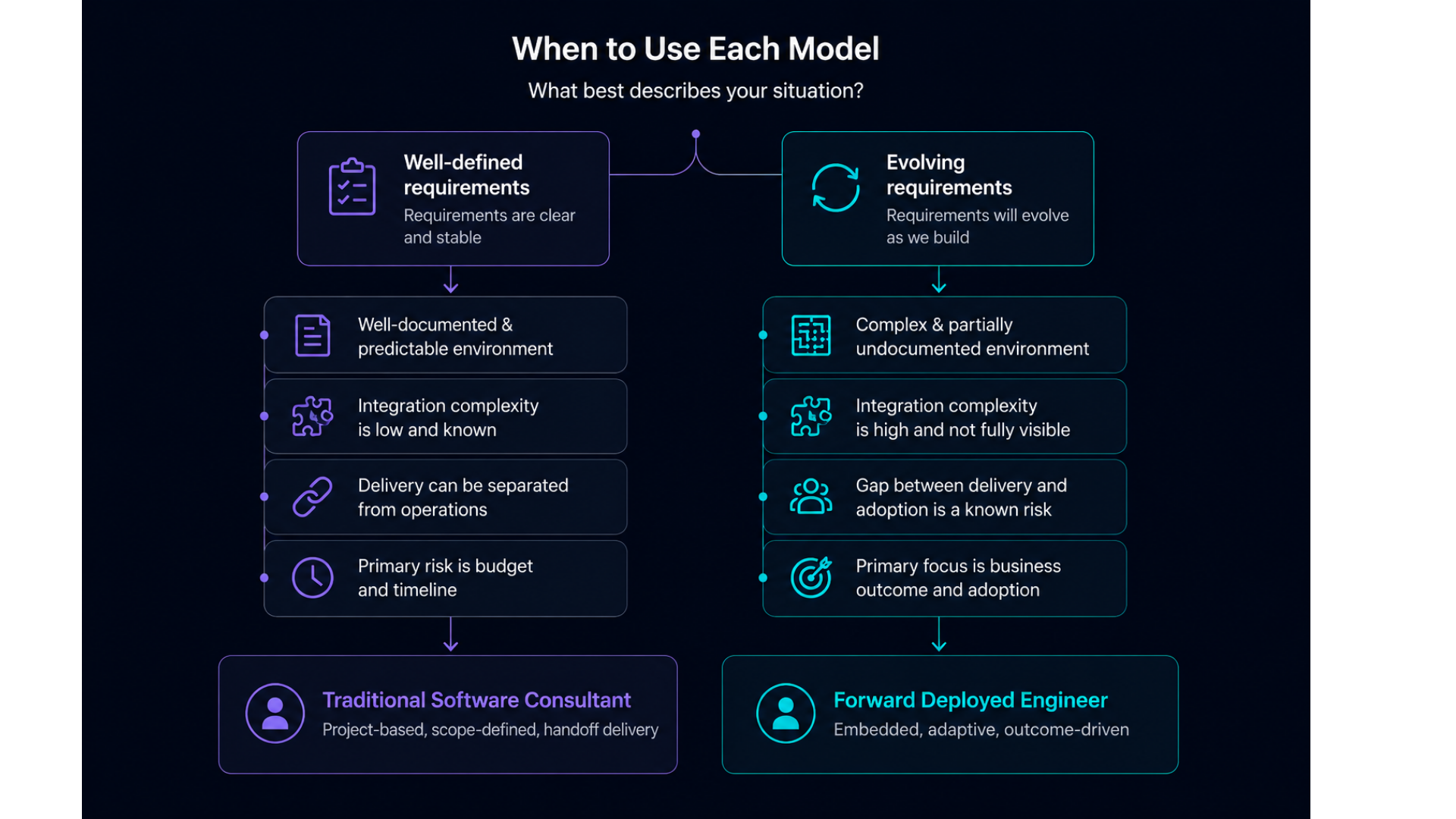
The two models are not in competition across all situations. A traditional consulting engagement is the right choice when requirements are well-defined and stable, the integration environment is well-documented and predictable, the delivery can be cleanly separated from the operational environment, and the primary risk is budget and timeline, not adoption and integration complexity.
A forward deployed engineering model is the right choice when the requirements will evolve as the build progresses, the integration environment is complex and partially undocumented, the gap between technical delivery and actual adoption is a known risk, and the business outcome, rather than the delivered system, is what the engagement is being evaluated against.
For most enterprise AI deployments in 2026, the second set of conditions describes the situation accurately. AI initiatives in automotive, consumer electricals, financial services, and supply chain almost always involve integration complexity that is not fully visible at the start, requirements that evolve as the real environment is understood, and adoption risk that cannot be designed away from a remote delivery environment.
The Questions to Ask When Evaluating a Partner
If you are evaluating AI delivery partners, three questions reliably distinguish a genuine forward deployed engineering model from a traditional consulting engagement rebranded with different language.
Where will the engineers actually work? A genuine forward deployed engineering team will be embedded inside your environment for the duration of the deployment. A consulting team will describe a process of site visits and regular touchpoints, which is a different operating model.
Where does accountability end? A forward deployed engineering engagement measures success at production adoption. A consulting engagement measures success at delivery and sign-off. Ask explicitly what happens if the delivered system is not adopted, and listen carefully to the answer.
How is scope change handled? A forward deployed engineering model will describe a continuous adjustment process. A consulting engagement will describe change control. Neither answer is wrong in isolation, but each tells you which model you are actually evaluating.
Conclusion
The distinction between a forward deployed engineer and a traditional software consultant is not a matter of skill level or seniority. It is a matter of operating model, where the work happens, what the engineer is accountable for, and how integration and scope change are handled in practice.
For enterprise AI initiatives where the integration environment is complex and adoption risk is real, the operating model matters as much as the technical capability being applied.
Vishleshan AI's forward deployed engineers work inside client environments across automotive, consumer electricals, financial services, and supply chain, staying accountable until the system is genuinely in production, not until it is delivered. Book a Consultation