



Forward deployed engineering services is often described as "engineers embedded with the client." That description is accurate, but it stops short of explaining what actually happens once that engineer is inside the client's environment, and whether the project ends up live in production or quietly stalls, which is the outcome for 95 percent of enterprise AI pilots, according to the MIT NANDA study.
This piece covers the mechanism, the actual sequence of what happens from the day a forward deployed engineer joins a client's environment to the day a system is genuinely running in production.
The Three Capabilities That Have to Operate Together
Forward deployed engineering works because it fuses three distinct capabilities into a single role, rather than splitting them across separate teams that have to coordinate through documentation and handoffs.
Build covers the technical execution, code, data pipelines, cloud infrastructure, and the AI application layer itself.
Embed covers the practice of working inside the client's actual environment, attending their meetings, absorbing their constraints, and being present for the decisions that never make it into a specification document.
Translate covers the ability to move fluently between business language and technical execution, so that a finance team's approval threshold or a compliance team's audit requirement gets built into the system correctly the first time, not discovered as a defect after deployment.
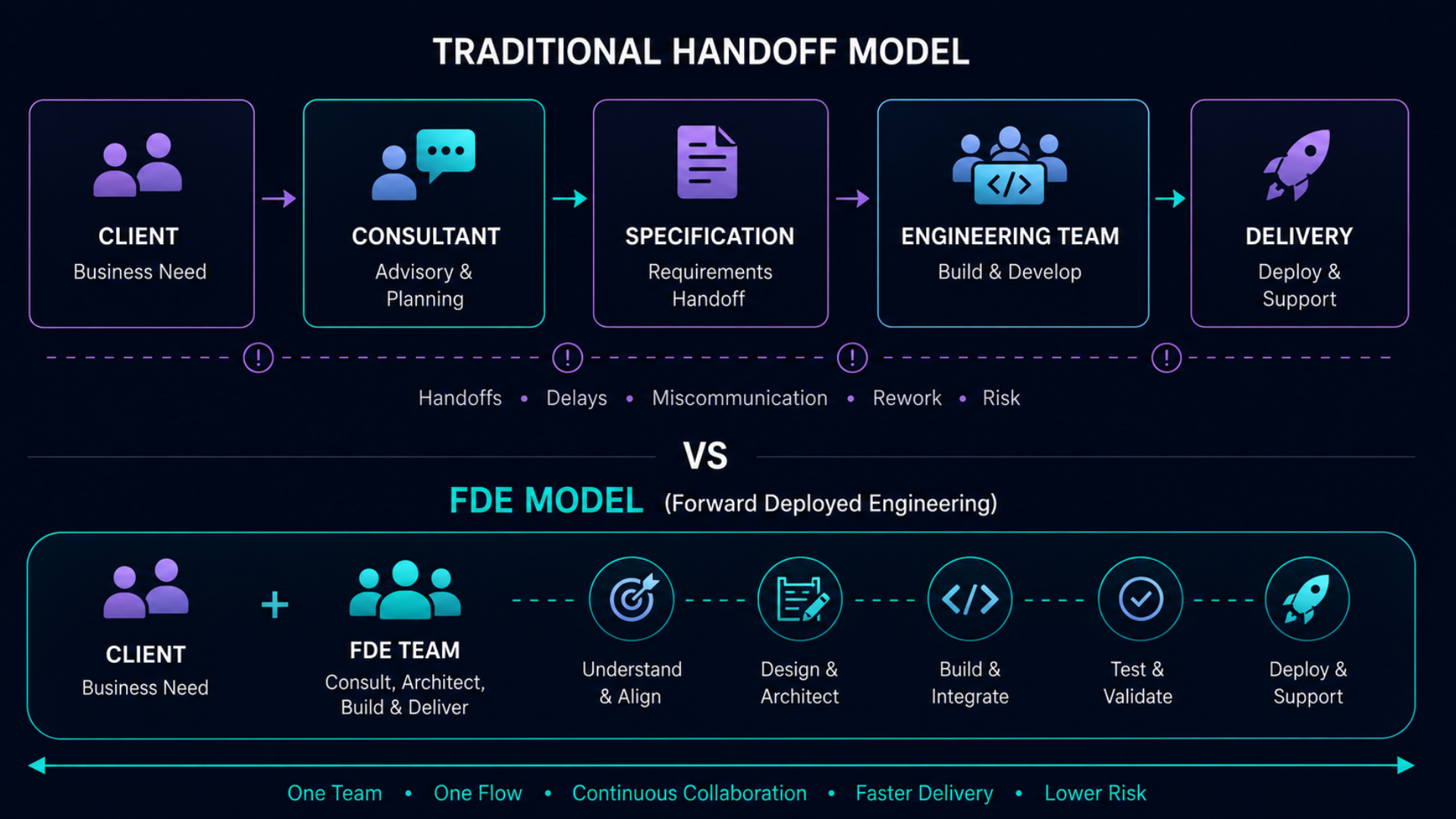
The reason these three have to live in one person, or one tightly coordinated team, rather than being split across a technical team and a separate client-facing team, is that the handoff between them is exactly where most enterprise AI projects lose the context that made them viable in the first place. A requirements document written by a client-facing consultant and handed to a remote engineering team strips out the texture, the half-stated constraints, the political reality of why a process exists, that a forward deployed engineer absorbs simply by being present.
Stage One: Discovery Inside the Environment, Not Outside It
A forward deployed engagement begins differently from a traditional consulting engagement. Rather than a discovery phase conducted through structured interviews and documentation review from outside the organisation, the forward deployed engineer is physically or virtually embedded inside the client's actual working environment from day one.
This matters because the most important constraints in any enterprise AI deployment are rarely the ones anyone states explicitly. A procurement team might describe their approval workflow accurately on paper, while the actual practice, developed over years to work around a system limitation nobody bothered to fix, looks nothing like the documented process. A forward deployed engineer sitting inside that environment sees the workaround happening and builds for it. A team working from documentation alone builds for the official process, and then wonders why the deployed system gets quietly ignored.
This is also where the enterprise context layer that governs how AI systems operate within business rules starts to take shape, not as an abstract architecture diagram, but as a direct accumulation of what the forward deployed engineer observes about how the business actually runs.
Stage Two: Building Against a Named Constraint, Not a Capability
Once embedded, the forward deployed engineer's first technical decision is what to build toward. The discipline here is building against a specific, named business constraint, a fill rate stuck below target, a dealer response time costing bookings, a procurement cycle adding weeks to a supply chain, rather than building toward an impressive technical capability and looking for a use case afterward.
This sounds obvious stated plainly, but it inverts how most AI initiatives actually get built. A team given access to a powerful model often starts by asking what the model can do, and builds a demonstration around that. A forward deployed engineer starts with what is actually broken in the business, and works backward to what the model needs to do to fix it. The first approach produces an impressive demo. The second produces something that survives contact with production.
This is the same discipline behind the architecture-first approach to enterprise AI more broadly, anchoring every deployment to a named constraint rather than a capability looking for a home.
Stage Three: Integration With What Already Exists, Not Replacement of It
The third stage is where most enterprise AI deployments either survive or quietly die, integration with the client's existing systems of record.
A forward deployed engineer working inside the client's environment builds against the client's actual ERP, actual CRM, and actual operational systems, layering AI on top of what already exists rather than proposing a parallel system that requires the client to change how they operate everything else. This is a deliberate constraint, not a limitation. Enterprises do not want to rip out a working ERP to deploy an AI use case. They want the AI use case to work within the ERP they already have.
This is also where the difference between a forward deployed engineer and a traditional delivery team becomes most visible. A remote team building from a specification will often discover integration complexity only once the build is substantially complete, at which point fixing it means significant rework. A forward deployed engineer working inside the environment from day one discovers the integration complexity early, because they are already inside the system that needs to be integrated with.
Stage Four: Staying Accountable Until Production, Not Until Delivery
The final and most distinguishing element of the operating model is where accountability ends.
A traditional engagement typically ends at delivery, the system is handed over, signed off, and the vendor's responsibility concludes. A forward deployed engineering engagement extends accountability to actual production use, the system is genuinely being used by the people it was built for, generating the outcome it was meant to generate, not just technically deployed and functioning in isolation.
This distinction explains a significant portion of the gap the MIT NANDA study identified between pilots and production. A pilot that technically works but is never actually adopted into daily operations counts as a failure in any meaningful sense, even though it might be marked as delivered in a project tracker. Forward deployed engineering treats genuine adoption, not technical delivery, as the actual finish line.
What This Looks Like Across a Typical Engagement
In practice, a forward deployed engagement at Vishleshan AI moves through these stages within a defined 90-day window, taking a named use case from initial discovery to production deployment. The pace is deliberate, not because speed is the goal in itself, but because a longer timeline increases the risk that the original business constraint shifts before the solution is deployed, which is one of the quieter reasons enterprise AI pilots stall.
The model works because the same forward deployed engineer, or tightly coordinated team, carries context across every stage. Nothing gets lost in a handoff between discovery and build, or between build and integration, because the same people who discovered the constraint are the ones building against it and integrating it into the client's actual systems.
Why This Operating Model Is Hard to Replicate Through a Traditional Delivery Structure
Enterprises sometimes ask whether a traditional consulting or systems integration team could simply adopt this approach without rebranding as forward deployed engineering. In principle, yes. In practice, the operating model requires a specific kind of engineer, one comfortable with ambiguity, capable across the full technical stack, and willing to spend extended time inside a client's environment rather than working from a comfortable remove. This combination is genuinely scarce, which is part of why FDE job postings have grown so sharply and why major AI labs are now building this capability as a strategic priority rather than treating it as a standard hiring category.
Conclusion
The forward deployed engineering operating model is not a service wrapped around AI deployment. It is a specific sequence, embedded discovery, constraint-led building, integration with existing systems, and accountability extended through to genuine production use, designed specifically to close the gap between a working pilot and AI that actually changes how a business operates.
Understanding this mechanism matters for any enterprise evaluating how to resource an AI initiative. The question is not simply whether a partner has skilled engineers. It is whether those engineers operate inside this model, or outside it.
Vishleshan AI's forward deployed engineers operate inside this exact model, taking AI from use case to production in 90 days. Book a Consultation