


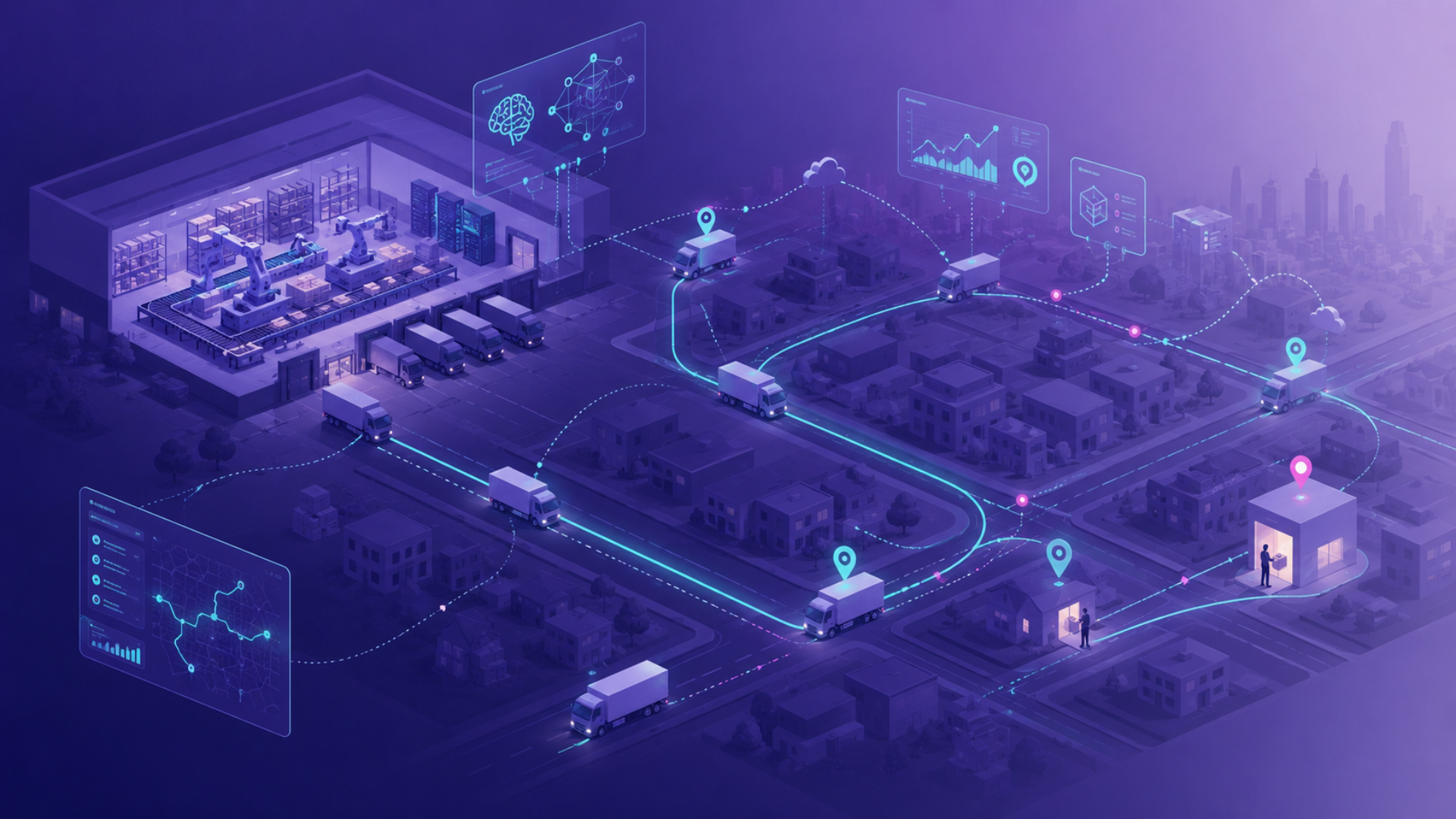
Logistics has always been a data problem. Thousands of shipments moving simultaneously across dozens of routes, weather disruptions, vehicle breakdowns, customer delivery windows that narrow by the year, and a last mile that consistently accounts for more than half of total delivery cost. The data has always been there. The ability to act on it in real time has not.
AI is changing that. Not incrementally but structurally. The enterprises getting the most from AI in logistics are not just moving parcels faster. They are operating with a fundamentally different level of visibility, responsiveness, and cost control than their peers. Here is what is actually changing and what it means for enterprises managing complex supply chains.
The Last-Mile Problem AI Is Solving
Last-mile delivery is the final leg of a shipment's journey from a distribution centre to the end customer and is the most expensive, most unpredictable, and most customer-visible part of the logistics chain. It accounts for an estimated 53 percent of total shipping costs globally, according to research from Capgemini, and it is the segment where delivery failures, delays, and customer dissatisfaction concentrate most heavily.
The last-mile problem has three components that have historically resisted efficient solution simultaneously.
Route complexity: Optimising delivery sequences across dozens of stops, variable traffic conditions, customer availability windows, and vehicle capacity constraints in real time is a combinatorial problem that exceeds human planning capacity at scale.
Dynamic disruption: A traffic incident, a failed delivery attempt, a vehicle breakdown, or a customer rescheduling request can invalidate an optimised route within minutes of dispatch. Traditional systems cannot re-optimise at the speed these disruptions occur.
Customer expectation: Delivery windows have compressed from days to hours in many sectors, and the tolerance for missed or late deliveries has fallen accordingly. The margin for error in last-mile execution is narrower than it has ever been.
AI addresses all three simultaneously in ways that previous optimisation tools could not.
Route Optimisation: From Static Plans to Real-Time Intelligence
Traditional route planning produces an optimised plan at the start of the day and delivers against it. When conditions change and they always do the response is manual adjustment or acceptance of the suboptimal outcome.
AI-powered route optimisation does something fundamentally different. It continuously re-optimises routes across an entire fleet in real time, incorporating live traffic data, weather conditions, vehicle telemetry, customer availability signals, and new delivery requests as they arrive. When a driver reports a road closure, the system does not wait for a dispatcher to reroute manually. It recalculates the optimal sequence for that vehicle and every other vehicle whose route might be affected, instantly.
The commercial impact is significant. DHL has reported that AI-driven route optimisation reduced fuel consumption by up to 15 percent across participating fleets while simultaneously improving on-time delivery rates. UPS attributes billions of dollars in annual savings to its AI-powered routing platform ORION, which optimises routes for tens of thousands of drivers daily.
For enterprises operating their own distribution fleets, automotive parts distributors, consumer electricals companies with direct delivery networks, and industrial goods manufacturers the same capability is now accessible without building proprietary technology. The AI infrastructure that major logistics operators developed over a decade is available through cloud platforms and specialist vendors at a fraction of the original development cost.
Demand Forecasting: Seeing What Is Coming Before It Arrives
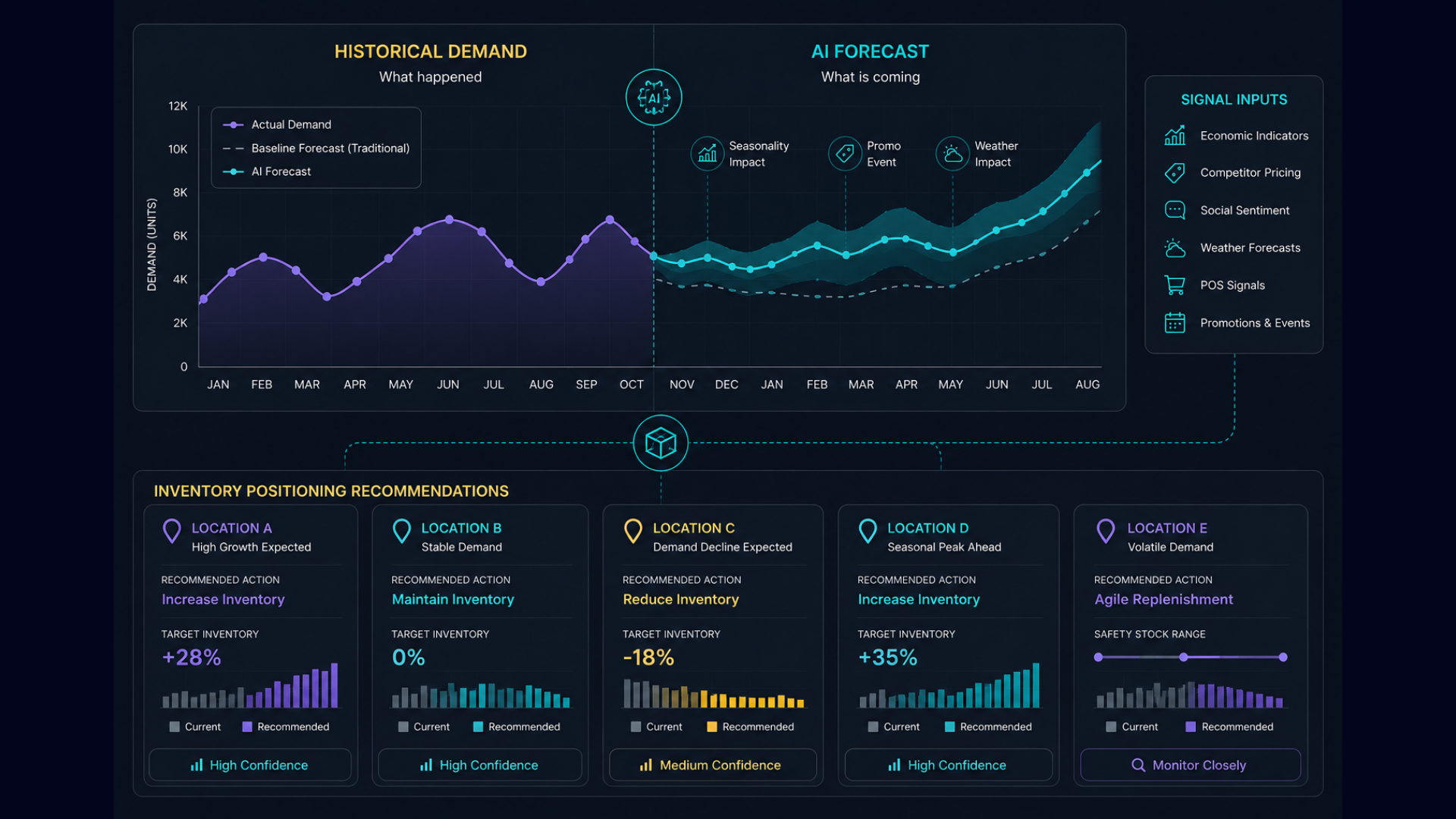
The most expensive thing in logistics is being wrong about demand. Too much inventory in the wrong location creates carrying cost and markdowns. Too little creates stockouts, emergency replenishment, and expedited shipping costs that eliminate margin.
Traditional demand forecasting used historical sales patterns, seasonal adjustments, and promotional calendars. It was reasonably accurate in stable conditions and consistently wrong when conditions changed which, in the post-2020 supply chain environment, has been most of the time.
AI-driven demand forecasting incorporates a significantly broader signal set. External economic indicators, competitor pricing movements, social sentiment data, weather forecasts, and real-time point-of-sale signals feed into models that update continuously rather than on a weekly or monthly planning cycle.
The practical result is inventory positioning that responds to what is actually happening in the market rather than what happened last year. For consumer electricals enterprises managing inventory across hundreds of distributor and dealer locations, this translates directly into fill rate improvement — the metric that most directly correlates with revenue capture in distribution-heavy business models.
Warehouse Operations: Intelligence at the Distribution Centre
The transformation of logistics AI is not limited to vehicles on roads. Inside distribution centres, AI is reshaping how inventory is managed, how orders are fulfilled, and how human and automated systems work together.
Computer vision systems integrated with warehouse management platforms can identify inventory discrepancies in real time catching picking errors, misplaced stock, and damaged goods at rates that human visual inspection cannot match at the throughput speeds modern distribution centres require. The same systems track worker movement and workflow patterns to identify bottlenecks and optimise task assignment across large warehouse teams.
Predictive maintenance for warehouse equipment such as conveyors, sorting systems, forklifts, automated storage and retrieval systems uses sensor data and AI models to identify failure risk before breakdowns occur. An unplanned conveyor stoppage in a distribution centre processing thousands of orders per hour is not just a maintenance event. It is a customer service event with compounding downstream consequences. Predictive maintenance changes the economics of that risk significantly.
For industrial manufacturers operating their own distribution infrastructure, these capabilities are becoming a competitive requirement rather than a differentiator. The enterprises that have invested in warehouse AI are processing more volume, with fewer errors, at lower cost per unit — and the gap with those that have not is widening.
Supply Chain Visibility: From Reactive to Predictive
Perhaps the most strategically significant application of AI in logistics is not optimisation within known parameters, it is early detection of disruptions before they cascade into operational crises.
Traditional supply chain visibility is retrospective. A shipment is delayed. A supplier misses a delivery window. A port experiences congestion. The enterprise finds out when the shipment does not arrive, when the production line runs short, or when the customer calls to ask where their order is.
AI-powered supply chain visibility platforms monitor signals across the entire logistics network in real time like carrier performance data, port congestion indicators, weather forecasts along shipping routes, geopolitical risk signals, and supplier financial health indicators. When a pattern emerges that historically precedes a disruption, the system flags it before the disruption materialises.
The practical consequence is that procurement and logistics teams shift from managing crises to preventing them. When the system identifies a supplier at risk of delivery failure three weeks in advance, the procurement team has options such as qualifying an alternative supplier, adjusting safety stock, rerouting production that are simply not available when the failure is discovered on the day it occurs.
This is the same principle behind agentic AI deployment in enterprise operations more broadly moving from reactive response to proactive intervention. In logistics, the financial impact of that shift is measurable in reduced expediting costs, lower safety stock requirements, and fewer production stoppages caused by supply chain failures.
The Last-Mile Customer Experience: Personalisation at Delivery Scale
The customer-facing dimension of last-mile AI is evolving rapidly. Dynamic delivery window management where AI models predict with increasing accuracy what time window a specific customer is most likely to be available, based on historical delivery patterns and real-time signals is reducing failed first-attempt delivery rates significantly.
Proactive exception management uses AI to identify shipments at risk of delay before the delay is confirmed, triggering automated customer communication and rescheduling options before the customer experiences a failed expectation rather than after. The difference in customer satisfaction between "your delivery has been rescheduled to tomorrow, please confirm a window" and "your delivery did not arrive as expected" is significant, and the operational cost of proactive communication is a fraction of the cost of managing reactive complaints.
For consumer-facing enterprises managing direct delivery at scale like eCommerce operations, direct-to-dealer fulfilment, field service parts delivery, this capability directly affects the metrics that matter: first-attempt delivery rate, customer satisfaction scores, and the cost per successful delivery.
What Enterprises Need to Get Right Before Deploying Logistics AI
The logistics AI capabilities described above are deployable today. The constraint is not technology availability, it is the data and integration foundation that makes these systems perform reliably in production rather than in a demonstration environment.
Three preparation steps consistently separate fast, successful deployments from slow, expensive ones.
Data connectivity across the logistics network. AI optimisation is only as good as the data it receives. Route optimisation that cannot access real-time vehicle telemetry, demand forecasting that cannot read point-of-sale data from distributor systems, and supply chain visibility that cannot see carrier tracking data are all solving smaller problems than the technology is capable of. Getting AI to work with existing systems rather than around them is the integration challenge that determines how much of the potential value is actually captured.
Master data quality in logistics systems. Delivery address data, customer availability records, vehicle capacity specifications, and route constraints are the inputs that determine output quality. Logistics AI deployed against poor master data produces poor optimisation. Resolving data quality issues before deployment is unglamorous work that consistently delivers outsized returns.
Phased deployment against a named business constraint. The enterprises that extract the most value from logistics AI start with a specific, measurable problem first-attempt delivery rate in a specific region, fuel cost per delivery in a specific fleet, fill rate for a specific product category rather than attempting to transform the entire logistics operation simultaneously. The constrained approach delivers faster results, builds organisational confidence, and generates the data and learning that makes the next deployment faster.
AI is not making logistics a simpler problem. It is making logistics organisations significantly more capable of managing the complexity that has always existed at a speed and scale that human planning alone cannot match.
The enterprises investing in logistics AI now are not just reducing costs. They are building a supply chain capability that compounds over time, with each deployment generating data and organisational knowledge that makes the next one faster and more effective.
For enterprises managing complex supply chains across automotive, consumer electricals, and industrial manufacturing, the question is no longer whether AI belongs in logistics. It is how quickly the integration foundation can be built to make it perform at the level the technology is capable of. Book a Consultation