



A forward deployed engineer is a software engineer who works directly inside a client's environment, rather than from a separate vendor team, to build and ship AI systems into production. Instead of handing over a specification and waiting for a delivery team to build it remotely, the forward deployed engineer sits with the client's data, workflows, and constraints, and builds the solution where the problem actually lives.
That is the short answer. The longer answer explains why this model exists, why it is growing faster than almost any other role in enterprise technology right now, and why it matters more than most companies evaluating AI partners currently realise.
Where the Term Comes From
The forward deployed engineer role originated at Palantir, where engineers were embedded inside government and enterprise client sites to configure and extend Palantir's platform against real operational data, rather than build generic software from a distance.
The model has since spread well beyond Palantir. It is now one of the fastest growing job categories in enterprise technology. FDE job postings on Indeed grew 729 percent year over year, climbing from 643 postings in April 2025 to 5,330 in April 2026. Google posted 59 new FDE roles in a single week, across eight countries. OpenAI launched a 10 billion dollar venture, internally referred to as a deployment company, built entirely around embedding engineers inside enterprise AI deployments. Anthropic followed with a 1.5 billion dollar joint enterprise services venture built on the same principle. Salesforce has committed to hiring 1,000 forward deployed engineers.
This is not a niche hiring trend. It is a structural correction to a problem that has been building across enterprise AI for several years.
What Problem Does Forward Deployed Engineering Actually Solve?
The problem is integration, not intelligence.
An MIT NANDA study examining 300 public enterprise AI projects found that 95 percent produced little or no measurable impact on profit and loss. The failure point identified across these projects was not model capability. It was the gap between a working pilot and a production deployment that actually changes how the business operates.
This is the gap forward deployed engineering exists to close. Most AI vendors are organised to sell a platform or a model. Few are organised to actually sit inside the client's systems, understand the specific constraints of their ERP, their compliance requirements, their approval workflows, and build something that survives contact with how the business actually runs.
A forward deployed engineer's job is to remove every excuse for why the pilot did not become production.
What Does a Forward Deployed Engineer Actually Do?
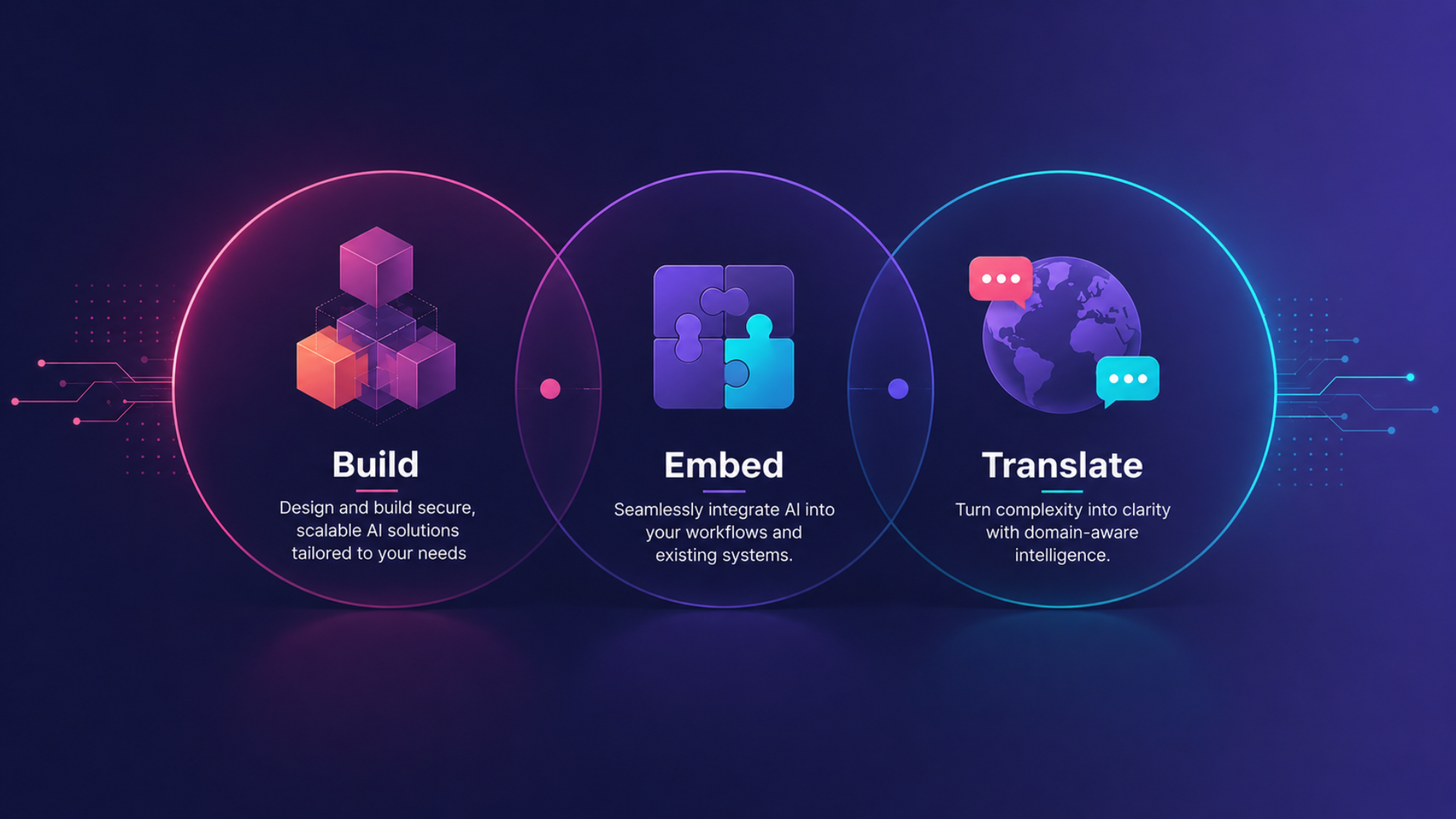
The role combines three distinct capabilities that are rarely found together in a traditional engineering hire.
Build. Forward deployed engineers are strong technical generalists, capable across code, data pipelines, cloud infrastructure, and AI application development. They are not narrow specialists who only work within one layer of the stack. A typical week might involve writing integration code against a client's ERP, building a retrieval pipeline against their internal documentation, and configuring deployment infrastructure, all for the same use case.
Embed. Unlike a remote delivery team, a forward deployed engineer works inside the client's environment, attends the client's meetings, and absorbs context that never makes it into a requirements document. This is what allows them to identify the real constraint behind a stated request, and to make judgment calls when the situation is ambiguous, which it almost always is in enterprise environments.
Translate. Perhaps the most underrated skill in the role is the ability to translate between business language and technical execution. A forward deployed engineer needs to understand why a finance team's approval threshold exists, not just that it exists, and to build a system that respects that constraint without needing it explained twice.
Forward Deployed Engineer vs Traditional Software Consultant
The two roles are often confused, but the operating model is fundamentally different.
A traditional software consultant typically works from a specification, delivers against a fixed scope, and hands off the finished system at the end of an engagement. A forward deployed engineer works inside the client's environment for the duration of the deployment, continuously adjusts scope based on what is actually discovered on the ground, and stays accountable until the system is genuinely in production and being used, not just delivered and signed off.
The distinction matters because most enterprise AI failures are not failures of technical capability. They are failures of context. A consultant who never sits inside the client's actual operating environment is structurally unable to catch the constraints that only become visible once you are working alongside the people who use the system every day.
Why This Model Is Growing Now
Three forces are converging at the same time.
AI capability has outpaced AI deployment capability. Models have become powerful enough to handle genuinely complex enterprise tasks, but most organisations lack the internal capability to integrate that intelligence into their actual operating systems, which is why the gap between pilot and production has become the defining bottleneck in enterprise AI.
Enterprises have learned, expensively, that buying a platform does not solve an integration problem. Many organisations have already run one or more AI pilots that demonstrated technical capability and then quietly stalled before reaching production. That experience has shifted buyer expectations toward vendors who can demonstrate they can actually deploy, not just demo.
And the talent required for this role is genuinely scarce. The combination of strong technical generalist skills, comfort with ambiguity, and the ability to operate inside a client's environment rather than a controlled internal one is rare, which is why every major AI lab is now competing to hire and build this capability internally.
What This Means If You Are Evaluating an AI Partner
If you are evaluating vendors or partners for an enterprise AI initiative, the presence or absence of a forward deployed engineering model is one of the clearest signals of whether that partner can actually get you to production.
Ask directly whether the team will be embedded inside your environment for the duration of the deployment, or whether you will be handed a specification and a delivery timeline from a remote team. Ask what happens when the pilot works technically but does not fit how your teams actually operate day to day. A partner with a genuine forward deployed engineering practice will have a direct, specific answer. A partner without one will describe a process instead.
How Vishleshan AI Approaches This
Vishleshan AI's forward deployed engineers work directly inside client environments across automotive, FMEG, financial services, and supply chain, taking AI from a named use case to a production deployment in 90 days. The model exists specifically to close the gap the MIT NANDA study identifies, the gap between a working pilot and a system that genuinely operates inside the business.
This is not a delivery methodology applied after the fact. It is the operating model from day one of every engagement.
Conclusion
A forward deployed engineer is not a rebranded consultant or a more senior version of a traditional delivery engineer. It is a distinct operating model, built specifically to solve the integration problem that causes the overwhelming majority of enterprise AI initiatives to stall before reaching production.
The enterprises that understand this distinction now, and evaluate AI partners accordingly, will spend less time running pilots that never go anywhere, and more time running AI that actually changes how their business operates.
Vishleshan AI's forward deployed engineers take AI from use case to production in 90 days. Book a Demo.