


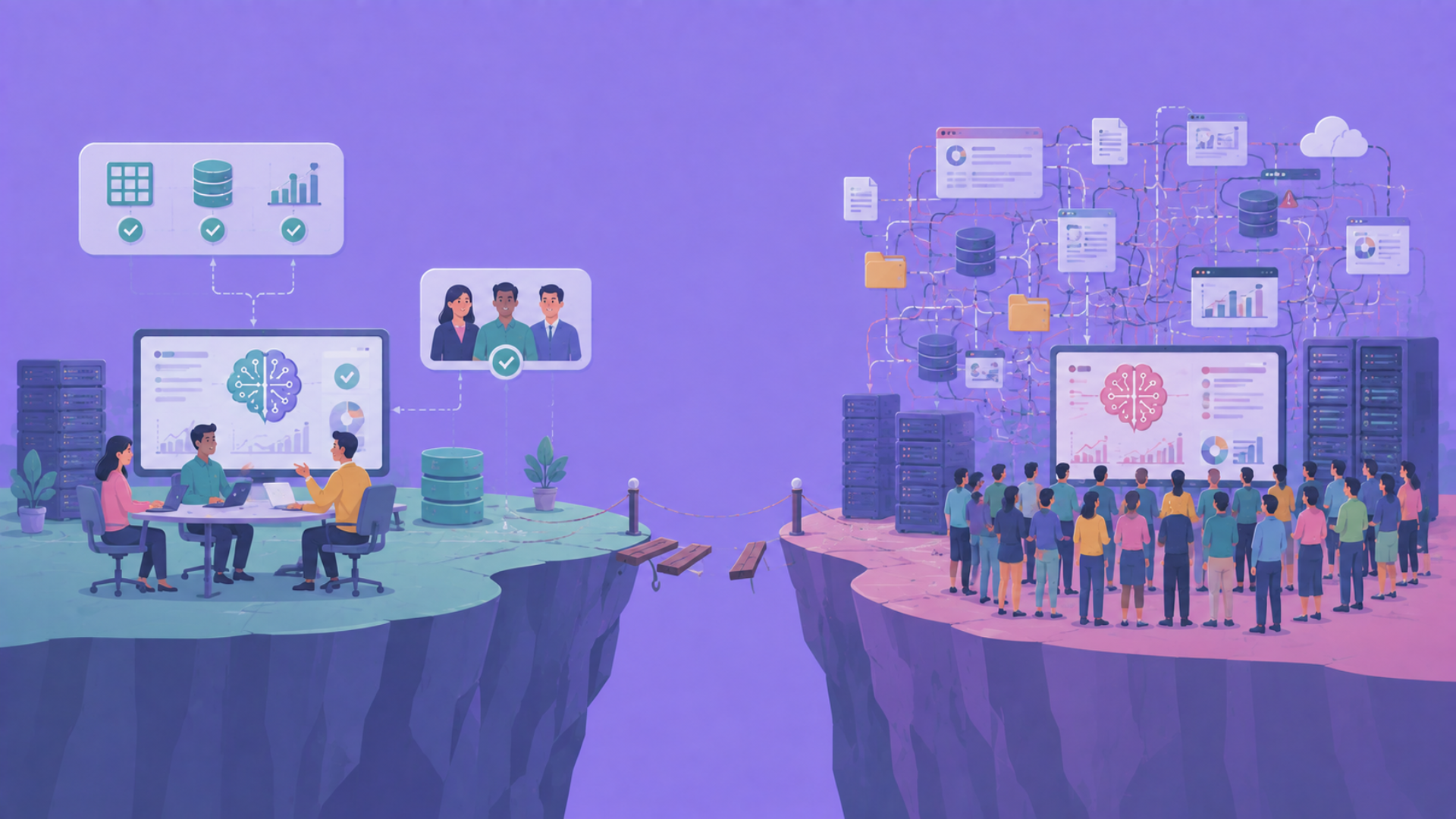
78% of enterprises have at least one AI pilot running. Only 14% have successfully scaled an AI agent to organisation-wide production use.
95% of generative AI pilots deliver zero measurable return. Not low return. Zero.
$547 billion of the $684 billion invested in AI in 2025 failed to deliver the intended business value.
These numbers do not suggest a technology problem. The models work. The demos are impressive. The use cases are real.
They suggest a deployment problem. And the deployment problem starts with how most organisations think about what a pilot is for.
What an AI Pilot Actually Is
An AI pilot, also called a proof of concept or PoC, is a small-scale test of an AI system before committing to full production deployment. The idea is sound. Test before investing fully. Validate the assumption. Learn before scaling.
A well-designed pilot tests whether the AI can do the thing it is supposed to do. It involves a limited group of users, a controlled environment, and a defined period of evaluation.
The problem is that most AI pilots are designed to succeed in conditions that do not exist in production.
The pilot runs on curated data. Clean, structured, complete. The production environment runs on the actual data that the organisation has. Inconsistent, incomplete, partially structured across systems that were never designed to share it.
The pilot bypasses legacy systems. It connects to a sandbox environment, a test instance, or a fresh database. The production environment requires integration with the ERP that has been running for fifteen years, the CRM that has been customised twelve times, and the authentication system that controls access to everything.
The pilot operates with a small, technically engaged user group. People who volunteered or were selected because they are comfortable with new technology. The production environment serves the full workforce. Including people who are not comfortable with new technology, who have no reason to change how they currently work, and who will find workarounds if the AI adds friction.
When the pilot meets production, it encounters a different world from the one it was designed for. In most cases, it fails quietly.
The Five Reasons AI Pilots Do Not Reach Production
1. No defined business outcome before the build started
The most consistent cause of pilot failure across multiple research bodies is the absence of a measurable business objective from day one.
Without a specific outcome to achieve, there is no forcing function to complete the journey from pilot to deployment. The pilot becomes a permanent experiment. It generates learning but no production system. The stakeholders who approved it move on to the next initiative. The AI team moves to the next pilot.
The organisations that make it to production define the business metric before the first line of code is written. Not "improve efficiency." A specific number. A specific process. A specific date by which the number should have moved. That specificity is what keeps the initiative anchored to a real outcome rather than drifting into indefinite exploration.
2. The integration layer was underestimated
The pilot connects to clean data in a test environment. Production requires connecting to the actual ERP, the actual CRM, the actual authentication system, the actual approval workflows.
MIT's research found that internal AI builds fail at twice the rate of vendor-led solutions. The gap is not engineering talent. It is the compounding complexity of connecting AI to the actual systems of record that enterprise operations run on.
This integration is harder than it looks. The ERP behaves differently under production load than in a test environment. The data structure in one field has been customised in a way not documented anywhere. The approval workflow exists in practice but not on paper. These are discovered only by working inside the actual environment, not by building against a specification.
Production infrastructure also costs significantly more than pilot infrastructure. Production generative AI deployments typically run 3 to 5 times the initial cost projection. The business case that was approved on pilot economics does not survive contact with production economics.
3. No ownership structure for after the pilot
Pilots are exploratory. Multiple stakeholders are involved. Accountability is spread across a committee. Decisions about the system's behaviour are made by consensus.
Production requires a named owner. Someone with the authority to make decisions, the accountability for outcomes, and the mandate to resolve the cross-functional conflicts that arise when AI starts touching live operational processes.
The talent market for enterprise AI product owners, people who combine technical understanding of AI systems with genuine business understanding of the process being automated, is competitive and supply is short. Organisations that have not developed this capability internally face a specific bottleneck at the transition from pilot to production.
4. The data foundation is not production-ready
Gartner estimates that 60% of AI projects lacking AI-ready data will be abandoned. That rate already stands at 42% of US companies.
The data that fed the pilot was prepared specifically for the pilot. It was cleaned, structured, and validated. The data that will feed the production system is the data the organisation actually has. Which is different.
Discovering the data quality gap during production deployment rather than before it causes delays, cost overruns, and the kind of unreliable AI outputs that erode user trust before adoption can take hold. Data readiness work done before the pilot accurately reflects what production will require is the preparation investment that most enterprises skip.
5. Change management was not part of the plan
AI reaches production when people use it. Not when it is technically deployed. Not when it passes user acceptance testing.
The field technician who has managed their job queue using WhatsApp for three years does not automatically switch to the new AI platform because it was launched. The procurement manager who has been running the supplier approval process from a spreadsheet does not immediately trust AI-generated recommendations because the system went live.
Change management, which includes understanding how people currently work, designing AI that fits into that workflow rather than replacing it, and building the trust that drives adoption, is consistently underinvested in pilot-to-production transitions. It is treated as a communications task rather than a design requirement. The organisations that reach production at meaningful adoption rates treat it as part of the technical design from day one.
What the 14% Do Differently
The organisations that successfully scale AI pilots to production share three observable characteristics, consistent across multiple research bodies.
They define production success before writing the first line of code:
The metric, the timeline, the ownership, and the measurement methodology are established before the pilot begins. The pilot is designed to test the assumptions that underlie the production business case, not to demonstrate that the AI can perform in a controlled environment.
They build the pilot at production-shaped conditions:
Real data where possible. Real system integrations where possible. A user group that includes people who are not early adopters. Realistic load and edge cases. The pilot that looks like production reveals the production problems before they become production costs.
They assign clear operational ownership before the pilot ends:
The transition from pilot to production does not happen without someone who owns it. That person has the authority to make decisions, the accountability for the production outcome, and the mandate to persist through the cross-functional friction that production deployment creates. They are identified before the pilot concludes, not after it succeeds.
What This Means for Enterprise Leaders
The pilot is not the problem. Testing before committing fully is sensible. The problem is testing in conditions that do not reflect the challenge you are actually trying to solve.
A pilot that runs on clean data and bypasses legacy systems is not testing whether your AI programme will work. It is testing whether AI can work in a controlled environment. That question has been answered. AI can work in controlled environments. The harder question is whether it will work in yours.
The most effective way to answer that question is the forward deployed engineering (FDE) approach. Engineers embedded inside the actual operating environment from day one. Building against real data, real systems, and real operational constraints. Discovering the integration complexity, the data quality gaps, and the organisational dynamics that determine whether the AI will be adopted. Before those discoveries become production failures.
The pilot that is designed to succeed tells you nothing about production. The engagement that starts with the production environment tells you everything.
Vishleshan AI does not run pilots designed to succeed in controlled conditions. Our forward deployed engineering (FDE) approach starts inside the client's actual environment. We discover the real constraints before committing to an architecture, not after. The result is AI that reaches production rather than AI that generates impressive demonstrations. Book a Consultation