


Poor quality costs manufacturers between 5 and 20% of annual revenue. For a manufacturer with $500 million in annual revenue, that is between $25 million and $100 million per year in scrap, rework, warranty claims, and customer complaints.
Most of it is preventable. And most of it is still being managed with quality control approaches designed in the 1990s. End-of-line inspection. Statistical sampling. Manual visual inspection by inspectors who cannot maintain consistent attention across a full shift.
AI quality control in manufacturing has moved from a pilot technology to production infrastructure in 2026. OEMs that have deployed it are reporting average savings of $180,000 per production line annually from quality inspection alone. BMW reduced defect rates by 30% within a year of implementing AI vision systems across its production facilities. AI detection accuracy consistently exceeds 99%. Human inspectors under sustained production conditions achieve 80 to 90%.
The gap between those numbers is where quality cost lives. Here is what OEMs are deploying to close it.
From Sampling to 100% Inspection
The most significant structural change that AI brings to manufacturing quality control is the shift from sampling to 100% inspection.
Traditional quality control inspects a sample of production output. A percentage of units are pulled from the line and inspected in detail. The rest are assumed to meet specification based on the sample results.
This approach has a fundamental statistical limitation. A defect that affects 2% of production will be caught in approximately 2% of sample inspections. The 98% of defective units not sampled pass through. They become warranty claims, customer complaints, and dealer service costs.
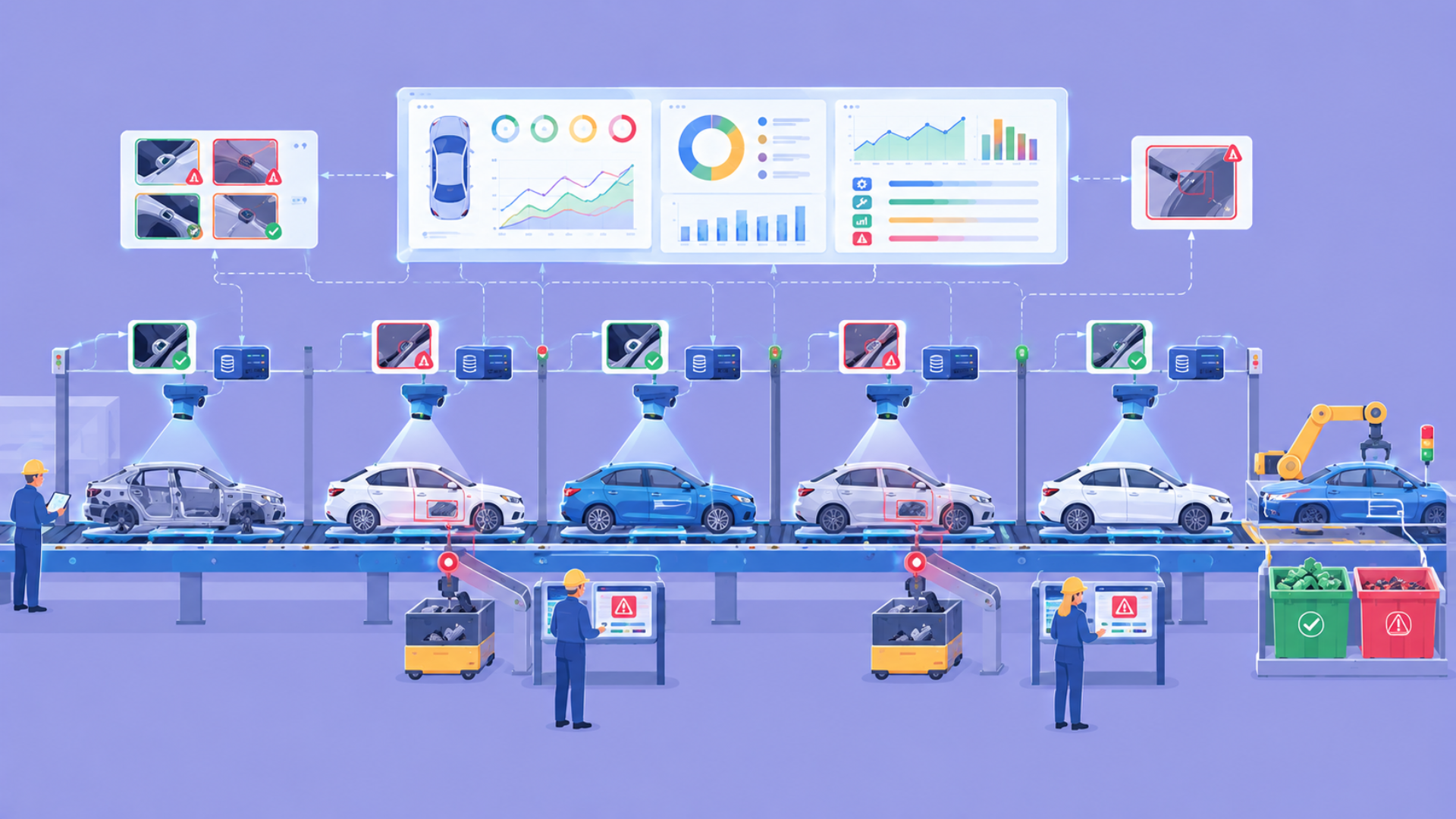
AI vision systems mounted inline on the production line inspect every unit at line speed. Not a sample. Every unit. The consistency of AI inspection means the 2% defect rate becomes visible and addressable from the first production shift the system operates.
The economics of 100% inline inspection compound over time. Defects caught inline before the unit moves to the next station cost a fraction of defects caught at end-of-line. Defects caught at end-of-line cost a fraction of defects that reach the customer. Moving the detection point earlier in the production process is where the majority of quality cost reduction comes from.
The Four AI Quality Control Capabilities OEMs Are Deploying
1. Inline visual defect detection
This is the most widely deployed AI quality control application and the one with the most documented returns. AI vision cameras mounted above production line inspection stations process images at line speed. Deep learning models trained on thousands of labelled defect images classify each unit as pass or fail and identify the specific defect type when a failure is detected.
The models handle variation in ways that rule-based machine vision systems cannot. Lighting changes across shifts. Product colour and surface finish variation. New product variants that differ slightly from the training data. Deep learning models learn the patterns that define defects rather than following rules that were programmed in advance. They adapt to normal variation while maintaining sensitivity to genuine quality failures.
Bosch deployed AI quality control to standardise inspection globally. Siemens trained AI models on thousands of component images to flag anomalies automatically. The pattern across large OEM deployments is consistent: the first production year typically shows a 25 to 35% reduction in scrap and rework, with the reduction compounding as the model improves on production data.
2. Predictive quality using process and sensor data
Visual inspection detects defects after they have formed. Predictive quality uses process data and sensor readings to identify conditions that will produce defects before those defects materialise.
Machine learning models trained on historical production data learn the correlations between process variables and quality outcomes. A specific combination of temperature, pressure, line speed, and material batch characteristics correlates with a specific defect type. When those conditions appear on the production line, the model flags the risk before the defect occurs.
The commercial value of predictive quality is in the interruption of the defect cycle at source rather than at the inspection gate. Catching a defective unit inline saves the rework cost. Preventing the defective unit from forming saves the materials cost, the energy cost, and the production capacity consumed by a unit that will never reach the customer.
Smart sensors and IoT devices generate continuous data streams across the production lifecycle. AI processes these streams in real time, monitoring micro-level changes in process variables that precede quality deviations. Operations teams receive alerts before the deviation produces visible defects.
3. Statistical process control augmented by AI
Statistical process control, monitoring production processes to detect when they are drifting outside specification limits, has been a standard quality management tool for decades. Traditional SPC requires human analysts to review control charts and identify developing trends.
AI augments SPC in two ways. First, it monitors all process variables simultaneously rather than the subset that an analyst team can track manually. A production line with 200 process parameters generates too much data for a human team to monitor in real time. AI monitors all 200 continuously.
Second, AI identifies correlations between process variables that statistical SPC cannot. A deviation in one variable may be inconsequential on its own. The same deviation in combination with a specific state of three other variables may reliably precede a quality failure. AI learns these multivariate patterns from historical data. Traditional SPC misses them.
4. Agentic quality control
The most advanced quality AI deployments in 2026 have moved beyond detection and prediction into autonomous action. Agentic quality systems detect a quality issue and initiate the response without waiting for human intervention.
A vision agent monitoring paint quality detects a recurring defect pattern. It identifies the pattern as correlating with a misaligned robot nozzle. It triggers a correction to the robot's calibration parameters automatically. The correction happens before the next production cycle generates another defective unit.
A predictive quality model identifies incoming material from a specific supplier batch as high-risk for a specific defect type. It automatically adjusts the inspection sensitivity for units produced with that material. The quality team is alerted to the high-risk batch. Increased inspection catches defects that would otherwise escape standard inspection protocols.
Agentic quality control requires the integration between the AI system and the production control systems where corrective actions are executed. The AI detects and decides. The production control system acts. Without that integration, the AI generates alerts that humans then act on manually, which is an improvement but not the closed loop that agentic quality delivers.
What Good Deployment Looks Like
The OEMs generating the strongest returns from AI quality control share a consistent deployment pattern.
They start with the highest-scrap production line rather than the easiest one. The easiest line to instrument is usually the one with the lowest defect rate and therefore the lowest quality cost. Starting with the highest-scrap line produces the most visible return, which builds the business case for subsequent deployments faster.
They integrate with the MES from day one. AI quality control that generates defect alerts which operators record manually on paper adds a step rather than removing one. Integration with the manufacturing execution system means defect data flows automatically to the quality management record, the production hold signal, and the root cause analysis process.
They track first-pass yield as the primary commercial metric. First-pass yield is the percentage of units that pass all quality gates on the first attempt without rework. AI quality control that detects defects earlier improves first-pass yield by preventing defective units from advancing to downstream processes where rework is more expensive. First-pass yield improvement translates directly to production capacity and cost reduction.
They retain human quality engineers for root cause analysis rather than for inspection. The role that AI eliminates is routine visual inspection. The role it creates is AI-augmented root cause analysis, where quality engineers use AI-generated defect data and process correlations to identify and eliminate the sources of quality problems rather than managing the consequences of them.
The IATF 16949 Compliance Dimension
Automotive OEMs and their Tier 1 suppliers operate under IATF 16949, the international quality management standard for automotive production. AI quality control creates both compliance requirements and compliance advantages.
The requirement: AI quality systems used as control points in the production process need to be documented, validated, and monitored under the IATF 16949 framework. Inspection records generated by AI systems need to be retained with the same traceability as manual inspection records. Model version changes need to be controlled and documented.
The advantage: AI quality systems generate complete, timestamped inspection records for every unit automatically. The audit trail that manual inspection produces inconsistently, depending on inspector diligence and documentation discipline, AI inspection produces consistently for every unit and every shift. IATF 16949 has no clause written specifically for AI vision, so auditors apply its existing measurement system principles. Repeatability, reproducibility, and detection capability need to be demonstrated, and the documentation should show how the model was validated and how changes are controlled.
For automotive OEMs and Tier 1 suppliers facing customer-specific requirements from OEM customers, AI quality systems that generate audit-ready records automatically can reduce the compliance overhead that manual quality documentation systems create.
Vishleshan AI's forward deployed engineering (FDE) approach builds AI quality control systems inside automotive and industrial manufacturing environments. We design inline inspection architectures for specific production conditions, integrate with MES and quality management systems to close the detection-to-action loop, and build the governance documentation that IATF 16949 and customer-specific requirements demand. Our manufacturing AI experience spans body shop, paint shop, assembly, and press shop applications across OEM and Tier 1 environments. Book a Consultation