


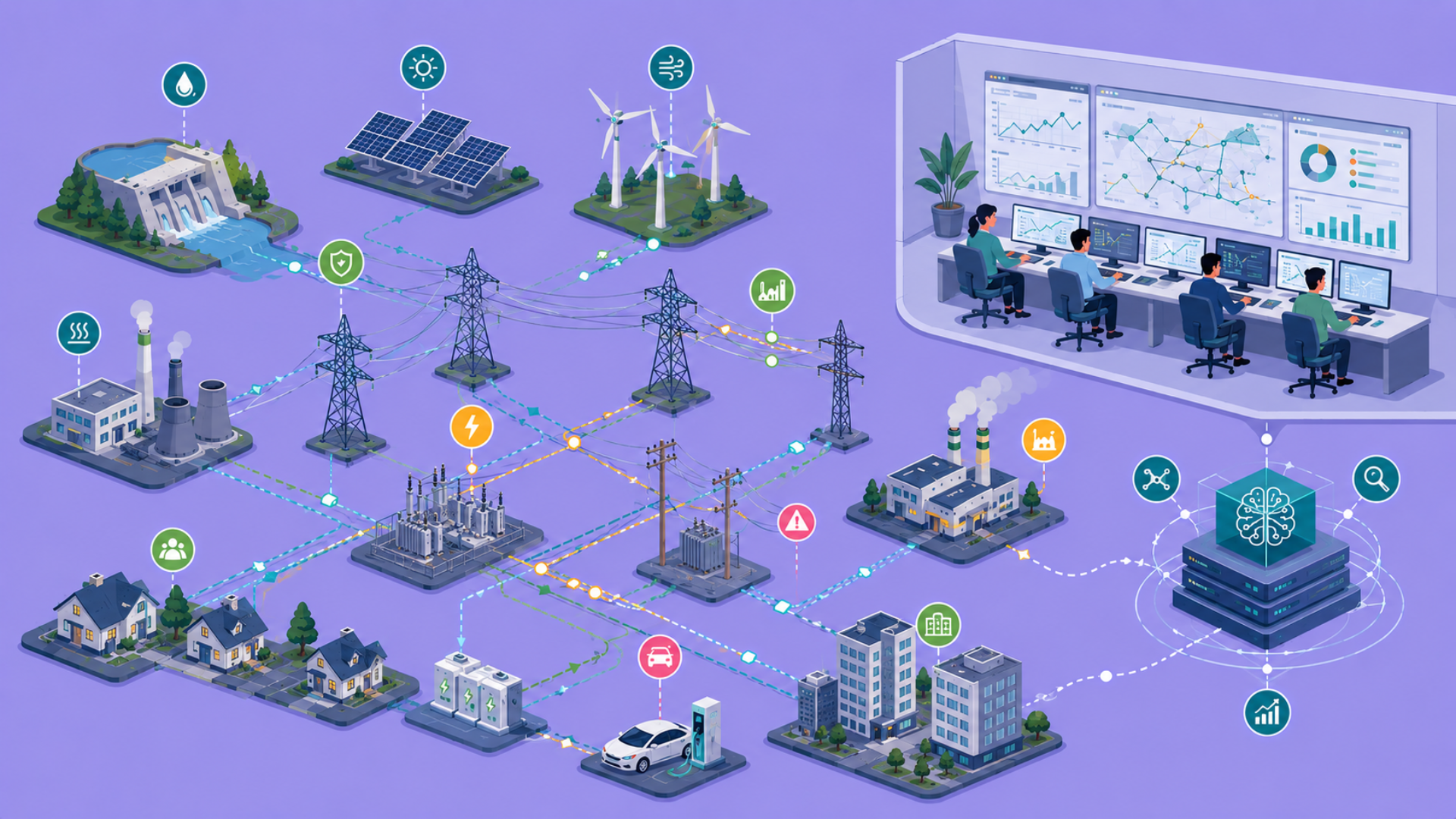
The energy sector in 2026 is under a convergence of pressures that makes the operational status quo untenable. Electricity demand in the United States is projected to grow at an average annual rate of 1.7%, with the commercial sector growing at 2.6% and the industrial sector at 2.1%. That demand is arriving from directions the grid was not designed to serve simultaneously: AI data centres requiring 176 gigawatts of capacity by 2035, electric vehicle charging infrastructure scaling across every major market, and industrial electrification driven by decarbonisation mandates.
The capital response to this demand — Deloitte counts more than $1.4 trillion needed through 2030, with roughly 2 terawatts of capacity sitting in interconnection queues, almost twice everything currently installed — is real and necessary. But capital programmes operate on decade-long timelines. The operational gap between what the grid currently delivers and what it needs to deliver is arriving faster than steel, copper, and permits can close it.
AI is one of the few operational levers that moves on a 12-month timeline rather than a decade-long capital programme. It does not replace the infrastructure investment. It makes the existing infrastructure perform significantly better while that investment is being made.
The AI in energy and utilities market is growing from $4.54 billion in 2026 to $9.18 billion by 2030 at a 19.2% compound annual growth rate. 94% of power and utility CIOs plan to increase AI investments, with average spending increases of 38.3%. The investment is accelerating because the returns, in the deployments that have reached production, are specific and measurable.
The Four Deployments Generating Documented Returns
Predictive maintenance and asset health monitoring
Predictive maintenance is the energy sector AI use case with the most accumulated deployment evidence and the most consistent return. The economics are straightforward: an unplanned outage at a power generation facility or on transmission infrastructure costs orders of magnitude more than the maintenance intervention that would have prevented it. AI systems that identify developing failures three to four weeks before they become unplanned outages are changing the economics of asset management across the sector.
The predictive maintenance return comes through two mechanisms. The first is the direct cost avoidance of prevented failures — the repair cost, the lost generation revenue, and the regulatory penalties for unplanned outages are all avoided when the failure is detected and addressed before it occurs. The second is the optimisation of planned maintenance scheduling AI systems that know the actual health condition of every asset in the network can schedule maintenance based on condition rather than calendar, extending the interval between maintenance activities for assets that are performing well and bringing forward interventions for assets showing early deterioration signals.
Predictive maintenance in energy deployments pays back in 12 to 18 months on average. Energy management AI more broadly reduces costs by 12 to 20%. These are not projected returns. They are reported outcomes from live deployments across utilities and large industrial energy consumers.
Gartner projects that 40% of power and utilities will deploy AI-driven operators in control rooms by 2027. The control room AI is not replacing operators. It is giving them access to pattern recognition across the full network that no human team can maintain manually — identifying the correlation between sensor readings that precede a failure and surfacing it for operator attention before the failure cascade begins.
Grid optimisation and demand response
Renewable energy integration is the operational challenge that is driving the most urgent AI investment in grid management. Renewable generation — solar and photovoltaic — is intermittent and increasingly dominant in the generation mix. Renewables are set to surpass coal-fired generation in 2026. Balancing a grid where generation variability is increasing requires a level of real-time optimisation that traditional grid management approaches cannot achieve.
AI systems managing grid dispatch in real time — continuously adjusting generation output, storage charging and discharging, and demand response signals to maintain grid stability as renewable generation fluctuates — are enabling higher renewable penetration without proportional investment in backup firm capacity. The International Energy Agency estimates that AI could reduce curtailment of renewable energy by up to 10% globally, which is significant given the scale of renewable investment currently in deployment.
Demand response is a specific application where AI is moving from analytics to autonomous action. AI systems that predict demand peaks, identify flexible load that can be shifted without customer impact, and automatically trigger demand response signals across commercial and industrial customers are reducing peak load requirements in ways that defer or eliminate the need for additional peaking capacity.
Energy forecasting and procurement optimisation
Large industrial and commercial energy consumers — manufacturers, data centre operators, large commercial real estate portfolios — face energy cost volatility that significantly affects their operational economics. AI forecasting systems that predict energy demand at the facility level, combined with AI-powered energy procurement that optimises the mix of contracted and spot market purchases, are generating measurable reductions in energy cost for large energy consumers.
The accuracy improvement that AI brings to energy demand forecasting is particularly significant for facilities with variable production schedules, where the relationship between production activity and energy demand is complex and the cost of procurement errors — buying too much at contracted prices or buying too little and paying spot rates — is directly visible in the P&L.
For utilities, AI demand forecasting at the grid level is improving the accuracy of capacity planning and reducing the frequency and magnitude of forecast errors that result in either excess capacity costs or reliability events. The combination of better demand forecasting and AI-optimised dispatch is changing the economics of grid operations in ways that flow through to both utility financial performance and consumer pricing.
Field workforce and asset management
The energy sector operates one of the largest field workforces of any industry. Lineworkers, technicians, engineers, and inspectors maintain infrastructure across enormous geographic areas, in conditions that range from routine to hazardous, on asset bases that are aging faster than they are being replaced.
AI applications in field workforce management for energy and utilities are following a similar trajectory to the applications in field service management for manufacturing and FMEG OEMs: AI-driven job allocation that matches skills and certifications to work requirements, predictive maintenance scheduling that prioritises field interventions based on asset condition rather than calendar, and mobile-first job management that works in the connectivity conditions that field crews actually encounter rather than the connectivity conditions that software designers assume.
GE Vernova's acquisition of Alteia to enhance AI tools for grid infrastructure monitoring and inspection is a specific signal that AI for grid inspection and situational awareness is being productised by major incumbents. Computer vision systems that analyse drone and satellite imagery to detect vegetation encroachment, conductor damage, and structural deterioration across transmission and distribution infrastructure are replacing manual inspection programmes that could not keep pace with the scale of the network being monitored.
The Operating Model Shift AI Is Enabling
The energy sector's AI trajectory in 2026 points toward a fundamental shift in how utility operations are managed — from periodic human-directed processes to continuous AI-monitored operations with human oversight at defined exception thresholds.
Deloitte's 2026 Power and Utilities Outlook describes this as AI enabling real-time optimisation of dispatch, asset performance, and outage response. The operational model that enables this is different from the operational model that most utilities currently run. It requires continuous data flows from connected assets, real-time integration between operational technology and information technology systems that have historically been kept separate, and governance frameworks that define what AI is authorised to do autonomously and what requires human authorisation.
The operational technology and information technology convergence is the infrastructure prerequisite that most utilities are investing in now. The sensors, communication networks, and data platforms that enable AI to see what is happening across the asset base in real time — rather than receiving periodic reports from disconnected systems — are the foundation without which the AI applications cannot perform at the level they are designed for.
This is the same data infrastructure prerequisite that enterprise AI deployment requires in every sector. The AI is only as good as the data it can access, and in energy and utilities the data is often locked in operational technology systems that were not designed to share it with analytics and AI platforms in real time.
The Specific Challenge of Regulated Environments
Energy and utilities is one of the most heavily regulated sectors in any major economy. AI deployments that affect grid operations, customer billing, or critical infrastructure management operate under regulatory frameworks that impose specific requirements on how AI decisions are made, documented, and audited.
The forward deployed engineering approach to regulated industry deployments applies directly to energy and utilities. Governance architecture built into the deployment from day one — audit trails, explainability documentation, human oversight mechanisms at defined decision thresholds — is what allows AI to operate within the regulatory framework rather than creating compliance exposure.
The utilities that are moving fastest on AI deployment have addressed this by building governance and regulatory requirements into the AI architecture specification before the build begins, rather than treating regulatory review as a post-deployment gate. The result is that deployments pass regulatory review without the rework cycles that are common when governance is retrofitted.
What the Next 18 Months Look Like
The energy sector AI investment trajectory is accelerating for reasons that are structural rather than cyclical. The demand growth from AI data centres and EV charging, the renewable integration challenge, the aging infrastructure maintenance backlog, and the workforce demographic shift as experienced engineers retire are all creating operational pressure that AI is uniquely positioned to address.
CenterPoint's $65 billion capital spending plan for 2026 to 2035, tied explicitly to load growth expectations from data centres and AI, is representative of the capital commitment being made across the sector. The AI operational layer that makes that capital investment perform better — by optimising existing assets, managing demand response, and enabling predictive rather than reactive maintenance — is being built in parallel.
The enterprises that are getting ahead in energy sector AI are not the ones waiting for the technology to mature further. The technology is mature enough. The constraint is the data infrastructure, the operational technology integration, and the governance framework that allows AI to operate reliably in a sector where reliability is measured in nines and failures have consequences that extend far beyond any individual organisation.
Vishleshan AI works with enterprises in the energy and utilities sector to deploy production AI across operations and supply chain, field service management, and asset and workforce intelligence, using forward deployed engineers who build AI inside client environments with the governance architecture that regulated operations require. Book a Consultation