


80% of retailers plan to increase AI investment in 2026. The average increase is 36 to 38%. That level of commitment reflects a genuine shift in how retail leadership views AI. Not as a technology experiment. As operational infrastructure.
Three forces are driving this simultaneously.
Consumer expectations have risen faster than manual processes can match. Shoppers expect personalised recommendations, seamless cross-channel experiences, and immediate support. Meeting these expectations at scale requires AI.
Supply chain volatility demands faster, more accurate decisions than traditional planning cycles allow. Tariffs, logistics disruptions, and demand shifts require inventory and fulfilment systems that can respond in near real time.
And AI shopping agents are beginning to reshape the fundamental question of how products get discovered and purchased. This last shift is the one with the most significant long-term implications for OEMs and consumer goods companies.
What Agentic Commerce Actually Means
The three retail AI trends highlighted at NRF 2026 were practical AI agents for retail operations, connected platforms enabling agentic commerce, and the continued relevance of physical stores as trust-building environments.
Agentic commerce is the most significant of these. It refers to AI systems making real-time decisions across retail operations independently. Not generating recommendations for humans to act on. Deciding, acting, and adjusting continuously.
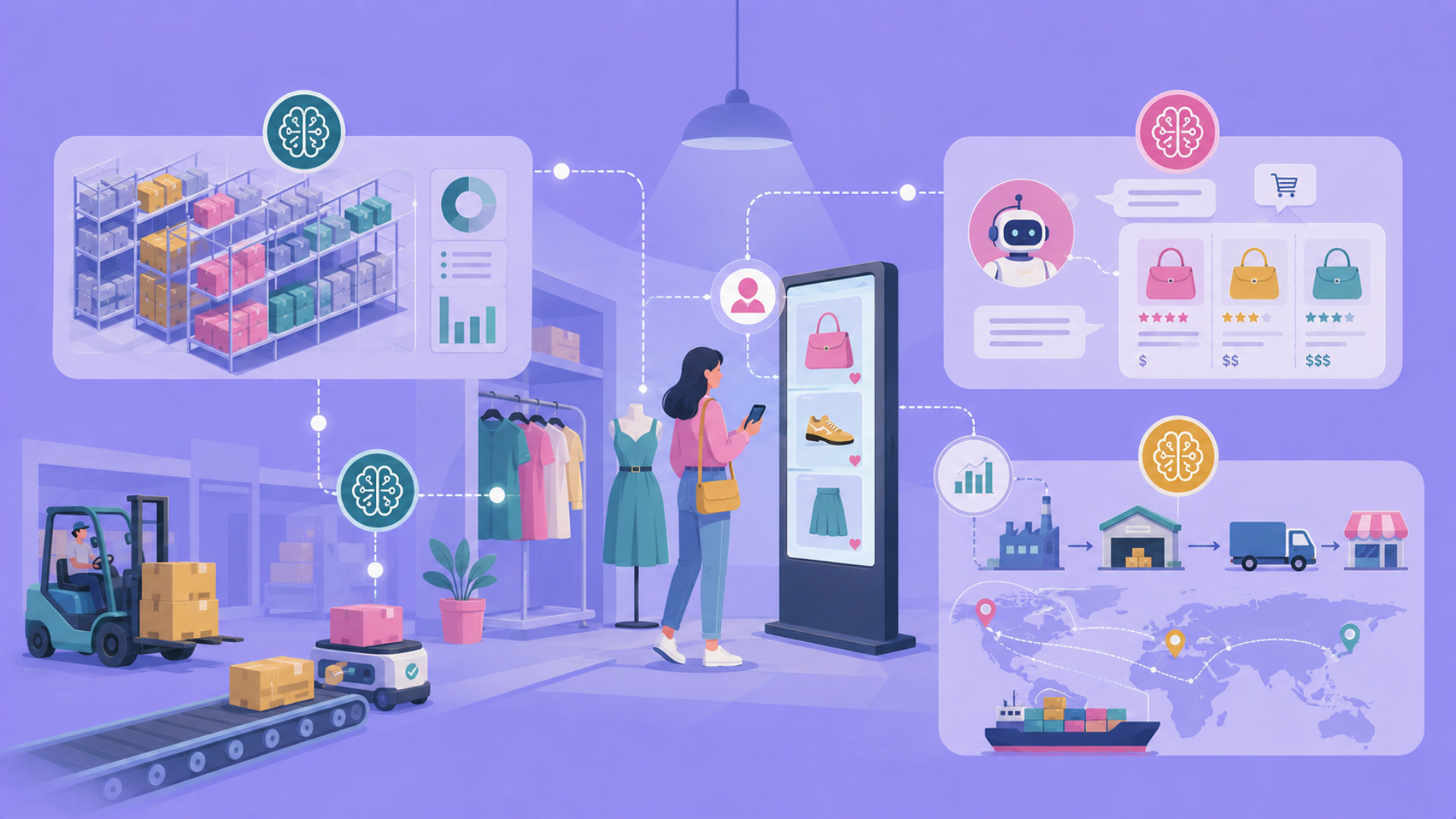
An agentic inventory system does not produce a weekly replenishment report. It monitors sell-through rates, weather forecasts, regional demand signals, and supplier lead times continuously. It adjusts stock positions across locations autonomously. It triggers purchase orders when thresholds are crossed. It reroutes shipments mid-transit when demand shifts.
An agentic pricing system does not produce a monthly price review document. It monitors competitor pricing, margin thresholds, demand elasticity, and promotional calendars continuously. It adjusts prices within defined parameters in real time.
An agentic customer service system does not route queries to a human for review. It resolves standard queries, initiates returns, tracks shipments, and escalates only when the situation genuinely requires human judgment.
These are not future capabilities. They are live in production at leading retailers in 2026. The gap between retailers running agentic systems and those still using periodic reporting is growing.
The AI Shopping Agent Shift That Changes Brand Visibility
The change with the most significant long-term implications for OEMs and consumer goods companies is not what is happening inside retail operations. It is what is happening in how consumers discover and buy products.
AI shopping agents are now mediating a growing share of product discovery. A consumer who asks an AI assistant to find the best washing machine under a certain budget does not see a page of search results or sponsored listings. They see a curated recommendation from an AI that has already compared options, read reviews, and applied the consumer's stated preferences.
The NRF Vice President who authored the retail trends piece for 2026 put it plainly: as shoppers rely more heavily on AI agents, brand visibility becomes upended. Whether a retailer or brand shows up in that recommendation depends on AI optimisation, not search engine optimisation or paid advertising.
This is a structural shift in how the retail funnel works. SEO and paid media have been the primary levers of brand visibility for two decades. AI optimisation is a different discipline. It depends on the quality, structure, and accessibility of the product data that AI agents query when they are building recommendations.
For OEMs and consumer goods companies, this means product data strategy is becoming a competitive asset. Brands with clean, structured, complete product data that AI agents can query reliably will appear in AI-generated recommendations. Brands without it will not, regardless of their advertising spend.
What Is Actually Changing in Operations
Demand forecasting and inventory optimisation
Retail demand forecasting has historically been based on historical sales patterns adjusted for known seasonal factors. This approach works well when conditions are stable. It breaks down when conditions change suddenly, which describes most of the retail environment in 2026.
AI forecasting systems incorporate external signals that traditional models ignore. Social media trends. Weather patterns. Economic indicators. Regional events. Competitor promotions. These signals, combined with historical patterns, produce forecasts that adapt to changing conditions rather than extrapolating from a past that may no longer be representative.
The inventory optimisation that follows from better forecasting reduces both stockouts and overstock simultaneously. Retailers running AI-powered inventory management are reducing inventory carrying costs while improving product availability. Both improvements flow directly to margin.
Personalisation at scale
Personalisation in retail is not new. What is new is the scale at which AI makes it operationally viable.
A retailer with 10 million customers cannot produce a personalised offer for each of them manually. AI systems that analyse purchase history, browsing behaviour, location, and contextual signals can generate personalised recommendations for every customer simultaneously. The system does not need a team to scale. It scales with the data.
For consumer goods OEMs whose products are sold through retail channels, this creates both an opportunity and a dependency. When the retailer's AI personalisation system favours a product, it drives volume. When it does not, the product becomes less visible even to customers who might have purchased it. Understanding how retailer AI systems make personalisation decisions is becoming part of channel management strategy.
Supply chain responsiveness
Retail supply chains are under more pressure in 2026 than at any point in the last decade. Tariffs, logistics disruptions, and demand volatility are compressing the time available to respond. Autonomous supply chain systems that can forecast demand, reroute shipments, and rebalance inventory across locations without waiting for a planning review cycle are generating measurable advantages in product availability and working capital.
For OEMs supplying into retail channels, this creates a pressure for data integration. Retail partners running autonomous supply chain AI need product data, availability signals, and lead time information in formats and cadences that their systems can consume in near real time. OEMs that can provide this data become better partners. Those that cannot become friction in the system.
What This Means for OEMs and Consumer Goods Companies
Retail AI transformation is usually discussed from the retailer's perspective. For OEMs and consumer goods companies whose products move through retail channels, the implications are equally significant.
Product data is now a channel management asset:
The AI systems that power retail recommendations, personalisation, and shopping agents operate on product data. The quality, completeness, and structure of that data determines how the AI represents the product. Investing in product data governance is no longer just a cataloguing exercise. It is a visibility strategy.
Channel intelligence requires real-time signals:
Understanding what is happening in retail channels — how products are performing, where inventory is building up, where stockouts are developing — has always mattered. The speed at which retail AI systems are now making decisions means that intelligence needs to be faster. Weekly sell-through reports are too slow when the retailer's inventory system is rebalancing daily.
The relationship between OEM and retailer is becoming a data relationship.
The OEMs that will have the strongest retail partnerships are the ones that can exchange data with retailer systems efficiently. This is the same data integration principle that governs AI in every other part of the value chain. The quality of the data connection determines the quality of the relationship.
The Physical Store Is Not Disappearing
One finding from NRF 2026 that is worth noting: the resurgence of physical stores as trust-building environments.
AI can personalise recommendations, manage inventory, and handle customer service queries. It cannot replicate the sensory experience of a physical store, the human expertise of a knowledgeable sales associate, or the trust that comes from a face-to-face interaction.
The retailers seeing the strongest results in 2026 are not the ones choosing between digital AI and physical stores. They are the ones using AI to make physical stores more productive and more personalised. AI-powered store associates who know what a customer has browsed online before they walk in. Inventory systems that ensure the store has the right products when the customer arrives. Customer service AI that handles routine queries so human associates can focus on the interactions that genuinely require human judgment.
Physical and digital are not competing channels in an AI-enabled retail environment. They are complementary touchpoints in a data-connected customer relationship.
Retail AI transformation affects OEMs and consumer goods companies as much as it affects retailers. The channel intelligence, product data strategy, and supply chain responsiveness required to perform well in an AI-driven retail environment are the same data and integration capabilities that forward deployed engineering (FDE) builds across Vishleshan AI's automotive, consumer electricals, and supply chain client engagements. Book a Consultation