


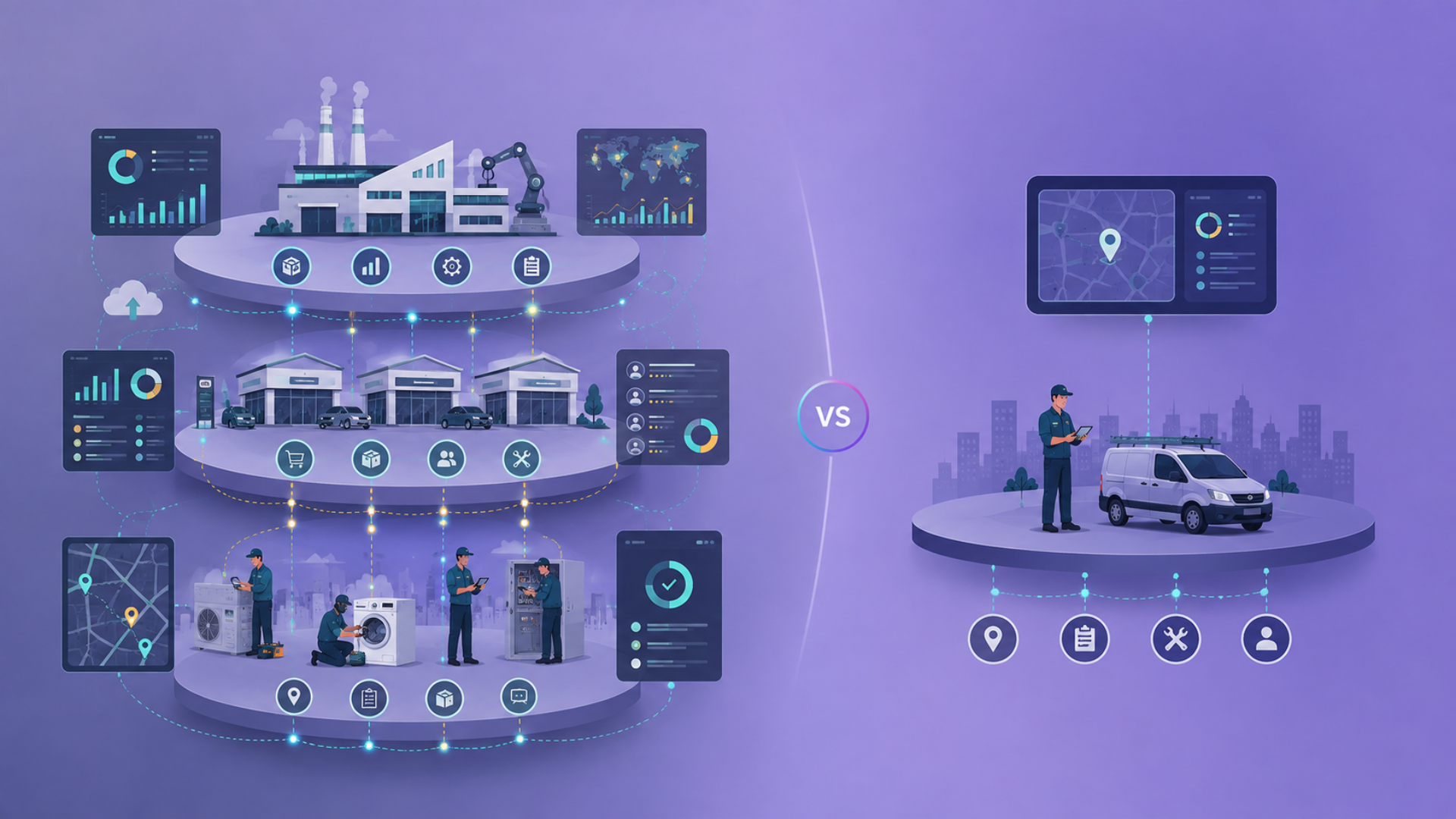
Field service management software coordinates the people, jobs, parts, and information that keep a service organisation running. At its core, FSM handles job scheduling and dispatch, technician management, work order tracking, parts and inventory, and customer communication. That definition fits almost every FSM platform on the market.
It also fits almost none of what makes OEM field service management actually hard.
The gap between what standard FSM software is designed to do and what OEM field service actually requires is the gap where most OEM FSM deployments fail. Understanding it clearly is the starting point for evaluating FSM solutions correctly.
What Standard FSM Is Designed For
Standard field service management software is built around a specific operating model: a company that employs its field technicians, controls its service scheduling centrally, operates in a relatively uniform job category, and manages its service operations within its own organisational boundaries.
In this model, the platform knows every technician because they are employees. It controls scheduling because the company owns the dispatch function. The job types are consistent enough that a configurable workflow handles most of them. The data model is clean because it comes from a single organisation's systems.
This model describes a facilities management company, a utilities service business, an HVAC contractor, or a technology hardware support organisation. It does not describe an automotive OEM managing warranty service through a national dealer network, or an consumer electricals manufacturer coordinating product repairs through a mix of authorised service centres, dealer-employed technicians, and doorstep mechanics.
What OEM Field Service Management Actually Is
OEM field service management has three characteristics that standard FSM platforms are not architected to handle.
Indirect technician networks:
An OEM does not employ most of the technicians who service its products. They work through dealer networks, authorised service partners, and in some cases independent mechanics who are certified but not employed. The FSM platform cannot assume it knows these technicians the way it knows employees. It needs to manage technician onboarding, identity verification, certification tracking, and performance monitoring across an indirect network where the data is less controlled and the relationships are more complex.
We helped a leading consumer electricals OEM deploy our FSM product Technician Plus across 9,500 technicians in exactly this model, with AI-verified technician identity from uniform check at job start through to photographic job completion. That capability did not exist in any standard FSM platform because standard platforms assume the technician is an employee whose identity and location are already known.
Multi-tier channel complexity:
Standard FSM connects a company directly to its technicians. OEM FSM connects a manufacturer to dealers, dealers to service centres, service centres to technicians, and all of them to customers — with different data, different permissions, different financial relationships, and different performance requirements at each tier.
The job card in an OEM service context is not a work order. It is a document that connects the customer's warranty status from the manufacturer's ERP, the dealer's parts inventory, the technician's certification, the service SLA, and the payment terms across potentially three different commercial relationships — manufacturer to dealer, dealer to service centre, service centre to technician — into a single transaction that needs to be resolved correctly and auditably the first time.
No standard FSM data model was designed for this. The OEMs that have built platforms that work at this complexity have either built custom solutions or deployed platforms that were designed specifically for the OEM-dealer-technician operating model.
ERP integration as a real-time requirement, not a sync feature:
Standard FSM platforms offer ERP integration. In most cases that integration is a scheduled data sync: job records flow out to the ERP and master data flows back on a defined cycle. This works when the FSM and ERP are genuinely parallel systems that periodically align.
It does not work when the field service transaction needs ERP data in real time to make a decision. A technician arriving at a customer site who needs to verify warranty coverage before starting work cannot wait for the next sync. A parts request that needs to check live inventory across three dealer locations and trigger an order if stock is insufficient is not a sync problem. It is a real-time integration problem that sync architecture cannot solve.
OEM FSM platforms that work in production treat ERP integration as an architectural requirement from day one, as covered in detail in why field service software fails at enterprise scale. The ERP is the system of record. The FSM reads from it and writes to it in real time through governed interfaces, making real-time warranty checks, real-time parts verification, and real-time job closure all possible within a single transaction.
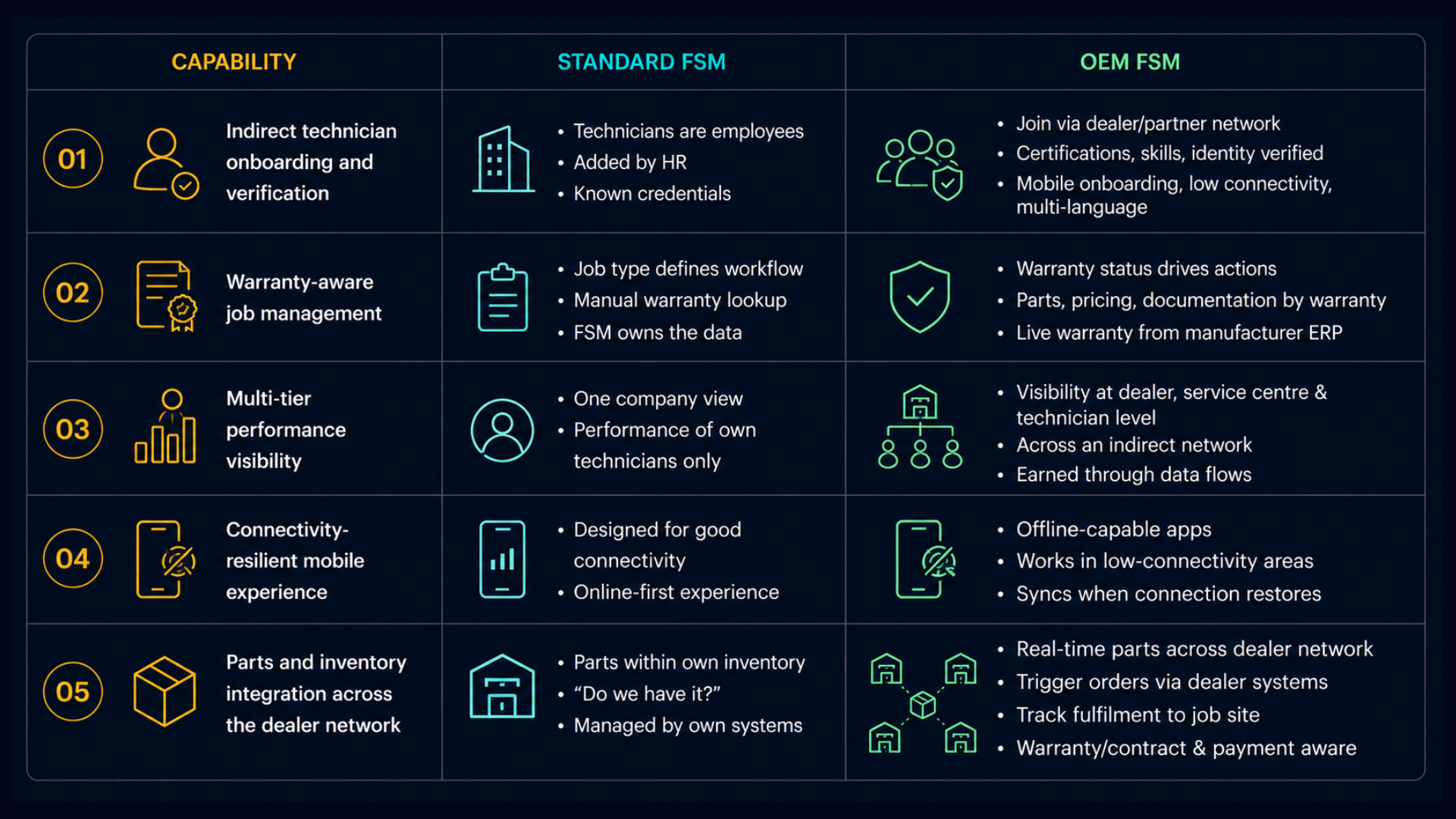
The Five Capabilities That Standard FSM Lacks for OEM Deployment
1. Indirect technician onboarding and verification
Standard FSM: Technicians are employees added by HR with known credentials.
OEM FSM requirement: Technicians join through dealer or partner networks with certifications that need to be verified, skill levels that need to be assessed, and identities that need to be confirmed at the point of job acceptance. Onboarding needs to work on mobile, in low-connectivity environments, across multiple languages, without assuming a desktop or a formal HR process.
2. Warranty-aware job management
Standard FSM: Job type determines the workflow.
OEM FSM requirement: Warranty status determines what the technician can do, what parts they can use, how the job is priced across different commercial relationships, and what documentation is required for the manufacturer's audit trail. Warranty logic needs to be live, not looked up manually, and it needs to come from the manufacturer's ERP rather than from a standalone FSM database.
3. Multi-tier performance visibility
Standard FSM: One company's performance across its own technicians.
OEM FSM requirement: The manufacturer needs visibility into performance at the dealer level, the service centre level, and the individual technician level simultaneously, across a network they do not directly control. That visibility needs to be earned through data that flows from the dealer's systems and the technician's mobile interactions, not assumed from a managed employee database.
4. Connectivity-resilient mobile experience
Standard FSM: Mobile apps designed for technicians with reliable smartphone connectivity.
OEM FSM requirement: Mobile applications that work in tier-two and tier-three cities, industrial environments, and semi-rural areas where connectivity is intermittent. Offline-capable job management that syncs when connectivity is restored is not a feature enhancement for OEM deployments. It is a prerequisite for the platform to function where the technicians are.
5. Parts and inventory integration across the dealer network
Standard FSM: Parts management within the company's own inventory.
OEM FSM requirement: Real-time parts availability checking across multiple dealer inventory locations, with the ability to trigger orders through dealer procurement systems when stock is insufficient and track fulfilment through to the technician's job site. The parts question in OEM service is not "do we have it" but "which dealer has it, can it reach the technician before the job, and who pays for it under what warranty or service contract terms."
What to Look For When Evaluating FSM for an OEM Deployment
Four questions cut through vendor claims quickly when evaluating FSM platforms for an OEM context.
1. Has the platform been deployed in an OEM-dealer-technician network?
Not in a similar industry. In the specific operating model of a manufacturer managing service through an indirect dealer and partner network. Reference deployments in this model are the most direct evidence that the platform was built for the right problem.
2. How does warranty logic integrate with the ERP?
Ask specifically whether warranty status is checked in real time from the ERP at job acceptance, or whether it is synced periodically into the FSM database. The answer tells you whether the integration architecture was designed for OEM service or for a simpler use case.
3. How does the platform handle technicians who are not employees?
Ask how technician onboarding, certification verification, and identity confirmation work for technicians who join through dealer or partner networks rather than through an internal HR process. The answer reveals whether the data model was designed for indirect networks or for employed workforces.
4. What does offline functionality actually cover?
Ask what the technician can and cannot do when connectivity is unavailable. A platform that offers offline viewing of job details but requires connectivity to complete a job, verify a warranty, or raise a parts order is not offline-capable for OEM deployment purposes. The offline capability needs to cover the full job transaction, not just the information retrieval.
Why This Matters for How You Build Your Evaluation Shortlist
The FSM platform market in 2026 is large, well-funded, and full of capable solutions for the problems they were designed to solve. The majority of those solutions were designed for employed workforces executing defined job types in relatively controlled operating environments.
OEM field service management is not that problem. It is an indirect network management problem, a real-time ERP integration problem, a multi-tier channel visibility problem, and a mobile-first low-connectivity problem simultaneously.
Evaluating standard FSM platforms against OEM requirements produces a shortlist of platforms that will configure to meet most requirements in a demo and fail to meet them in production. The evaluation shortlist for an OEM deployment should start with platforms that have been deployed in the OEM-dealer-technician model, not with platforms that have the largest market share or the most features in a standard FSM evaluation.
Vishleshan AI's Technician Plus was built for the OEM-dealer-technician operating model. It integrates with existing ERP in real time, handles indirect technician networks at scale, and has been deployed at Fortune 500 OEM scale across automotive and consumer electricals service operations. Our forward deployed engineers deploy it inside client environments until it is genuinely live in production. Book a Consultation