


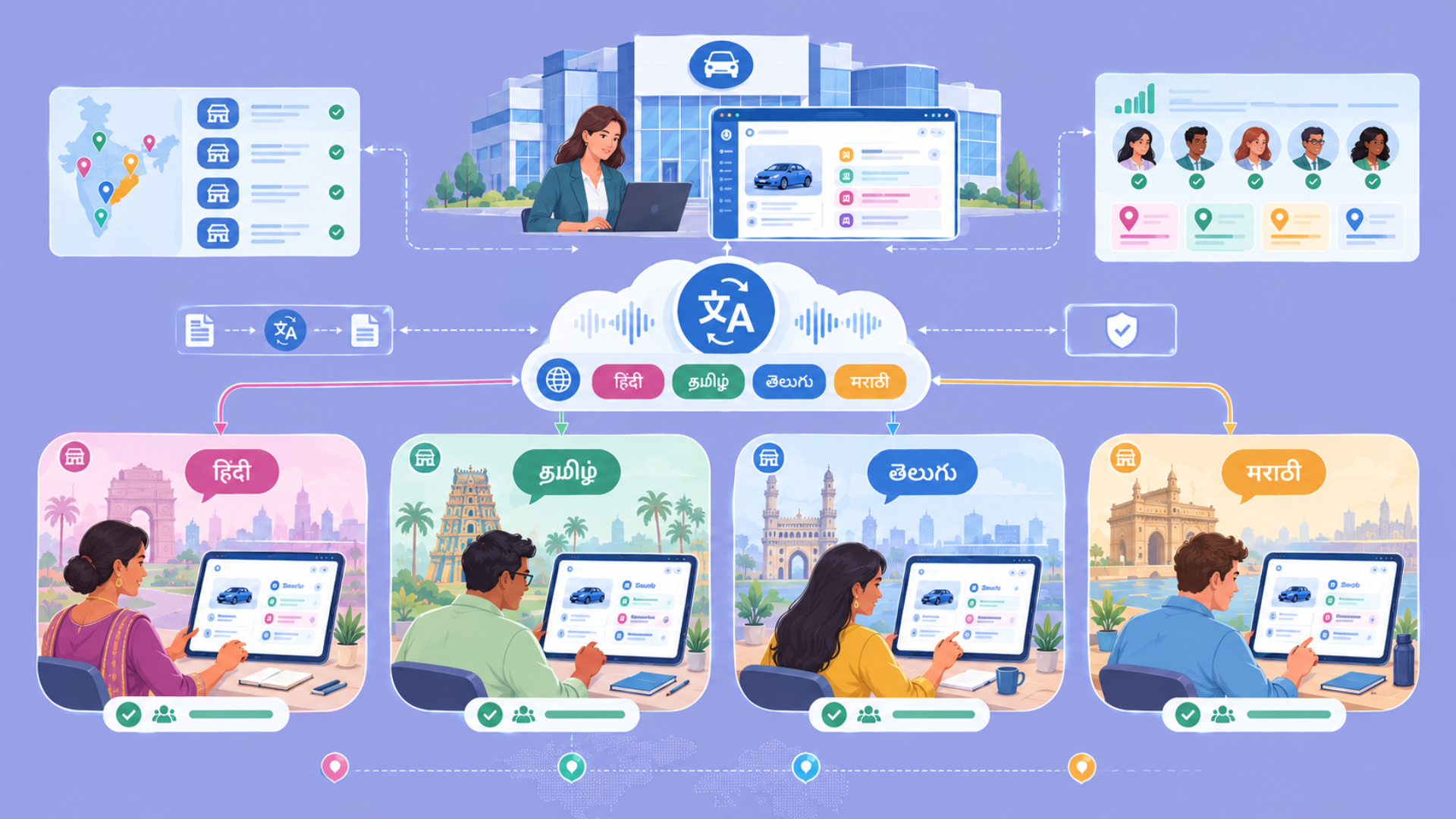
A manufacturer with a dealer network across India operates in a country where more than 20 languages are spoken as first languages across different states. The portal that carries scheme information, product updates, support content, and training materials is built in English.
English is the commercial language of the enterprise. It is not the first language of a large proportion of the dealer network. Dealers and distributors in Tamil Nadu, Maharashtra, Gujarat, Karnataka, and Kerala are navigating a portal in their second or third language to access information that directly affects their commercial decisions.
The result is predictable. Dealers who are not comfortable in English call the support team instead of finding answers in the portal. They engage less with scheme communications. They miss scheme activations because the notification did not land clearly. They delay training completions because the content is harder to absorb in a non-native language.
Language is not a minor accessibility issue in dealer and distributor management. It is a direct driver of partner engagement, scheme participation, and the return on investment the manufacturer gets from the technology it has built.
The Commercial Cost of a Single-Language Partner Portal
The connection between language accessibility and commercial performance in dealer networks is specific and measurable.
Scheme participation is lower among dealers who do not engage regularly with the portal. The dealers who engage least are disproportionately those for whom the portal language is not their first. They understand the scheme exists. They do not engage with it in depth because the effort required to navigate the portal in a non-native language exceeds the perceived short-term benefit.
Support call volume is higher from regions where the portal is less accessible. Dealers who cannot find what they need in the portal call the support team. Each support call costs more than a portal self-service interaction. Across a large dealer network, the aggregate cost of redirected support is material.
Training completion rates are lower among dealers who find the content harder to absorb in a second language. This matters because trained dealers sell more effectively. They know the product range. They can answer customer questions confidently. They recommend the right product for the customer's need. A training programme that does not reach the full dealer network is an investment that is delivering a fraction of its potential return.
New scheme activation is slower in regions where communication clarity is lower. A scheme that activates in the first week across Hindi-speaking markets but takes three weeks to achieve the same participation rate in Tamil-speaking markets is losing commercial momentum in those regions. The timing difference is not indifference to the scheme. It is the friction of processing scheme information in a non-native language.
Why Separate Language Versions Are Not the Answer
The instinctive response to this problem is to build the portal in multiple languages. A separate version in Hindi, Tamil, Telugu, Marathi, and so on. Each version maintained and updated as the portal evolves.
For some enterprises this is what happens. The investment is significant and the outcome is typically worse than anticipated.
The portal content changes regularly. New schemes are announced. Product information is updated. Support content is revised. Each change in the primary language version needs to be replicated across every language version. The content team that was already stretched now has a multiplication of their workload across every language supported. Updates take longer to reach all language versions. The portal in the primary language is current. The portal in regional languages is always weeks or months behind.
The developer overhead compounds this. Each language version is a separate deployment. When a new feature ships, it ships to the primary language version first and to other versions later. Partners in regional language markets consistently see an older version of the product than partners in the primary language market.
Over time, the separate version approach produces exactly the problem it was supposed to solve: partners in some markets receiving a materially worse experience than partners in others, with the language divide mapping onto the quality divide.
The Real-Time Translation Architecture That Solves Both Problems
The alternative is a translation layer that operates on the single portal version, rendering content in each user's language in real time without a separate build.
The portal team maintains one codebase. One deployment. One update cycle. When a new scheme is announced, the scheme information appears in the portal and is immediately available in every supported language. When a product page is updated, the update is immediately visible to every partner regardless of their language setting. There is no replication lag and no version gap between language markets.
The partner experience is the same portal in their preferred language. The same design. The same navigation. The same content, current and complete. The only difference is the language in which it is displayed.
This is what Vidura Translate delivers for dealer and distributor portal deployments. It operates as an agentic AI layer between the portal and the partner, detecting content as it loads, routing it through the translation engine, and rendering the translated content in place before the partner sees it. The portal has no separate versions. The manufacturer's technology team maintains one system.
Where This Applies Across Dealer and Distributor Operations
Scheme and incentive portals:
Scheme information, targets, progress tracking, and redemption interfaces render in each dealer's language. Scheme communications land clearly. Participation rates improve across linguistically diverse regions.
Product and training content:
Product specifications, installation guides, technical documentation, and training modules are accessible in the language the technician or dealer is most comfortable learning in. Training completion rates improve. Product knowledge across the dealer network deepens.
Support and self-service content:
FAQs, troubleshooting guides, warranty information, and service procedures are available in regional languages. Dealers find answers in the portal rather than calling the support team. Support call volume from self-serviceable queries reduces.
Order management and commercial interfaces:
Order placement, inventory checking, and account management interfaces operate in the partner's language. Commercial transaction friction reduces for partners operating in a non-native language.
Distributor management systems:
For manufacturers with a tier-one distributor layer above the dealer network, distributor-facing portals carry the same language accessibility requirement. Distributors operating in regional markets engage more effectively when the systems they depend on operate in their language.
The Broader Market Expansion Angle
The same architecture that solves the regional language problem in India applies when a manufacturer expands into international markets.
A consumer electricals manufacturer entering Southeast Asian markets, an automotive OEM establishing a dealer network in the Middle East, a financial services company building a partner network in Europe — each faces the same foundational challenge. The systems built for the primary market need to serve new markets without a rebuild for each one.
Vidura Translate extends the architecture that was already deployed for regional Indian languages to cover international markets without a new implementation. The translation engine, the integration, the governance framework, and the centralised language management are already in place. Adding a new market language is a configuration decision, not a development project.
For manufacturers with international expansion on their horizon, the value of building this architecture early is that it scales. Each new market extends the same system rather than adding a new operational burden.
What Changes in Practice
A manufacturer that deploys Vidura Translate across its dealer portal sees a specific set of operational changes in the months following deployment.
Support call volume from self-serviceable queries declines as more dealers find answers in the portal rather than calling. The effect is larger in regions where the portal language gap was widest.
Scheme participation rates improve in regions where communication clarity was previously lower. Dealers who were nominally enrolled but not actively participating begin engaging with scheme mechanics they now understand clearly.
Training completion rates increase across the dealer network. The content that was less accessible in a non-native language becomes accessible. Dealers in regional markets complete certifications they were not completing before.
New scheme activation timelines even out across regions. The delay between scheme launch and meaningful participation in regional language markets narrows as the communication friction reduces.
None of these changes require a separate portal build. They follow from making the portal that already exists accessible in every language the dealer network speaks.
Vidura Translate is deployed across dealer portals, distributor management systems, and field service applications as part of the Vidura Agentic Platform. It is part of the enterprise AI infrastructure that Vishleshan AI's forward deployed engineers build and operate inside client environments. Book a Consultation