


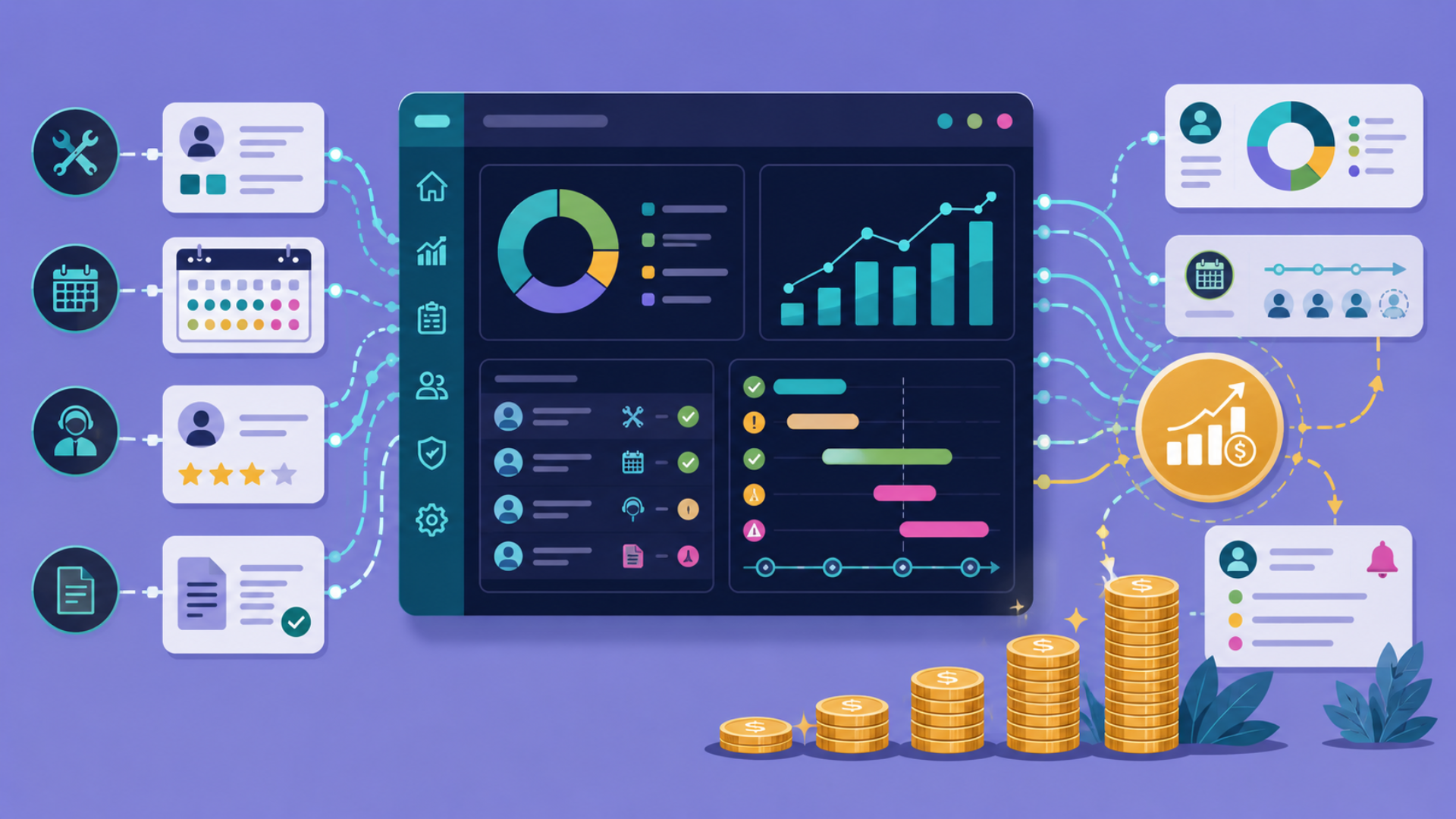
Annual Maintenance Contract revenue has an unusual characteristic that most OEM service heads understand in theory but rarely fully exploit in practice. The revenue is already sold. The customer has already committed to a service relationship. The contract exists. The payment obligation is defined.
The gap between contracted AMC revenue and captured AMC revenue is not a sales problem. It is a data problem.
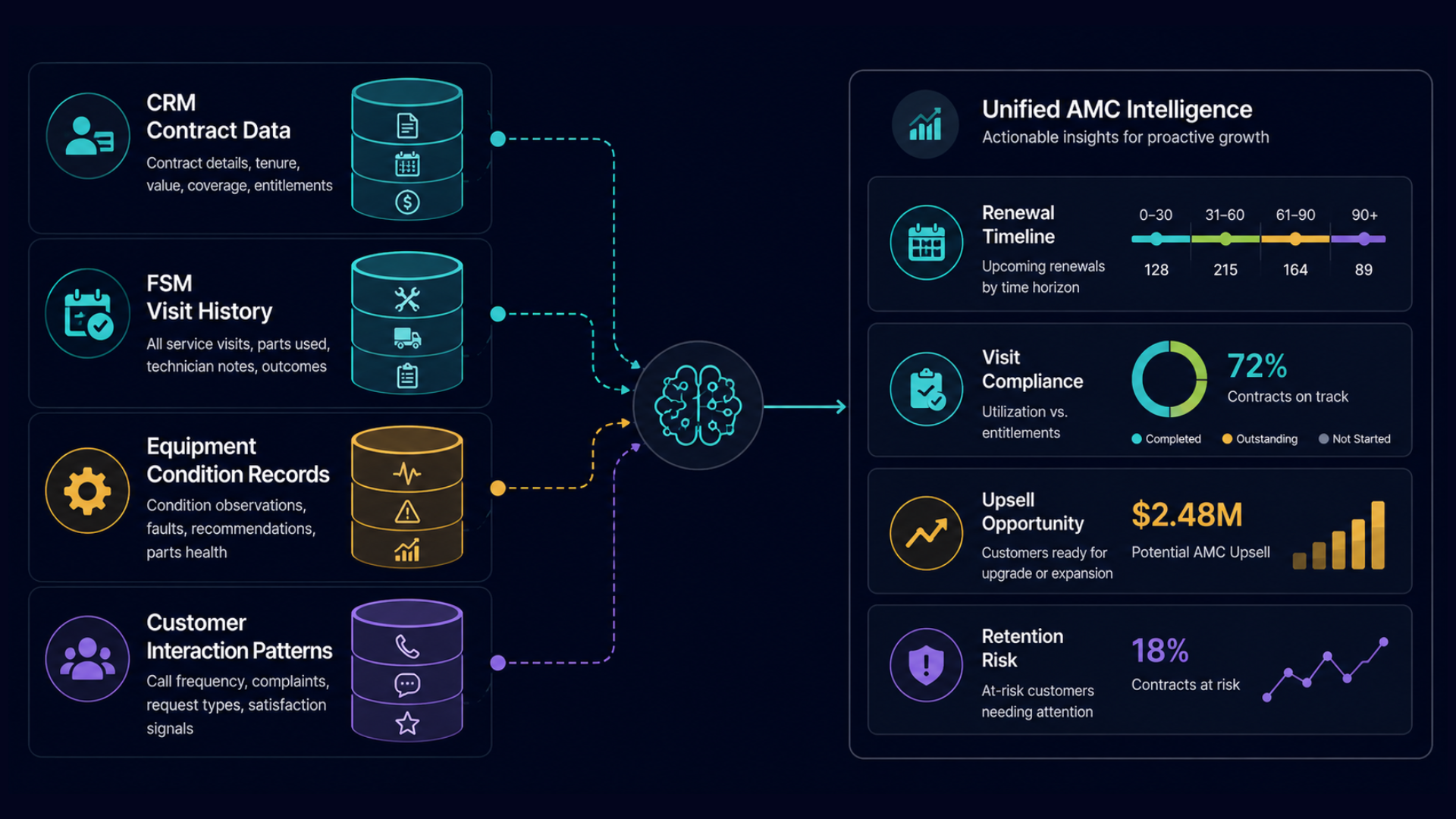
In most OEM service operations, the data required to proactively manage the AMC relationship is distributed across systems that do not connect. The AMC contract lives in the CRM. The service visit history lives in the field service management solution. The renewal date lives in the billing system. The technician who last visited the customer knows things about that customer's equipment that none of those systems have captured. No single view of the AMC relationship exists, which means the proactive outreach, scheduled visits, and renewal management that should be systematic are instead ad hoc, inconsistent, and frequently too late.
A leading consumer electricals OEM achieved 27% AMC order growth within three months of connecting those systems and putting AI to work on the data they contained. The growth did not come from acquiring new AMC customers. It came from capturing the revenue that existing contracts already entitled the organisation to receive.
Where AMC Revenue Goes Uncaptured
Understanding where AMC revenue disappears is the starting point for recovering it. Three failure points account for the majority of AMC revenue leakage in large service networks.
Missed renewal windows:
An AMC contract that expires without a renewal conversation is not a customer who chose not to renew. In most cases, it is a customer who was never contacted before the expiry date or was contacted too late for the renewal to be processed before the contract lapsed. In a large service network with thousands of AMC customers, managing renewal timelines manually is not operationally feasible. The customers who are contacted are the ones whose accounts are actively managed. The ones who are not contacted lapse, and converting a lapsed customer back to an active AMC relationship is significantly more expensive than a proactive renewal.
Uncompleted contracted visits:
Many AMC contracts include a defined number of preventive maintenance visits within the contract period. In the majority of OEM service networks, tracking whether every contracted customer has received every contracted visit within the required window is done manually, inconsistently, or not at all. Customers who have not received their contracted visits are AMC customers who are not getting the value they paid for, which makes them more likely to lapse at renewal and less likely to upgrade their contract. The contracted visit is also a service touchpoint that, properly managed, is the single most effective renewal conversation in the OEM service playbook. If the visit does not happen, the conversation does not happen.
Underutilised upsell opportunities at service touchpoints:
Every technician who visits an AMC customer is standing in front of someone who has already demonstrated a willingness to pay for a service relationship. That visit is the highest-conversion upsell opportunity in the OEM service model. In most networks, the technician has no visibility of the customer's current contract status, what the contract includes, what it excludes, and what the customer's equipment condition suggests about what they might need. The upsell opportunity is present at every visit. The data required to act on it is not in the technician's hands.
What the Service Data Actually Contains
The service data that most OEMs are sitting on contains significantly more AMC revenue intelligence than is currently being used. The challenge is not that the data does not exist. It is that it is fragmented across systems in ways that make it invisible to the people who need to act on it.
Contract status and renewal timing:
CRM systems hold AMC contract data including start dates, end dates, contract value, covered products, and included service visits. This data is accurate but it is not surfaced to the people who interact with the customer like the service coordinator who schedules visits, the technician who attends the site, the regional service manager who reviews performance.
Service visit history against contract entitlements:
Field service solutions hold records of every visit that has been made to every customer. Cross-referencing visit history with contract entitlements shows which customers have received all their contracted visits and which have not. Most solutions do not surface this automatically because the data sits across separate CRM contract and FSM visit records. When this calculation is made available, the list of customers who have contracted visits outstanding is often significantly larger than service management teams expect.
Equipment condition signals from technician interactions:
Every service visit generates information about the condition of the customer's equipment. In most networks, this information lives in job cards that are completed and filed. It is not systematically analysed across the customer base to identify customers whose equipment condition suggests an upcoming need for an extended contract, a higher-tier contract, or an additional covered product. The equipment condition data that would support proactive AMC conversations is present in the service records. It is not being read.
Customer interaction patterns:
Service call frequency, complaint history, and the nature of service requests over time are signals that reveal customer satisfaction and contract retention risk. A customer who calls more frequently than expected under their contract is a customer whose experience is not meeting their expectations, which is both a service quality signal and a renewal risk signal. A customer who calls less frequently than expected is a customer who may not be getting the full value of their contract, which is an engagement opportunity. These patterns exist in the service data. They are rarely surfaced in a form that enables proactive action.
What AI Does With Connected Service Data
When AMC contract data, service visit history, equipment condition records, and customer interaction patterns are connected in a unified data layer and AI is applied to that data, three capabilities emerge that are not possible with fragmented systems.
Proactive renewal management at scale:
AI can monitor every AMC contract in the portfolio simultaneously, flagging renewal windows at the right lead time for each customer segment, generating personalised renewal communication, and prioritising the renewal pipeline by contract value, renewal risk, and upsell potential. The service coordinator does not need to manually track renewal dates for thousands of contracts. The AI surfaces the priority actions. The coordinator acts on them.
Contracted visit compliance tracking and scheduling:
AI can calculate, in real time, which AMC customers have outstanding contracted visits, how much of the contract period remains, and what the scheduling window is to complete those visits before contract expiry. It can automatically generate scheduling recommendations for outstanding visits, prioritised by urgency and geography, and trigger scheduling workflows that ensure no contracted visit is missed. The compliance tracking that was previously a manual administrative task becomes an automated operational process.
Technician-side AMC intelligence at the point of interaction:
When a technician arrives at an AMC customer site, the service solution can surface the customer's full AMC context: what their contract covers, what visits are outstanding, what the equipment condition history suggests, and what the upsell opportunity looks like given the contract tier and equipment age. The technician does not need to know the customer's AMC status from memory. The system puts it in their hands at the moment it is relevant.
This is what produced 27% AMC order growth for the consumer electricals OEM within three months of deployment. Not a new AMC sales strategy. Not additional sales headcount. The AI reading the service data that already existed, surfacing the opportunities that were already present, and putting the right information in front of the right person at the right moment in the service interaction.
The Integration That Makes It Work
The AMC revenue intelligence described above requires one architectural capability that most field service solutions do not deliver out of the box: real-time integration between the CRM contract data and the field service solution, in both directions.
The field service solution needs to read contract status from the CRM at the point of dispatch, when the technician's briefing is being prepared, and when scheduling decisions are being made. It cannot work with a periodic sync that may be hours or days out of date. An AMC contract that renewed yesterday needs to be reflected in today's technician briefing.
The field service system also needs to write back to the CRM. When a technician completes a contracted visit, that completion needs to update the CRM's record of visit entitlement. When a technician identifies an upsell opportunity at the customer site, that opportunity needs to flow into the CRM as a lead for follow-up. When equipment condition data suggests a renewal risk, that signal needs to reach the account management team through the CRM, not sit in a job card that nobody reads.
This bidirectional, real-time integration between field service and CRM is the infrastructure that turns AMC revenue from a manual administrative function into an AI-powered revenue stream. It is also the integration that most configure-it-yourself FSM systems require significant custom development to achieve — because it requires understanding the specific data model of the OEM's CRM, the specific AMC contract structure, and the specific business rules that govern how visit entitlements, renewal windows, and upsell opportunities are defined.
This is precisely why forward deployed engineers who work inside the client's environment, rather than building against a generic specification, consistently produce better AMC intelligence outcomes. The integration that is required is specific to this OEM's data and systems. Building it correctly requires understanding those specifics from the inside.
What to Measure to Know It Is Working
Three metrics reveal whether AMC revenue capture is improving after deployment.
AMC renewal rate by segment:
The percentage of AMC contracts that renew, tracked by customer segment, contract tier, and product category. Improvement in renewal rate is the primary indicator that proactive renewal management is working. Segment-level tracking reveals which customer types are responding to proactive outreach and which require a different approach.
Contracted visit compliance rate:
The percentage of AMC customers who receive all contracted visits within the contract period. A compliance rate below 90% indicates that contracted visit scheduling is not being managed systematically. Every percentage point of improvement in compliance rate is a direct indicator of service quality improvement and a leading indicator of renewal rate improvement.
AMC upsell conversion rate at service touchpoints:
The percentage of technician visits to AMC customers that result in a contract upgrade, additional product coverage, or extended contract term. Tracking this metric requires that upsell opportunities be recorded at the point of the technician visit, which requires the technician-side AMC intelligence described above. The baseline for this metric in most networks without systematic AMC intelligence is close to zero, not because upsell opportunities are absent, but because they are not being systematically identified and acted on.
The AMC revenue that most OEM service operations are leaving on the table is not theoretical. It is already contracted, already in the data, and already present in the customer relationships that the service network maintains. The gap between contracted and captured is a data connectivity problem and a workflow problem, both of which are solvable with the right solution architecture and the right deployment approach.
Vishleshan AI's Technician Plus connects AMC contract data, service visit history, and customer interaction records in real time, surfacing AMC revenue opportunities to the right person at the right moment in the service workflow. It has been deployed at Fortune 500 OEM scale with documented AMC order growth of 27% within three months of go-live. Book a Consultation