


Gartner's latest research contains a number that enterprise leaders should be paying attention to. By end of 2026, 40% of enterprise applications will ship with task-specific AI agents built in. That is up from less than 5% a year earlier. More than 60% of organisations expect to deploy AI agents within two years.
Gartner calls this the steepest adoption curve of any emerging technology it has ever measured.
To put that in context: cloud computing took a decade to reach the penetration that agentic AI is projected to reach in two years. Mobile enterprise applications took six years to become standard. AI agents embedded in enterprise software are on a trajectory that has no historical precedent in enterprise technology adoption.
The question this raises for enterprise leaders is not whether agentic AI is coming to your organisation's software stack. It is coming, whether you plan for it or not. The question is whether your organisation is ready for what happens when it arrives — and what readiness actually means in practice.
What Agentic AI in Enterprise Applications Actually Means
The term agentic AI is used loosely enough that it is worth being precise about what it means when embedded in enterprise applications specifically.
An AI agent in an enterprise application is not a chatbot or a recommendation engine. It is a software component that can observe a situation, reason about it, decide what to do, and take action — autonomously, within defined parameters, without requiring a human to initiate each step.
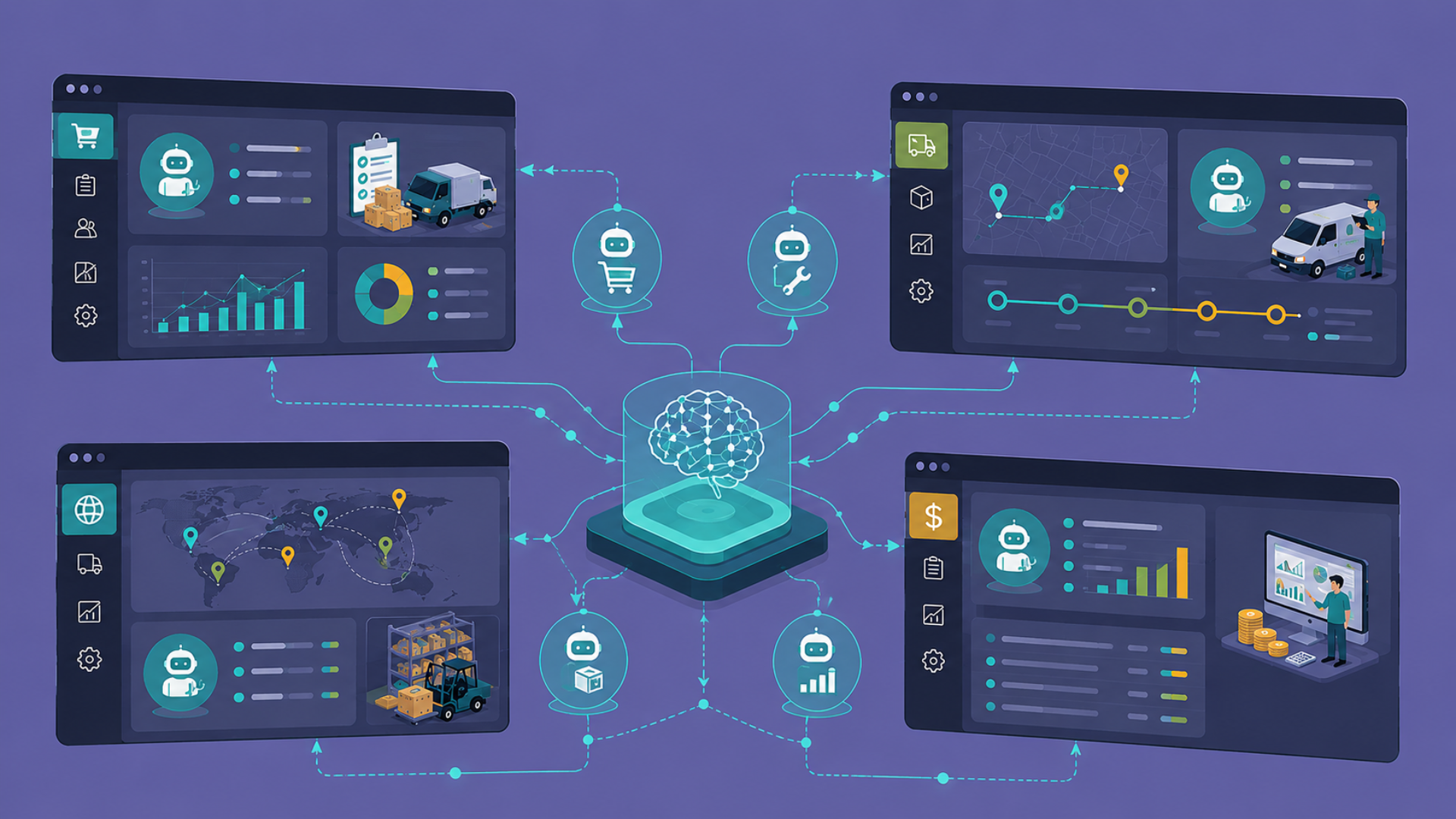
In a field service application, an AI agent might monitor job completion data, identify patterns suggesting a specific component is failing ahead of schedule across a product cohort, cross-reference warranty records and parts inventory, and automatically raise a proactive service campaign for affected customers — without a service manager having to notice the pattern, query the data, and manually initiate the campaign.
In a procurement application, an AI agent might monitor supplier performance signals, detect a developing delivery risk, identify alternative suppliers that meet qualification criteria, model the inventory impact of a potential switch, and surface a decision-ready recommendation to the procurement manager — before the delivery failure has occurred.
In a dealer management application, an AI agent might track dealer ordering behaviour against historical patterns, identify a dealer showing early signs of performance deterioration, and trigger an outreach workflow to the regional sales manager with a prioritised intervention brief — three weeks before the deterioration would appear in a monthly performance report.
These are not hypothetical use cases. They are deployments that are live in production today in automotive, consumer electricals, and financial services environments. The difference between 2025 and 2026 is that these capabilities are moving from bespoke deployments into the standard feature sets of enterprise application vendors.
The Readiness Gap That Most Organisations Have Not Addressed
The speed of agentic AI adoption into enterprise applications is creating a readiness gap that most organisations have not yet addressed. Understanding what that gap consists of is the starting point for closing it.
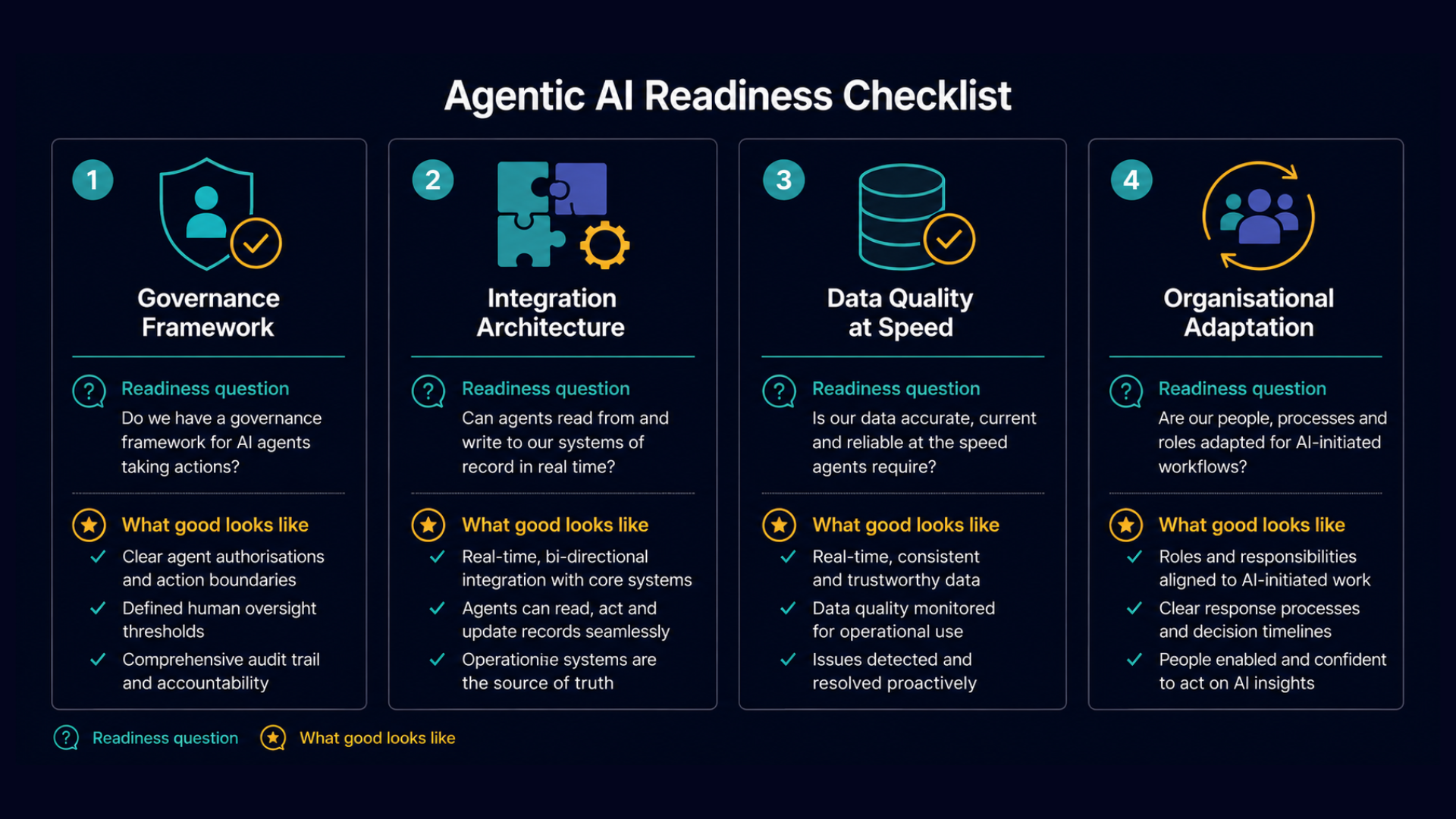
Governance for autonomous action.
AI agents that take actions, not recommendations, but actual actions within enterprise systems require a governance framework that most organisations do not yet have in place. Which agents are authorised to take which actions? Within what parameters? With what human oversight thresholds? What audit trail is required for regulatory or operational accountability?
These questions have clear answers in most organisations for human actors. They do not yet have clear answers for AI agents. An agent that raises a purchase order, schedules a service visit, or triggers a supplier switch is taking an action with real operational and financial consequences. The governance framework that authorises and audits those actions needs to be in place before the agent is deployed, not defined after the first incident.
The agentic AI governance architecture that regulated industries require is instructive here even for organisations not subject to formal regulation. Defined autonomy levels, clear escalation thresholds, comprehensive audit logging, and human oversight mechanisms at defined decision boundaries are the components of a governance framework that allows agentic AI to operate productively rather than creating liability.
Integration with systems of record.
AI agents embedded in enterprise applications need to read from and write to the systems of record where business operations are actually managed. An agent in a field service application that cannot read warranty status from the ERP in real time cannot make a correct service decision. An agent in a procurement application that cannot raise a purchase order in the ERP has only completed the analysis step, not the operational step.
Most enterprise applications have integration with ERP systems. The quality and depth of that integration varies significantly. Batch-based integration that syncs periodically is not the same as real-time integration that allows agents to act on current information and write actions back to the system of record immediately.
As organisations receive enterprise applications with AI agents built in, the integration architecture that connects those agents to existing systems of record becomes a critical infrastructure question. An agent is only as useful as the data it can access and the systems it can act on. Getting this right is the integration challenge that determines whether agentic AI in enterprise applications delivers the outcomes the vendor promises or produces sophisticated-looking outputs that do not connect to operational reality.
Data quality at the speed agents require.
AI agents operating in real time require data that is current, consistent, and reliable at the moment of decision. The data quality issues that are acceptable in a reporting context — a dealer's inventory position that is accurate to within 24 hours, a supplier's delivery performance score that is calculated weekly — become operational problems when an agent is making real-time decisions based on them.
The data foundation gaps that organisations have been managing as an analytics problem become an operational reliability problem when AI agents are the consumers of that data. An agent acting on inaccurate data does not produce an inaccurate report. It takes a wrong action.
Organisational readiness for AI-initiated workflows.
Perhaps the least-discussed readiness challenge is organisational. AI agents embedded in enterprise applications will initiate workflows, surface recommendations, and trigger actions on timelines that are determined by what the AI observes in the data, not by human-managed review cycles.
This changes how people work. A procurement manager whose role previously involved actively reviewing supplier performance and initiating response actions now receives AI-initiated intervention recommendations that require faster response than a weekly review cycle accommodates. A service manager whose role involved reviewing job completion reports and identifying follow-up actions now receives AI-initiated proactive service campaigns that require approval or rejection within a defined window.
The work is faster and better-informed. It is also different in character. Organisations that have not thought through how human roles adapt when AI agents are initiating workflows will find that the agents' outputs pile up unactioned, which is operationally equivalent to not having the agents at all.
What the Automotive and Consumer Electricals Experience Tells Us
The readiness challenges described above are not hypothetical. They have already played out in the early enterprise agentic AI deployments that Vishleshan AI has been involved in across automotive manufacturing, consumer electricals, and field service operations.
In every case, the agentic AI capability itself was not the constraint. The models are capable. The use cases are valid. The constraint was consistently the readiness of the surrounding environment: the integration architecture that connects agents to systems of record, the data quality infrastructure that makes agent decisions reliable, and the governance framework that defines what agents are authorised to do and how their actions are audited.
An automotive OEM that deployed AI agents in its supply chain operations discovered that the agents' recommendations were correct but the integration with the ERP was batch-based rather than real-time, which meant agents were making decisions on inventory data that was 18 hours old. The recommendations were accurate for the situation as it existed 18 hours ago. They were sometimes wrong for the situation as it existed when the human acted on them.
An consumer electricals manufacturer that deployed AI agents in its dealer management operations discovered that the agents were surfacing intervention recommendations that regional managers did not have a defined process for acting on quickly. The agents identified dealers at risk three weeks ahead of the traditional reporting cycle. The organisation had no workflow for three-week-ahead intervention. The value of the early warning was not captured because the human process was not designed to use it.
Both of these are solvable problems. Both are problems that need to be solved before deployment, not discovered after it.
The Three Things to Do Before Agentic AI Arrives in Your Applications
For enterprise leaders whose software vendors are already announcing agentic AI features or whose procurement teams are evaluating platforms with AI agents built in, three preparation steps consistently determine whether the deployment generates value or creates operational noise.
Define the governance framework before enabling agents:
For each agent capability being deployed, define explicitly: what actions is this agent authorised to take without human approval, what actions require human approval before execution, what audit trail is required, and who is accountable when the agent's action produces an unexpected outcome. This framework does not need to be comprehensive before any agent is deployed. It needs to be specific to the agent capabilities being enabled.
Audit the integration architecture for real-time readiness:
The agent capabilities your vendor is deploying will only perform to their design specification if the data they access is current and the systems they act on respond in real time. Auditing the integration between your enterprise application and your systems of record — specifically looking at data latency, write-back capability, and failure handling — before enabling agent features identifies the infrastructure gaps that will limit performance.
Design the human workflows that receive agent outputs:
For each agent capability being deployed, define explicitly: how does the human who receives an agent-generated recommendation or alert act on it, within what timeframe, through what process, and with what escalation path if they cannot act on it in time. Agents that generate outputs faster than the organisation can process them create a backlog problem that erodes trust in the system faster than almost any other issue.
The Competitive Implication
The steepest adoption curve Gartner has ever measured for any emerging technology is not a description of a distant future. It is a description of what is happening now in the enterprise application market.
The organisations that are ready when agentic AI arrives in their standard software stack will extract value from day one. The organisations that are not ready will spend the first 12 to 18 months of their agentic AI journey discovering the readiness gaps that they could have addressed in advance.
The delivery model that has consistently produced faster time to value in enterprise AI deployments — engineers embedded inside the client's environment, building against actual systems and data, accountable to production outcomes — is precisely the model that closes readiness gaps before they become operational problems rather than after.
The competitive advantage of agentic AI does not accrue to the organisations that adopt it first. It accrues to the organisations that are ready for it when it arrives.
Vishleshan AI's forward deployed engineers deploy agentic AI across automotive, consumer electricals, financial services, and supply chain environments, building the integration architecture, governance framework, and organisational readiness that makes agentic AI work in production rather than in a demonstration. Book a Consultation