



In 2026, the hard question is no longer whether AI will be regulated. The question is which regulatory system your company is actually building into.
For most of 2023 and 2024, enterprise leadership teams treated AI regulation as policy theater: consultations, white papers, government announcements that created noise without creating consequences. That phase is over. Jurisdictions with comprehensive, in-force AI laws now include the EU through the AI Act, South Korea through the AI Basic Act effective January 2026, and China through a stack of binding measures. The US has no federal law but around 38 states have enacted AI measures.
We are entering a phase of enforcement. The initial shock of new laws is wearing off, replaced by the grind of audits, penalties, and cross-jurisdictional conflicts.
This is what enterprise leaders operating globally need to understand right now.
The EU AI Act: What Is Actually in Force and When
The EU AI Act is the regulatory framework that most enterprise compliance teams are focused on, and it is also the one most frequently misunderstood in terms of what is actually enforceable today versus what is coming.
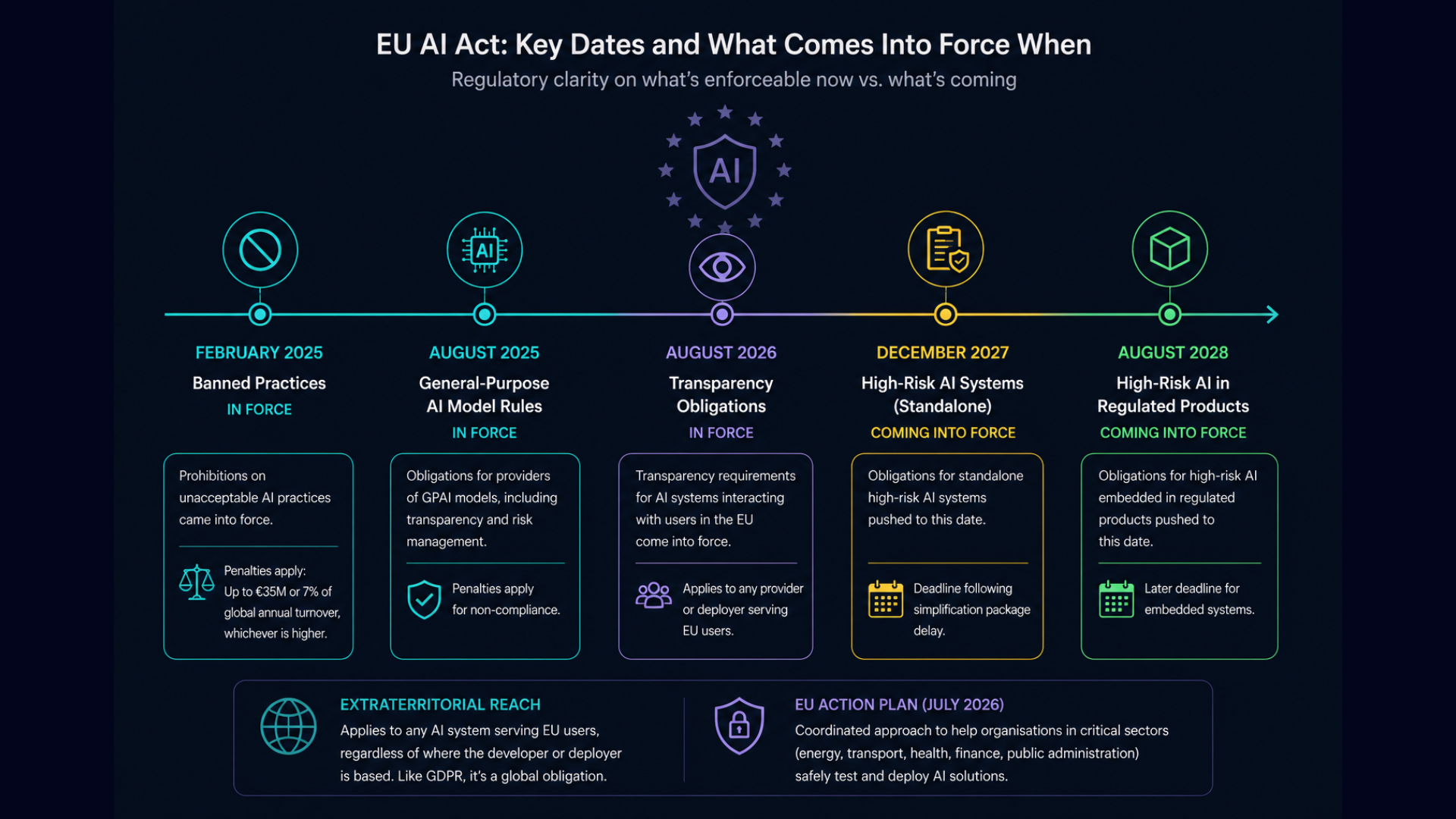
The timeline that matters: certain provisions are already in force. Banned practices came into force in February 2025. General-purpose AI model rules came into force in August 2025. Transparency obligations come into force in August 2026. The deadlines most commonly cited in enterprise compliance discussions, the high-risk system obligations, have been pushed back. A simplification package pushed standalone high-risk system obligations to December 2027 and high-risk AI embedded in regulated products to August 2028.
This does not mean enterprises can defer action. The transparency obligations arriving in August 2026 affect any enterprise deploying AI systems that interact with users in the EU. And the penalty structure that makes the EU framework consequential is already attached to the provisions that are in force. Breach a banned practice and you face up to 35 million euros or 7% of global annual turnover, whichever is higher.
The EU AI Act also has extraterritorial reach. Like GDPR, it applies to any AI system serving EU users, regardless of where the developer or deployer is based. For enterprises headquartered outside Europe with EU customers, EU partners, or EU employees, this is not a European compliance issue. It is a global one.
The European Commission also presented an EU Action Plan on Cybersecurity and Artificial Intelligence in July 2026, setting out a coordinated approach to help organisations in critical sectors, including energy, transport, health, finance, and public administration, safely test and deploy AI solutions. For enterprises in these sectors, the regulatory expectation is tightening further.
China: Targeted Rules With Immediate Operational Impact
China's regulatory approach to AI differs fundamentally from the EU's architecture. Rather than a single comprehensive law, China has used scoped instruments tied to content governance, data obligations, and platform responsibility.
The practical impact on enterprises serving Chinese users is immediate and specific. China's Interim Measures for the Administration of AI Anthropomorphic Interactive Services took effect on 15 July 2026, requiring AI services that simulate human personality to implement anti-addiction systems, mandatory usage notifications, and instant-exit mechanisms. Major platforms with hundreds of millions of users shut down or significantly modified their agent features ahead of this deadline.
For enterprises operating in China or serving Chinese users through AI-powered products, the compliance obligation is not theoretical. Pre-deployment security assessments, content labelling requirements, and platform responsibility obligations are active. China's approach serves explicit strategic objectives: promoting domestic AI champions while controlling the societal impact of the technology.
The practical consequence for global enterprises is that products built for one market frequently cannot be deployed unchanged in China. Content restrictions, data localisation requirements, and platform governance obligations require configuration decisions at the product architecture level, not just the compliance policy level.
The United States: A Patchwork That Is More Complex Than It Appears
The US federal approach to AI regulation remains deliberately light. There is no comprehensive federal AI law. The current administration has prioritised innovation over restriction at the federal level.
But the state-level picture tells a different story. In the 2025 legislative session, all 50 states, Puerto Rico, the Virgin Islands, and Washington DC introduced AI-related legislation, and 38 states adopted or enacted around 100 measures.
The specific laws with immediate enterprise impact are worth understanding directly.
Texas TRAIGA, effective January 2026, requires reasonable care, transparency, testing, and impact assessments for AI systems deployed in Texas. Colorado's comprehensive bill was narrowed significantly in a 2026 amendment but still introduces disclosure requirements effective January 2027. New York City Local Law 144 requires annual bias audits for automated employment decision tools, with results publicly posted. Illinois BIPA imposes strict consent requirements for biometric data collection that directly affects AI systems using facial recognition or voice analysis.
A company deploying the same AI system in New York, Colorado, and Illinois may face three distinct sets of obligations, bias audits, impact assessments, and biometric consent requirements, none of which are harmonised.
The practical recommendation from compliance specialists is consistent: build the compliance programme around the EU AI Act's high-risk requirements, which will satisfy most US requirements by default, then add jurisdiction-specific obligations as supplementary requirements. The EU framework is the highest common denominator that covers most US state obligations when implemented fully.
The Agentic AI Governance Gap
One regulatory challenge that is not yet fully addressed by any major framework deserves specific attention for enterprises deploying agentic AI systems: the governance of agents operating across jurisdictional boundaries.
AI agents can operate across jurisdictional boundaries instantaneously. An agent deployed in the US can interact with EU systems, trigger actions in Singapore, and access data stored in Japan. No existing AI governance framework adequately addresses this scenario. The result is a legal grey zone where agents may be compliant in their jurisdiction of deployment but violating regulations in jurisdictions where their actions take effect.
Singapore has moved furthest in addressing this. The Infocomm Media Development Authority released the world's first model AI governance framework specifically addressing agentic AI in January 2026, introducing graduated autonomy levels ranging from tool-assisted to fully autonomous, with governance requirements increasing at each level, and a clear allocation of liability between the entity that builds an AI agent platform and the entity that deploys it.
For enterprises deploying agents across multiple geographies, this framework, while not legally binding outside Singapore, provides the clearest available template for how to think about governance at different levels of agent autonomy. The oversight intensity proportional to action impact principle it establishes is likely to become the standard that other jurisdictions adopt as they develop their own agentic AI frameworks.
This is also where the architectural choices matter as much as the compliance policy. Building governance into the deployment architecture from day one — audit trails, access controls, human oversight mechanisms at appropriate decision thresholds — is what allows enterprises to demonstrate compliance across jurisdictions rather than retrofitting it after deployment.
What Enterprises Operating Across Multiple Geographies Should Do Now
The compliance picture is genuinely complex. But the practical steps that move enterprises from exposure to defensible position are reasonably consistent across frameworks.
Build an AI system inventory: Research shows that most enterprises significantly undercount their AI deployments. The average organisation uses two to three times more AI systems than leadership is aware of. You cannot classify, govern, or comply for systems you do not know exist.
Classify against EU AI Act risk tiers: Even for enterprises not primarily focused on EU compliance, the EU's risk classification methodology, from banned practices through high-risk to minimal-risk, is the most developed and most internationally referenced framework available. Using it as a classification baseline provides coverage across most other jurisdictions by default.
Assign accountability: 78 percent of organisations now employ dedicated AI compliance officers, up from 32% in 2023. The question of who owns AI governance, as discussed in how enterprises should structure AI ownership, has a regulatory dimension as well as an organisational one. Regulators will ask who was responsible. The answer should be specific and documented.
Build audit trails into deployment architecture: The transparency and auditability obligations across EU, US state, and Asian frameworks all require being able to demonstrate what an AI system did, on what basis, with what human oversight. This capability needs to be built into systems at deployment, not added after the fact when a regulator asks for it.
Monitor the pace of change: Regulations change weekly. 52 percent of AI leaders find regulatory monitoring their most significant challenge precisely because of this fragmentation. This is not a compliance project with an end date. It is an ongoing operational function.
The regulatory landscape for enterprise AI in 2026 is complex, uneven across geographies, and changing faster than most compliance functions are organised to track. But the direction of travel is clear. The frameworks are tightening, the enforcement is beginning, and the enterprises that have built governance into their AI architecture rather than treating it as a compliance overlay will find the transition significantly less disruptive than those that have not.
The question is not whether your AI deployments will face regulatory scrutiny. It is whether the architecture underneath them is ready for it when it arrives.
Vishleshan AI's forward deployed engineers build enterprise AI systems with governance, auditability, and compliance built into the architecture from day one, not retrofitted after deployment. Whether you are navigating the EU AI Act, US state legislation, or cross-jurisdictional agentic AI obligations, the right architecture is your first line of compliance. Book a Consultation