


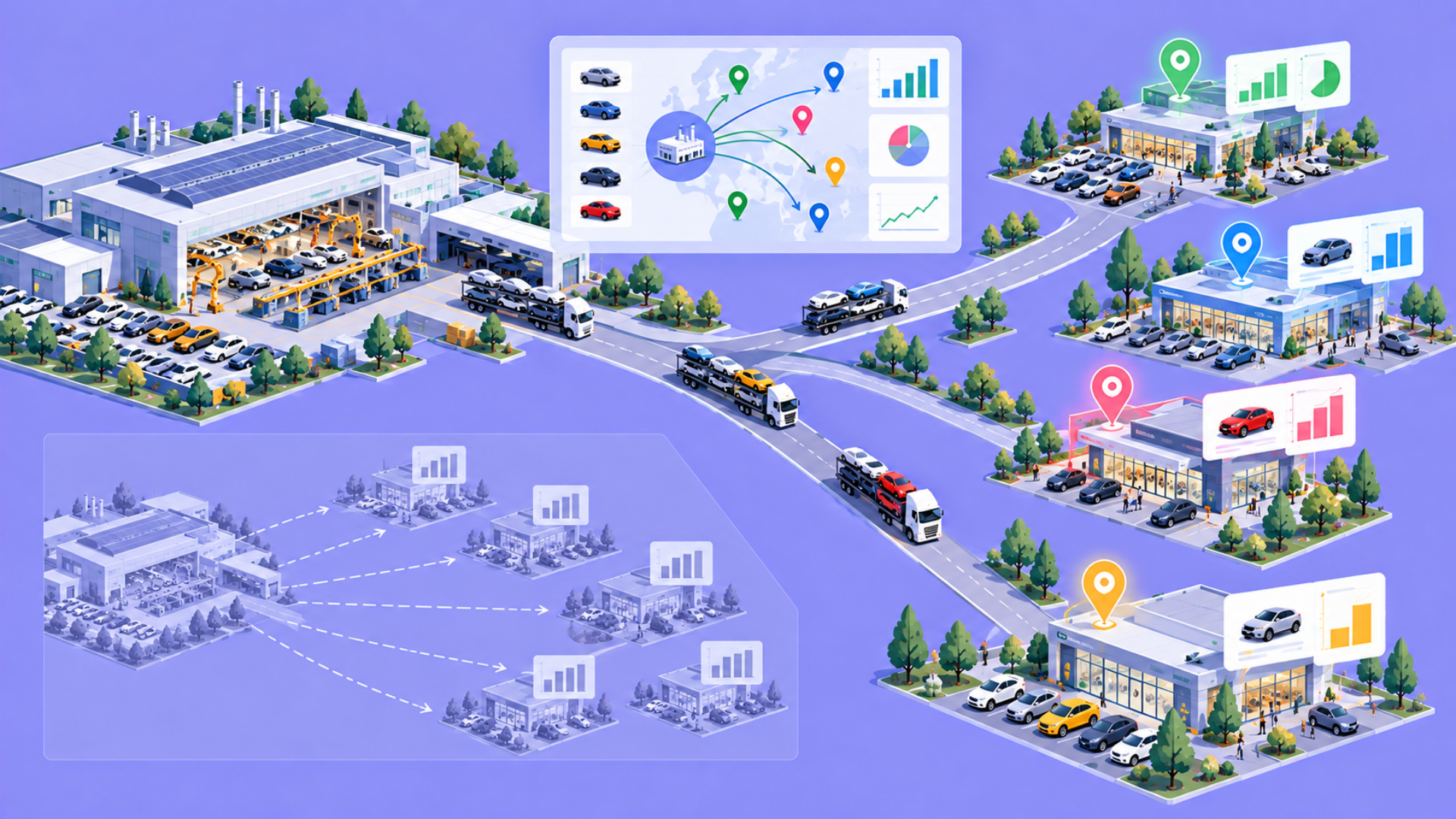
Vehicle allocation is one of the most consequential decisions an automotive OEM makes every week. Which dealers get which models in which quantities determines how quickly inventory turns, how much price support the OEM needs to deploy to clear excess stock, and how often customers walk away from a dealer unable to find what they want.
Most OEMs still make this decision using a process designed for a slower, less data-rich world. Historical order volumes determine the allocation baseline. Monthly sell-through reports inform adjustments. Regional sales managers advocate for their dealers in allocation meetings. The process is structured. It is also consistently backward-looking.
A dealer who overstocked a specific model last quarter receives a reduced allocation this quarter based on their lower order volume. A dealer whose local market has shifted toward that model in the last four weeks shows nothing unusual in the monthly report yet. The allocation system does not know what the market is doing. It knows what the market did.
AI changes this. SAP Vehicle Management System was enhanced in 2026 with AI-driven vehicle allocation optimisation specifically designed to match vehicles in transit to the dealers most likely to sell them quickly, based on current sell-through rates, live dealer orders, and regional demand patterns.
That is the directional change. Here is what it looks like in practice.
Why Traditional Allocation Consistently Misallocates
The structural problem with historical order-based allocation is that it measures dealer behaviour rather than market demand.
A dealer's order volume reflects their assessment of demand at the time they placed the order, adjusted for their inventory position, their working capital, and their relationship with the OEM's regional sales team. It is a filtered signal. It tells the OEM what the dealer was willing to order, not what the market will buy.
When market conditions shift, order-based allocation continues allocating based on the old market. A body style that was slow-moving nationally but is gaining momentum in a specific geography keeps receiving the same allocation it received when it was slow everywhere. A model that was in high demand but whose competitive position has shifted keeps receiving high allocation after the market has moved on.
The result is a perpetual mismatch between what each dealer receives and what their local market will buy quickly. Some dealers have too much of the wrong stock. Others have too little of what their customers are asking for. Both situations have costs.
Overstocked dealers age out their inventory. Aged inventory requires price support to move. Price support erodes margin across the dealer network. It also signals to the market that the product is not in demand, which further slows sell-through.
Understocked dealers lose sales to competitors or to other dealers further away. In 2026, 30% of in-market vehicle shoppers use AI tools during their buying journey. These tools recommend the nearest available matching vehicle regardless of brand preference. A buyer who would have purchased from their local dealer buys from a dealer two cities away, or from a competitor, because the local dealer's allocation did not match local demand.
How AI-Powered Allocation Works
AI vehicle allocation shifts the allocation decision from backward-looking to forward-looking. Instead of asking what dealers ordered last quarter, it asks which dealers are most likely to sell specific models in the next 30 to 60 days based on current evidence.
The inputs that feed this decision are different from those that feed traditional allocation. They include current sell-through velocity at each dealer, not quarterly averages but week-by-week rates that reveal momentum in either direction. Live dealer order positions, including vehicles in transit, on order, and available. Regional demand signals drawn from market data, competitive activity, and consumer search and enquiry patterns. And seasonal and event-driven factors that affect local demand in ways that national allocation models miss.
The algorithm processes these inputs continuously. It does not wait for the monthly reporting cycle. When a dealer's sell-through velocity accelerates, the next allocation recommendation reflects that acceleration before it appears in a quarterly report. When a market shift is developing, the allocation shifts ahead of the order data rather than trailing it.
The specific application that SAP implemented in VMS matches vehicles in transit to dealers based on this forward-looking demand picture. A vehicle that will arrive from the plant in two weeks is allocated to the dealer most likely to turn it quickly rather than to the dealer with the highest historical order volume. The allocation decision is made when the vehicle enters the logistics pipeline, not after it arrives at a distribution point.
What This Changes for OEM Operations
AI allocation produces measurable changes in three operational metrics that flow directly to OEM financial performance.
Days in stock:
The number of days between a vehicle arriving at a dealer and being sold to a customer is the primary measure of inventory efficiency in automotive distribution. Vehicles allocated to dealers with strong current demand sell faster. The average days-in-stock across the network declines. Working capital tied up in dealer inventory reduces. The capital efficiency of the distribution operation improves.
Price support requirement:
Aged dealer inventory requires price support in the form of dealer cash, factory incentives, or both to clear. When allocation mismatches are smaller, fewer vehicles age. The price support required to maintain acceptable sell-through rates across the network declines. Margin is preserved across a larger proportion of transactions.
Dealer satisfaction and order predictability:
Dealers who consistently receive vehicles that match their local demand are more satisfied with the OEM relationship. They maintain more predictable ordering patterns. They are less likely to over-order as a buffer against allocation uncertainty, which is a behaviour that itself creates allocation distortions. Better allocation creates a more stable and more predictable dealer network, which improves OEM forecasting accuracy downstream.
The Data Requirements for AI Allocation to Work
The quality of AI allocation is directly dependent on the quality and currency of the data it operates on.
Three data inputs are non-negotiable.
Real-time or near-real-time sell-through data:
Allocation decisions made on monthly sell-through data are decisions made on old information. The competitive advantage of AI allocation comes from its ability to detect demand shifts as they happen rather than after the monthly close. This requires sell-through data that updates at least weekly and ideally in near real time from dealer point-of-sale systems.
Accurate in-transit inventory positions:
AI allocation that matches vehicles to dealers needs to know where all vehicles in the pipeline currently are. A vehicle that is at the port, versus one that is at a regional distribution centre two days from a dealer, has a different allocation calculus. Accurate in-transit visibility is the prerequisite for allocation decisions that reflect the actual pipeline rather than a modelled version of it.
Market demand signals beyond order history:
Order history tells the AI what dealers thought the market would do. Market demand signals, including consumer search data, enquiry volumes, competitive sell-through rates, and regional economic indicators, tell the AI what the market is actually doing. OEMs that integrate these external signals into their allocation models make better decisions than those that rely on internal order data alone.
This is the data foundation that secondary sales visibility, described in the secondary sales visibility piece, makes possible. An OEM that can see what is actually selling through to end customers in near real time has the data quality that AI allocation requires. An OEM relying on distributor-reported data has a data quality problem that limits what the allocation AI can achieve.
What OEM Executives Expect From AI Allocation
59% of OEM executives in the Kerrigan Advisors 2026 OEM Survey expect AI to increase dealer profitability, primarily through lower operating costs and improved sales efficiency. Vehicle allocation optimisation is one of the specific mechanisms through which this expectation is being realised.
The mechanism is straightforward. Better-matched allocation means faster-turning inventory. Faster-turning inventory means lower working capital requirements for dealers. Lower working capital requirements mean lower interest costs. Lower interest costs improve dealer economics. Better dealer economics improve the commercial health of the network that OEMs depend on.
At least two major OEMs are expected to tie AI tool usage to dealer incentive programmes by Q4 2026 or Q1 2027. Toyota and Stellantis have already added AI-related language to dealer standards programmes. The direction of travel is toward OEMs using their allocation and incentive systems to accelerate AI adoption across their dealer networks, with vehicle allocation optimisation as one of the specific capabilities being embedded in OEM-dealer commercial relationships.
The Integration With the Broader Dealer Intelligence Architecture
Vehicle allocation AI does not operate in isolation. It is most effective when it is part of a broader dealer intelligence architecture that gives the OEM visibility into what is actually happening in the dealer network rather than what is being reported.
Allocation decisions that optimise for sell-through velocity require sell-through data from dealers. Customer demand signals require market data that the allocation system can access. In-transit visibility requires integration with the logistics systems where vehicle movements are tracked.
Building this integrated data layer is the same challenge that secondary sales visibility addresses from a different angle. The OEM that has genuine real-time visibility into dealer sell-through, inventory positions, and market demand signals can use AI allocation to its full potential. The OEM that relies on periodic dealer reports and historical order data gets the form of AI allocation without the substance.
Vishleshan AI works with automotive OEMs to build the dealer intelligence and data integration architecture that makes AI allocation viable in practice. Our forward deployed engineering (FDE) approach works inside client environments to connect sell-through data, in-transit inventory positions, and market demand signals into the unified data layer that AI allocation and broader dealer intelligence capabilities require. Book a Consultation