


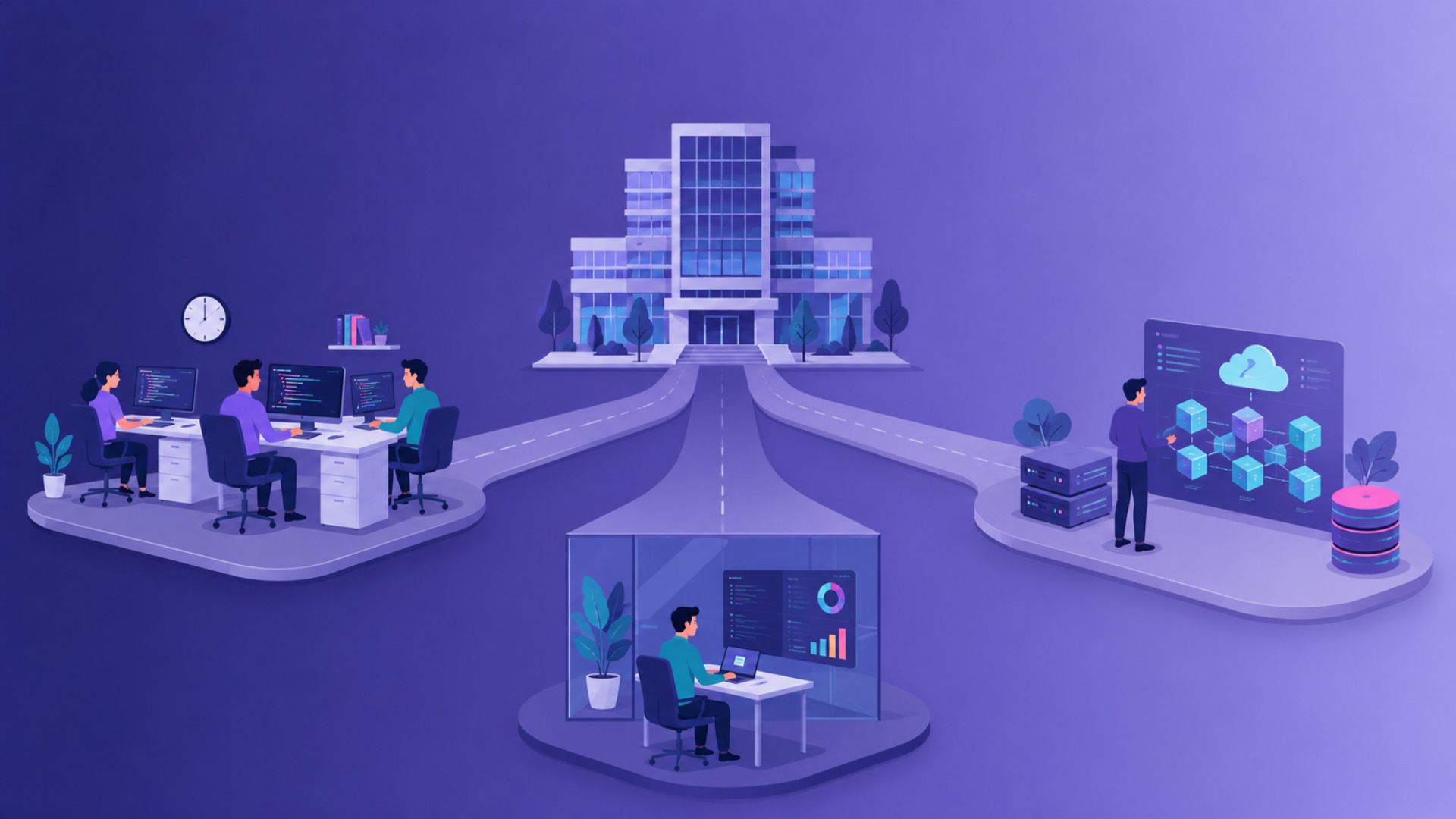
Every enterprise running an AI programme eventually faces the same resourcing question. Do we build this capability in-house? Do we buy a platform and configure it? Or do we bring in engineers who work directly inside our environment?
The answer to that question determines more about whether AI actually reaches production than almost any other decision made during the programme. Yet most enterprises make it based on instinct, procurement habit, or whoever made the most compelling case in the last steering committee meeting.
This piece sets out a clear framework for thinking through the decision, what each model actually delivers, where each one breaks down, and how to match the right model to the right situation.
The Three Models, Defined Clearly
Before comparing them, it is worth being precise about what each model actually means in practice, because all three are frequently described in ways that obscure more than they reveal.
Build means your organisation hires or develops the engineering capability internally. Data scientists, ML engineers, AI architects, and the infrastructure to support them are all owned and operated by your organisation. The IP is yours. The capability compounds internally over time. The dependency is on your own team.
Buy means your organisation licenses a platform, product, or tool from an external vendor and configures or extends it to meet your requirements. The underlying capability is owned and maintained by the vendor. Your organisation's dependency is on the vendor's roadmap, pricing, and continued existence.
Embed means your organisation brings in external engineers who work directly inside your environment for the duration of a specific deployment. They are not building a generic platform you configure. They are not maintaining a remote delivery team you coordinate with. They are inside your systems, your meetings, and your operational reality, building against your specific constraints until the system is genuinely in production.
Each model sounds appealing in its own way. Each has a specific failure mode that rarely gets discussed clearly enough before the decision is made.
The Case for Build and Where It Breaks Down
Building internal AI capability is the right long-term aspiration for most large enterprises. Internal capability compounds. Teams that have shipped one AI deployment into production are faster on the second. Organisations that own their AI infrastructure develop a depth of contextual knowledge about their own systems and data that no external partner can fully replicate.
The problem is the timeline.
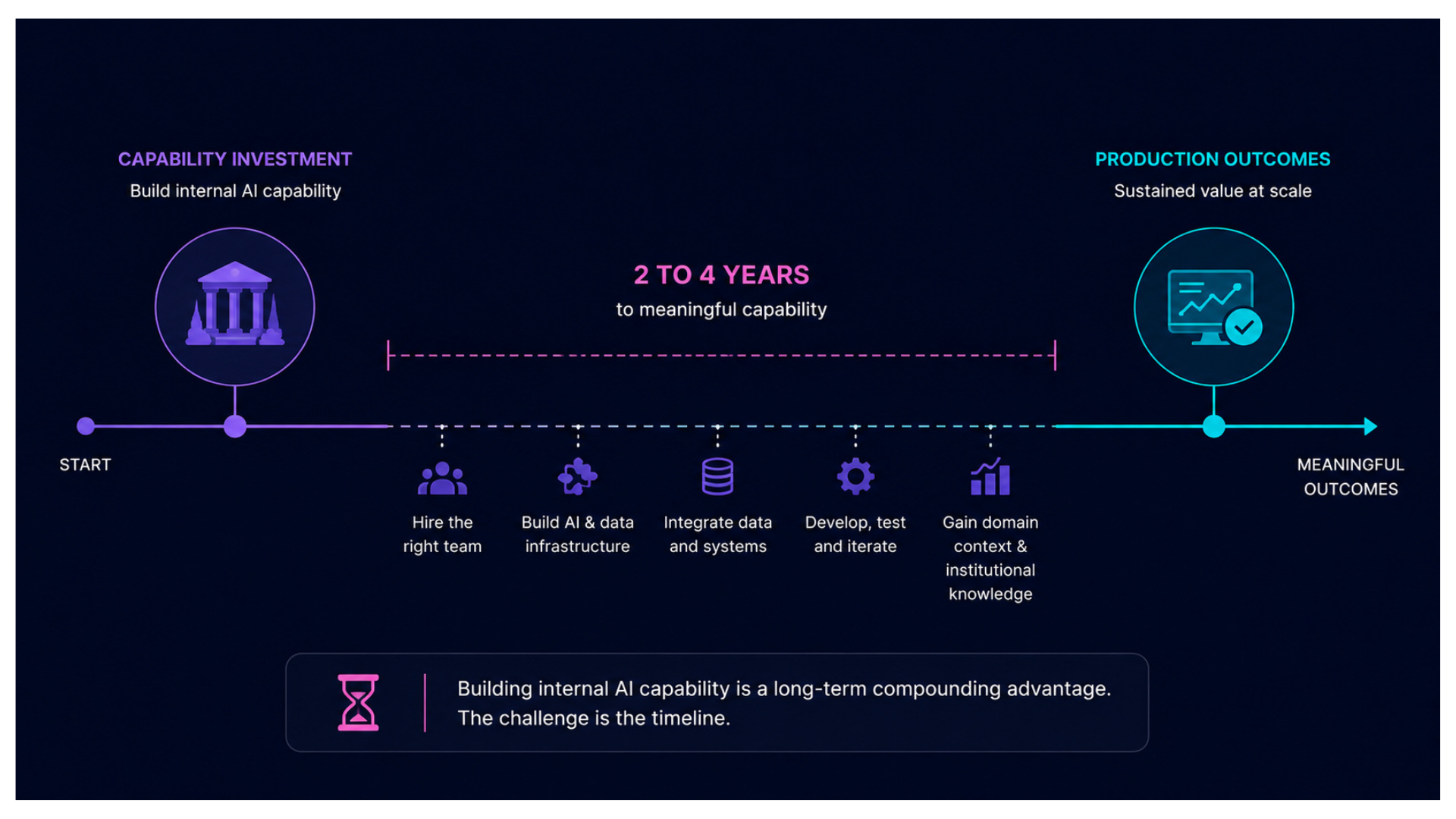
Building a genuinely capable internal AI delivery team takes two to four years in most large enterprises. Hiring the right combination of ML engineers, data engineers, AI architects, and product managers with relevant domain experience is difficult in a competitive market. Retaining them once hired is harder still, particularly when hyperscalers, AI labs, and well-funded startups are competing for the same talent at significant salary premiums.
The enterprises that have built strong internal AI capability largely started that build three or four years ago. Organisations starting now are not going to close the capability gap through hiring alone before their competitors have moved significantly further ahead.
Build is the right destination. It is rarely the right starting point in 2026 if production outcomes in the near term are the objective.
The Case for Buy and Where It Breaks Down
Buying a platform is the most common first move enterprises make, and for understandable reasons. Platforms offer speed to deployment, established functionality, vendor support, and a clear commercial relationship with defined terms.
The failure mode is integration.
Most enterprise AI platforms are built to be broadly applicable across many organisations and sectors. That breadth is a commercial necessity for the vendor. It is a structural limitation for the buyer. The platform is not built around your ERP configuration, your approval hierarchies, your compliance requirements, or the specific data structures that have accumulated in your systems over 20 years of operation.
Configuring a platform to work within those constraints is almost always more complex and more expensive than the initial evaluation suggested. MIT's finding that vendor-led solutions succeed roughly twice as often as internal builds is real, but it applies specifically to vendors with genuine delivery capability alongside their platform, not to platform licenses handed to internal teams to implement.
The enterprises that have extracted the most value from platform purchases are almost always the ones that paired the platform with embedded delivery capability. The platform provided the foundation. External engineers working inside the environment provided the integration work that made it actually function.
Buy rarely works in isolation in complex enterprise environments. It works when it is paired with the right delivery model.
The Case for Embed and What It Actually Requires
The embed model, also called forward deployed engineering, is the model gaining the most ground in enterprise AI in 2026, and the Forrester Wave Q2 2026 criteria reflect this directly, rewarding firms specifically for production deployment capability and operating model design rather than platform breadth or strategy advisory.
The embed model works because it addresses the specific failure mode that derails both build and buy: the gap between what a system does in a controlled environment and what it needs to do in a live enterprise environment.
An embedded engineer working inside your environment discovers the integration constraints, the undocumented workarounds, the compliance edge cases, and the organisational dynamics that determine whether an AI system is actually adopted, not by reading documentation, but by being present when those things happen.
The accountability structure is also different. An embedded delivery team measures success at production adoption, not at technical handoff. The engagement does not conclude when a system is delivered. It concludes when the system is genuinely being used by the people it was built for and generating the outcome it was designed to produce.
What the embed model requires is selecting a partner with genuine engineering depth, not an advisory firm that has rebranded as a delivery partner. The distinction matters because embedding engineers who cannot build is worse than not embedding at all. It consumes the organisational bandwidth required for a genuine delivery partner without producing the integration and deployment capability that makes the model work.
A Direct Comparison
Build | Buy | Embed | |
|---|---|---|---|
Time to production | 2 to 4 years | Months, if integration works | 90 days in most cases |
Integration | High, eventually | Depends on internal team | High, by design |
Capability Cost structure | High fixed cost, scales over time | Licence plus implementation | Variable, engagement-based |
IP ownership | Full | Limited | Shared, usually |
Failure mode | Hiring and retention | Integration complexity | Partner capability gap |
Best for | Long-term AI capability building | Defined use cases with clean integration | Complex environments, first production deployments |
Governance | Internal control | Vendor-dependent | Built into delivery |
The Decision Is Rarely Binary
Most enterprises making this decision frame it as a choice between three mutually exclusive options. In practice, the most effective AI programmes combine elements of all three in a deliberate sequence.
Embed first to get AI into production quickly, building institutional knowledge about what works in your specific environment and validating that the use case delivers the expected business outcome.
Buy strategically once the use case is validated and the integration requirements are understood, selecting platforms that complement the production architecture rather than replacing it.
Build progressively as the organisation develops its own AI capability, starting with the teams closest to the validated use cases and expanding the internal capability over time.
This sequence is not the only viable approach, but it is the one that consistently produces production outcomes faster than starting with build or buy in isolation. It is also the sequence the Forrester Wave criteria implicitly reward, prioritising firms that can deliver the embed phase effectively over firms that can only support the buy or advise on the build.
Matching the Model to Your Situation
Three questions help clarify which model, or which combination, is right for a specific enterprise AI initiative.
How well-defined are the integration requirements?
If you have a clear picture of what your AI system needs to connect to and how, and those connections are well-documented and accessible, a platform purchase with internal implementation is viable. If the integration environment is complex, partially undocumented, or likely to reveal constraints only once the build is underway, embedded delivery is the lower-risk option.
What is your timeline for production outcomes?
If the business case requires AI running in production within 90 to 180 days, build is not viable and buy-only carries significant integration risk. Embedded delivery with a partner accountable to a production timeline is the model that fits the requirement.
What happens after the engagement?
If the objective is to build lasting internal capability, the embed model should be structured to transfer knowledge and operating patterns to internal teams, not to create permanent dependency on an external partner. The best embedded delivery partners build internal capability as a deliberate output of the engagement, not as an afterthought.
Build, buy, and embed are not competing philosophies. They are tools with different applications, different timelines, and different failure modes. The enterprises getting the most out of AI in 2026 are the ones that have matched the right model to the right situation, rather than defaulting to the approach that felt most familiar or most defensible in a procurement meeting.
The shift visible in the Forrester Wave Q2 2026 criteria is toward production delivery capability and operating model design, which means the market is moving toward the embed model as the primary delivery mechanism for complex enterprise AI, with build and buy supporting it rather than replacing it.
Ready to move from pilot to production? Vishleshan AI's forward deployed engineers work inside client environments across automotive, consumer electricals, financial services, and supply chain, until AI is genuinely live in production. Book a Consultation