


A pilot runs on a laptop with clean sample data. Everyone is impressed. Then it meets the real world.
The data is messy. The enterprise resource planning (ERP) system has rules nobody wrote down. Security wants a review. The people who will use it were never asked. Six months later, the pilot is still a pilot.
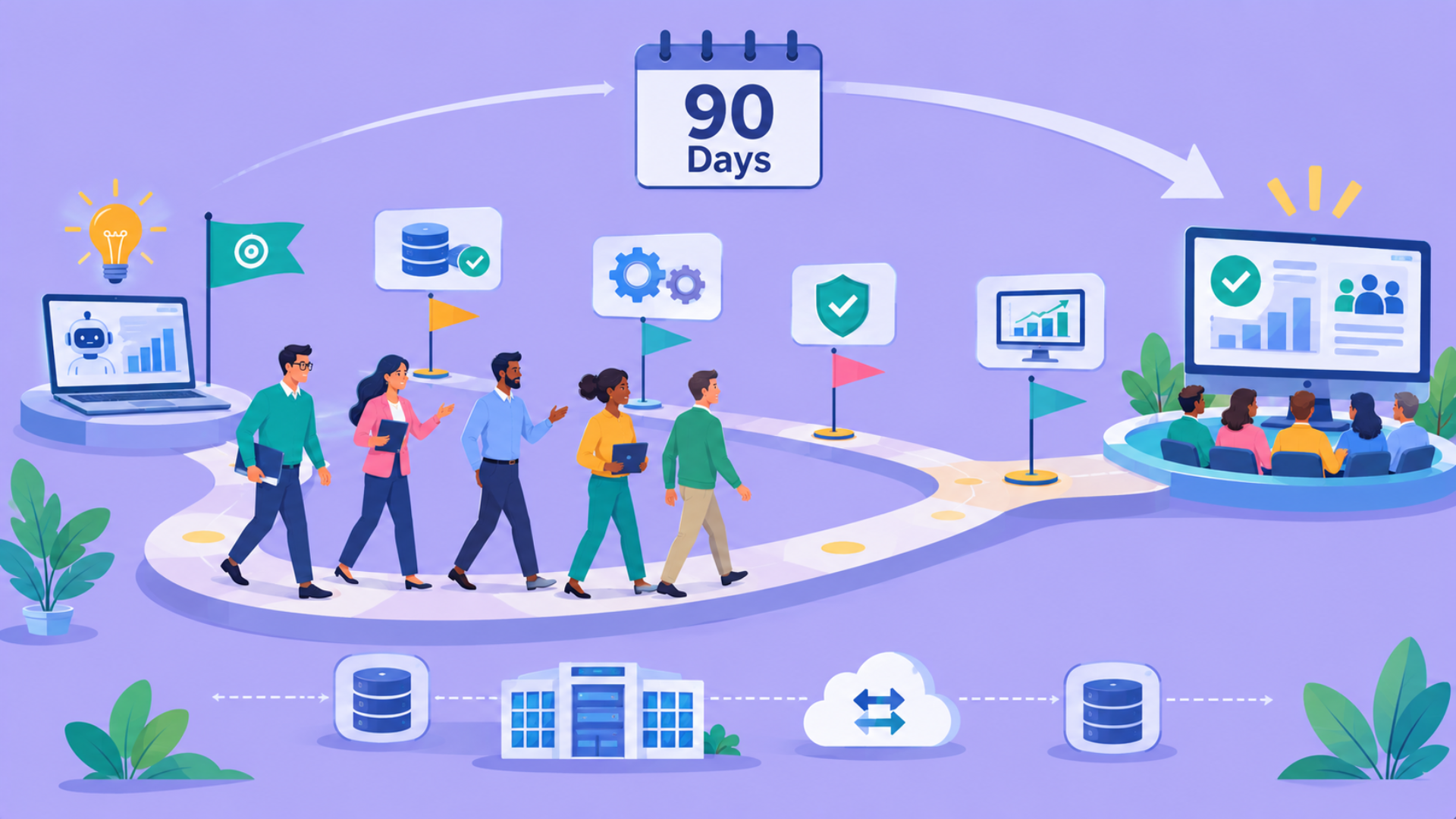
Forward deployed engineering (FDE) is built to avoid that outcome. A small team of engineers works inside the client’s environment, with the client’s data, systems, and people, and works toward a production date from the first day. Vishleshan AI’s FDE teams take AI from use case to production in 90 days. That is not a speed trick. It is a rhythm.
The stakes are real. Gartner predicts that over 40% of agentic AI projects will be canceled by the end of 2027, because of escalating costs, unclear business value, or inadequate risk controls. Each of those is a failure of operating discipline, not of the model. A good rhythm answers all three.
The rhythm at a glance
An FDE engagement runs as a loop of short cycles, not a long march from plan to launch. Each cycle ends with working software in front of real users. The table shows what happens at each move and what you can see as a result.
Move | What happens | What you can see |
|---|---|---|
Agree the outcome | One owner, one measurable goal, a baseline, and a definition of production | A written outcome and baseline |
Get inside | The team gets access to systems, data, and people | Access in place and integration risks named |
Build in increments | Short cycles on real data | Working software in each cycle |
Integrate early | The hardest connection is built first | Live connections to the systems you already run |
Test like production | Real cases, user testing, security checks, monitoring | A test record and a monitoring view |
Go live small | A limited first release, then a wider one | Usage and quality data |
Plan the handover | Client owners work beside the team | Runbooks and trained owners |
Each move removes a risk that tends to sink AI pilots. The sections below take them in order.
Start with an outcome, and get inside the environment
Every FDE engagement begins with one business owner and one measurable outcome. Not “deploy an AI agent,” but “cut the time to validate a dealer claim,” or “reduce repeat service visits.”
The team writes down the baseline today. It also agrees what “production” means. For most clients, it means live, used by real people, on real data, and monitored. A demo is not production.
In the first days, the FDE team needs access to the systems, the data, and the people. Engineers meet the users who will live with the solution. They meet the security, information technology (IT), and data owners who will have to approve it.
They map how the work is done today, including the workarounds. And they identify the three or four integration points that will decide whether the project succeeds. Finding those early is worth more than any design document.
Build in working increments
The work runs in short cycles. Each cycle ends with working software shown to real users, not slides. Users react, the team adjusts, and decisions are written down.
Real data enters the work early. The business owner holds the scope, so the project does not grow quietly. Short cycles also expose problems while they are still cheap to fix.
Integrate early, not last
Most delays hide in integration. The new solution has to read from and write to the ERP, customer relationship management (CRM), and legacy systems, usually through application programming interfaces (APIs).
An FDE team tackles the hardest connection first. If a system cannot be reached, or the data inside it is unreliable, the team wants to know in the first weeks, not the last.
Test like production, then go live small
Before go-live, the team tests with real cases, not clean samples. It runs user acceptance testing (UAT) with the people who will use the solution. It checks what happens when the AI is wrong, when a system is down, or when the input is odd. It reviews security and performance. And it sets up monitoring, so someone will know the day something drifts.
The first release then goes to a limited group. The team watches usage, errors, and feedback, fixes what it finds, and widens the group step by step. A small first release limits risk and builds trust with users and with the risk teams.
Plan the handover from the start
An FDE team works alongside named people from the client. Documentation is written as the work happens, not at the end. Runbooks, training, and ownership are part of the plan from the first cycle. The aim is a solution the client can run.
What you provide
An engagement moves at the speed of its slowest dependency. Four things from the client make the difference.
A business owner with decision rights. Someone who can say yes or no without a committee.
Access within days, not weeks. Systems, data, and environments.
Time from users and experts. Real feedback on real workflows.
A security and IT contact. One person per area who can answer questions quickly.
What slows a 90-day engagement
Access delays. A request for a system login that takes a month eats a third of the schedule.
Data surprises. The data is incomplete, inconsistent, or locked in a format nobody expected.
Late approvals. Security or governance reviews that start after the build.
Scope growth. New requests added without removing anything.
No clear owner. Decisions wait for a meeting that keeps slipping.
Integration dependencies. The one person who understands a legacy system is unavailable.
The remedy is the same each time. Raise the risk early, put it in front of the business owner, and decide.
Vishleshan AI’s forward deployed engineering teams embed with client teams to take AI from use case to production. If you have a use case and a date, we can show you what the rhythm looks like for your environment. Book a Consultation