


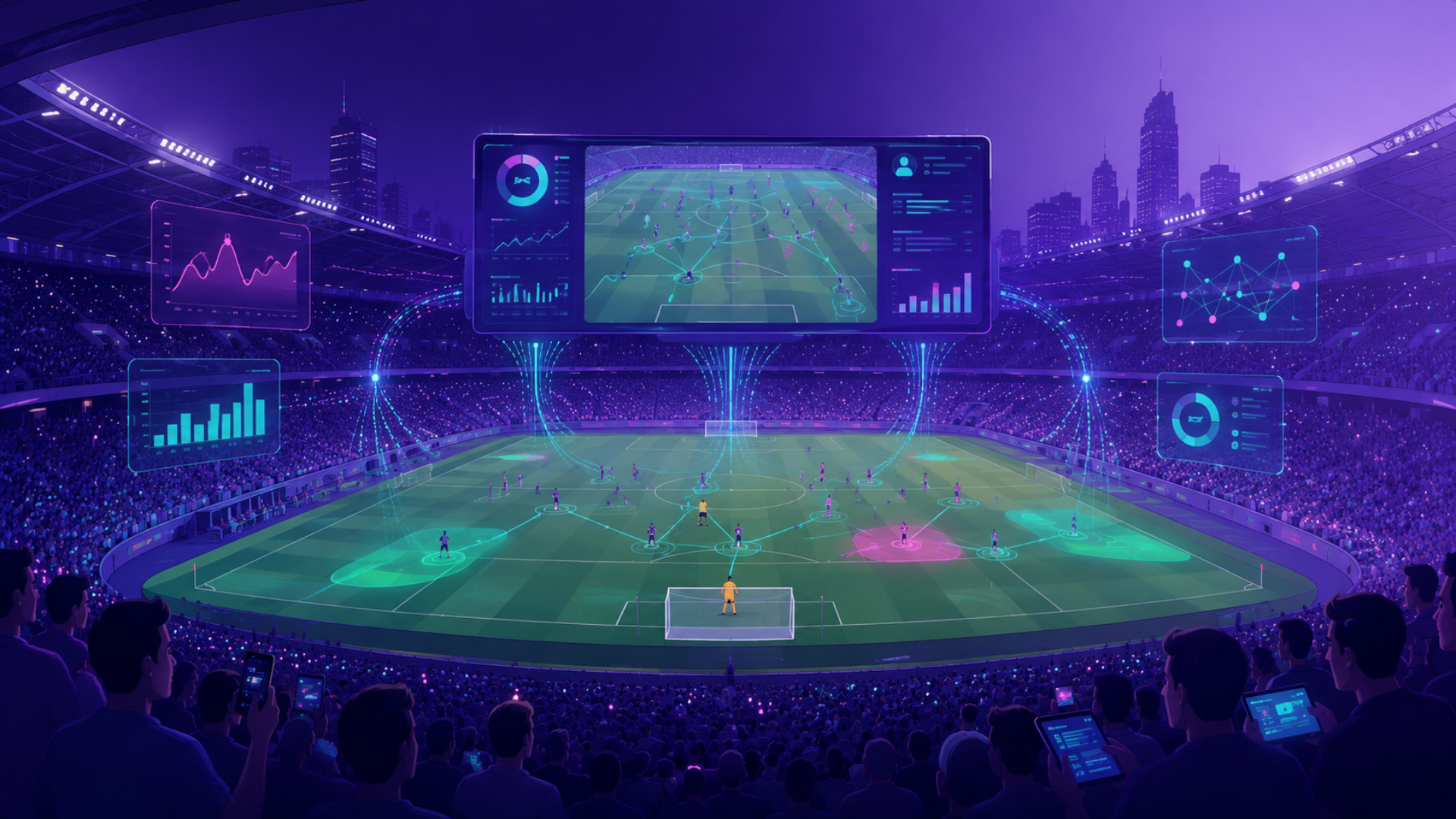
The FIFA World Cup 2026 is being played across the United States, Canada, and Mexico. It's the largest edition of the tournament in history, with 48 teams, 104 matches, and an estimated global audience of over five billion people across the tournament's run.
It is also the most technologically advanced World Cup ever staged. Artificial intelligence is now embedded in how matches are officiated, how teams prepare and perform, how broadcasters produce and distribute content, and how fans around the world experience the game. None of this is experimental. It is live, operating at scale, and changing football in ways that will outlast the tournament itself.
Here is what AI is actually doing at the 2026 World Cup, and why the implications extend well beyond sport.
Officiating: AI in the Referee's Decision
The most visible and most debated application of AI at any major football tournament is in officiating. The semi-automated offside technology first deployed at the 2022 World Cup has been significantly advanced for 2026.
The system uses a network of cameras installed around each stadium to track up to 29 data points on every player's body, limbs, torso, head at 50 frames per second. When an offside call is required, the AI reconstructs the exact positions of the relevant players at the precise moment the ball was played and generates a three-dimensional model that officials can review in real time.
What previously took several minutes of VAR review and remained subjective in many cases now produces a geometrically precise determination in seconds. The human referee still makes the final call, but the AI removes the ambiguity from the spatial data.
The technology has not eliminated controversy. It has changed its nature. Fans no longer argue about whether a player was offside. They argue about whether the data point used such as a shoulder versus a hip, or a toe versus a heel was the right one. The AI has made the decision more precise and the debate more specific.
This is an instructive pattern for enterprise AI broadly. AI does not eliminate judgment. It changes the level at which judgment operates.
Player Performance: Intelligence on the Training Ground
Long before the first match of the 2026 tournament was played, AI was already shaping which players were selected, how they were prepared, and how they were deployed tactically.
Elite national teams are now using AI-powered performance analytics platforms that process data from GPS trackers worn in training, biometric sensors monitoring recovery and fatigue, and video analysis systems that automatically tag and categorise every technical action across thousands of hours of footage.
The outputs are significant. A coaching staff that previously had to rely on manual video review and subjective observation now has quantified data on every player's pressing intensity, defensive positioning, sprint recovery rate, and technical execution under pressure — across an entire squad, updated daily.
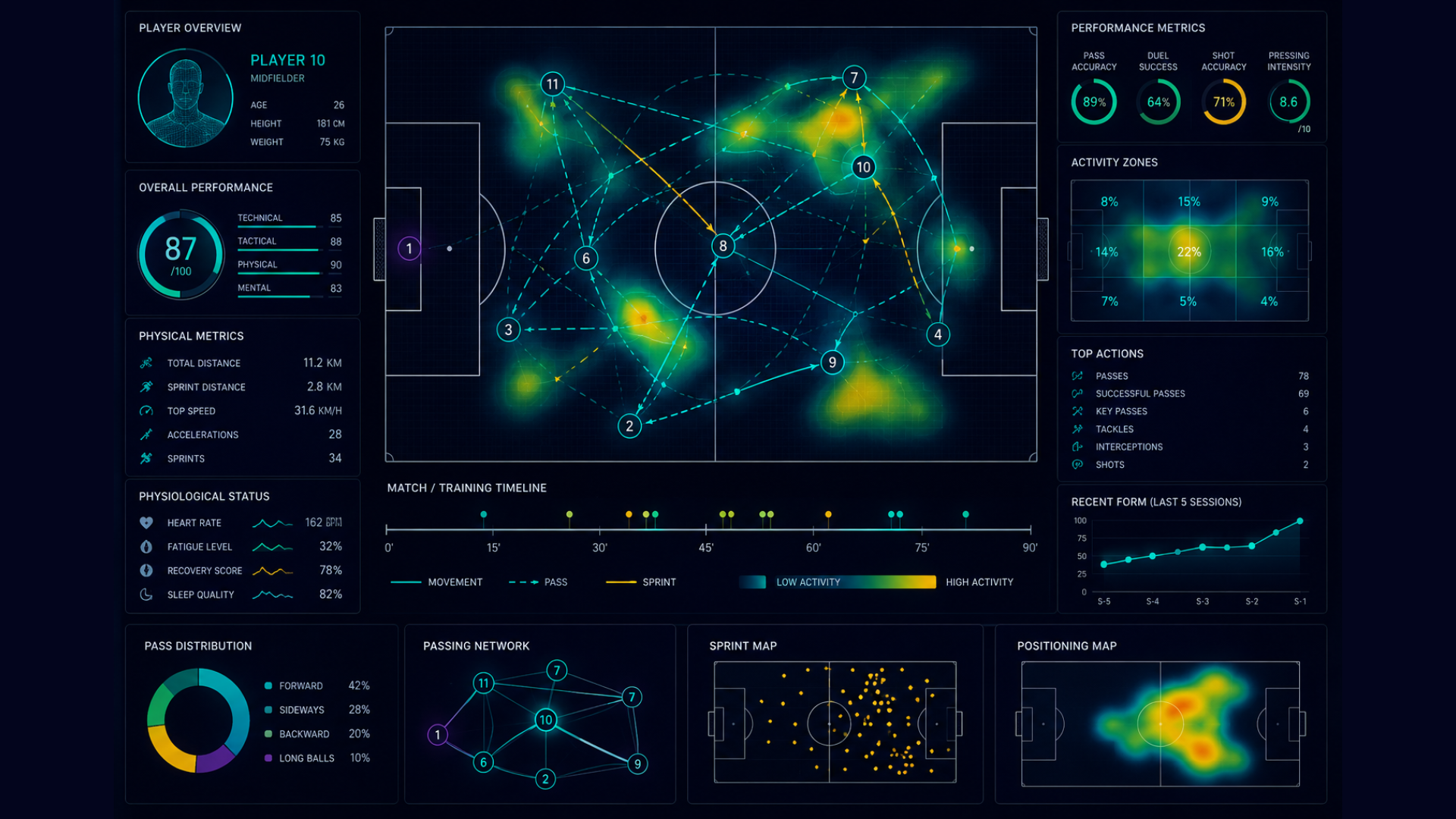
Tactical preparation has also been transformed. AI systems can now analyse an opponent's patterns of play across an entire season, identifying defensive shape tendencies, set piece routines, pressing triggers, and individual player behaviours and generate a detailed tactical profile in a fraction of the time that manual analysis would require.
The coaching staff still makes the decisions. What has changed is the quality and completeness of the information those decisions are based on.
Broadcasting: AI in the Control Room
The 2026 World Cup is being broadcast to a global audience across dozens of languages and hundreds of platforms. AI is embedded throughout the broadcast production chain in ways that most viewers will never notice but that directly shape their experience of the tournament.
Automated camera systems using computer vision track the ball and key players continuously, adjusting angles and cuts faster and more consistently than human operators can. AI systems tag and categorise every significant match event in real time like goals, shots, fouls, cards, substitutions making that metadata instantly available to broadcasters, statisticians, and content platforms simultaneously.
Highlight generation, previously a manual editing process that took hours, is now partly automated. AI systems can identify the highest-engagement moments of a match based on crowd noise, player reactions, ball trajectory, and action intensity and produce shareable highlight packages in minutes rather than hours. This is why match clips appear on social platforms almost immediately after the events they depict.
Multilingual commentary assistance is also being deployed at scale. AI tools are supporting commentators across languages with real-time statistical context, player biographical data, and tactical analysis surfacing relevant information at the right moment without requiring the commentator to break the flow of their delivery.
Fan Experience: Personalisation at Two Billion Scale
The 2026 World Cup is the first edition where AI-driven fan personalisation is operating at genuinely global scale.
Official broadcast apps and streaming platforms are using AI recommendation systems to personalise the viewing experience based on the teams, players, and match types individual fans engage with most. A fan who consistently watches defensive statistics will see different pre-match content and tactical analysis than one who tracks goal-scoring patterns. A fan following a specific player will receive push notifications tied to that player's actions rather than generic match updates.
Second-screen experiences of the data, analysis, and social content that fans consume alongside the live broadcast are being generated and personalised in real time using AI. Fantasy football and match prediction platforms serving hundreds of millions of users are running AI models that continuously update probability estimates as match conditions change.
Stadium experience is also evolving. Several 2026 venues are using AI-powered crowd management systems that monitor density, movement, and wait times across different stadium zones in real time, adjusting digital signage, concession availability, and staff deployment accordingly. The goal is reducing the friction that diminishes the live event experience like the queues, the missed moments, the navigation uncertainty without reducing the atmosphere that makes attending a World Cup match irreplaceable.
The Broader Signal
The FIFA World Cup is watched by more people than any other recurring event on earth. When AI is deployed at World Cup scale, it is being tested against an audience and an operational complexity that few environments can match.
Several things are becoming clear from how AI is performing at 2026.
AI is most effective when it handles the data-intensive, time-sensitive tasks that overwhelm human capacity at scale such as tracking 29 body points across 22 players at 50 frames per second, tagging thousands of match events in real time, personalising content for hundreds of millions of concurrent users. These are tasks where AI's advantages of speed, consistency, and scale are decisive.
The human elements of coaching judgment, referee authority, commentator craft, the atmosphere of 80,000 people in a stadium are not being replaced. They are being supported, informed, and freed from the tasks that do not require human presence.
This is the same pattern playing out in enterprise AI deployments across manufacturing, supply chain, and financial services. AI takes over the monitoring, the pattern recognition, the data retrieval, and the routine decision-making. Humans focus on judgment, relationships, and the decisions that genuinely require them.
The World Cup is demonstrating this at a scale and visibility that no enterprise deployment can match. For anyone still uncertain about what AI actually does in practice and not in theory, not in a demo, but in a live environment under maximum pressure, the 2026 tournament is about as clear an answer as exists.
Artificial intelligence is not a sideshow at the 2026 FIFA World Cup. It is embedded in officiating, performance preparation, broadcast production, and fan experience simultaneously. It is operating at a scale of five billion viewers, 104 matches, 48 nations that would have been impossible to serve effectively without it.
The technology is not making football less human. It is making the human moments like the goals, the saves, the tactical brilliance, the drama more visible, more accessible, and more precisely understood than at any previous point in the sport's history.
That is what well-deployed AI does. Not replace. Amplify.
Vishleshan AI helps enterprises deploy AI that amplifies human performance at scale from manufacturing operations to dealer networks to field service. Book a Consultation