


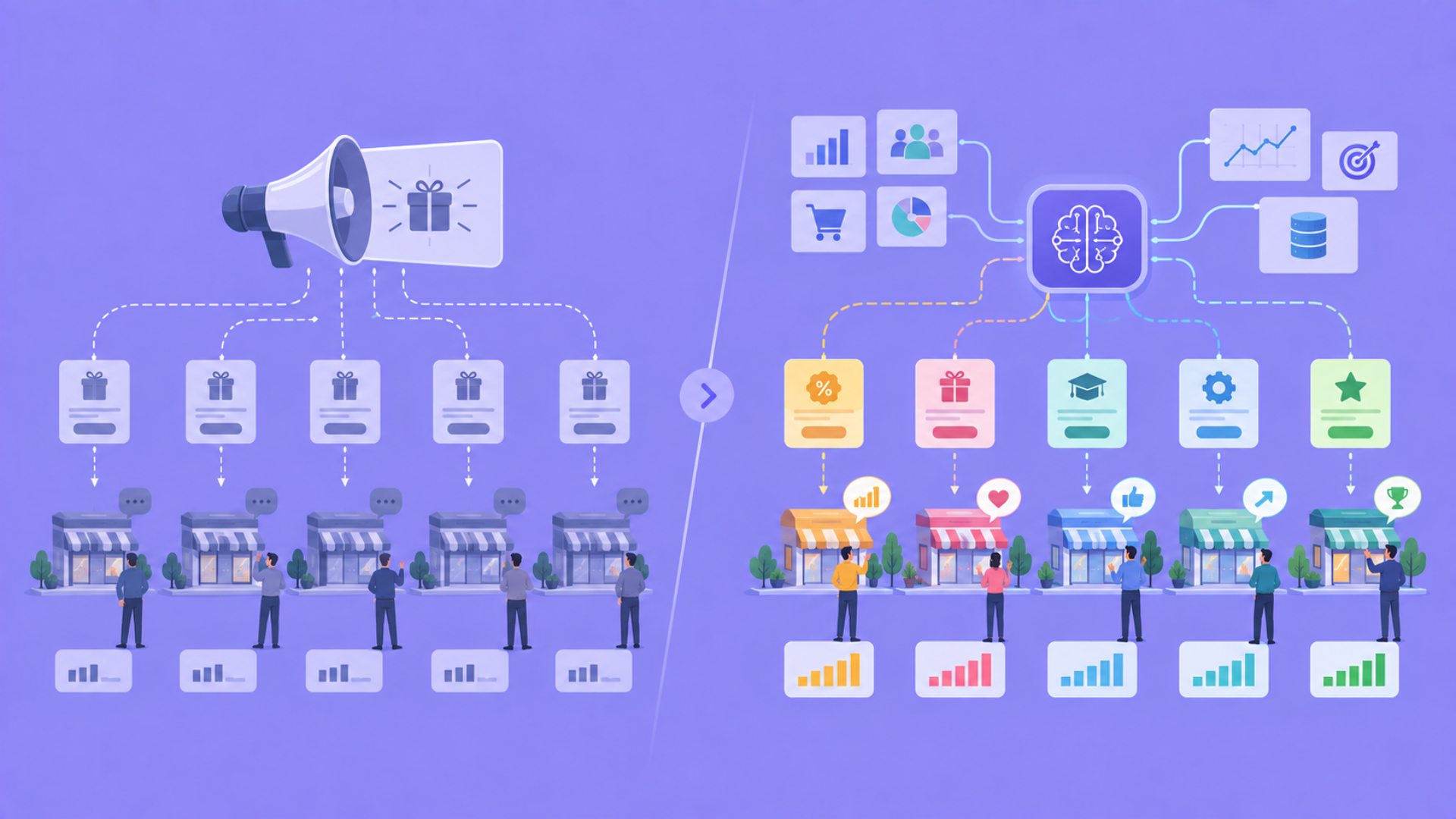
"Sell more" is not a behaviour. "Register net-new customers for Product X within 60 days of scheme activation" is.
That distinction is the starting point for channel incentive design that works. Most channel incentive programmes are built around the first type of instruction. They reward the outcome, more sales, more volume, more market share, without specifying the behaviour that produces it. The dealer is left to figure out how to hit the target. They do what they already do, slightly harder. The scheme runs. The margin is spent. The behaviour does not change.
67% of B2B channel leaders plan for indirect revenue to grow more than 30% above the previous year. That is an aggressive target to hit with incentive programmes designed for a different era. 60% of channel organisations plan to embed AI into their partner programmes by end of 2026. But AI applied to a poorly designed incentive structure delivers the wrong outcomes faster. The design comes first.
Watch how Loyalty Plus handles incentive design, targeting, and payout across a large partner network.
<embed video>
The Five Design Decisions That Determine Whether Incentives Work
1. Define the specific behaviour, not the outcome
Every effective channel incentive starts with a specific, attributable, commercially relevant behaviour. Not "sell more." Not "grow market share." A behaviour that a dealer can take a specific action to perform.
Register a net-new customer in a specific product category. Complete a certification for a new product line. Conduct a product demonstration for a minimum of five customers in a month. Maintain display compliance standards as verified by a field visit. These are behaviours. They are specific. They can be verified. They connect to the commercial outcome the manufacturer wants.
The test for whether something is a behaviour is simple. Can a dealer do it intentionally? Can you verify that they did? Does doing it move the metric you care about? If the answer to all three is yes, it is a behaviour worth incentivising.
If the answer to any of them is no, go back to the design. "Sell more" fails all three tests. A dealer cannot sell more intentionally without taking specific actions, and the specific actions they take are what you actually want to incentivise.
2. Set the right target for each partner, not a uniform target
A channel network of 5,000 dealers spans partners of dramatically different sizes, in different markets, at different stages of their relationship with the manufacturer, and with different capacity to hit targets.
A uniform target that 20% of dealers can hit comfortably, 60% need to stretch for, and 20% cannot reach regardless of effort is not a programme. It is a reward scheme for the top 20% with decoration for everyone else.
Effective incentive design sets targets that are meaningful for each partner's specific situation. A target that requires a 15% uplift from a large dealer in a mature market is a different challenge from the same uplift target for a small dealer in a developing market. One is achievable with effort. The other may not be achievable at all.
73% of channel partners say they value training programmes over rebates. This finding, counterintuitive to most incentive designers who default to financial rewards, reflects the reality that many channel partners are more motivated by capability building than by incremental margin. A programme that only offers financial rewards is leaving a significant portion of the partner motivation landscape untouched.
Target design and reward design need to reflect the diversity of the partner network. AI makes this possible at scale by modelling each partner's performance history, market conditions, and engagement patterns to recommend the right target and the right reward for each partner individually.
3. Make the earn mechanics simple and the payout fast
Channel partners disengage from incentive programmes when they cannot easily understand how to earn or when they earn but do not see the reward quickly.
Complexity kills participation. A scheme with multiple earn tracks, conditional modifiers, tier adjustments, and qualifying criteria that requires a spreadsheet to understand will not be used by the partners you most need to activate. The dealers who engage with complex schemes are usually the large, commercially sophisticated partners who were going to participate anyway. The long tail of smaller, developing partners, whose collective potential is often larger, disengages when the mechanics are not immediately clear.
Speed matters as much as clarity. When a dealer completes a qualifying behaviour and does not see a point credit or reward acknowledgment within a short timeframe, they conclude that the programme does not work or that they are not eligible. Both conclusions lead to disengagement. Real-time point crediting, the kind that shows the dealer their balance update within minutes of a qualifying action, builds the trust that sustains participation.
4. Use data to see what is actually happening, not what was reported
Most channel incentive programmes are managed on data that arrives after the decision window has closed. Monthly sales reports reviewed in the weekly manager meeting. Quarterly performance data presented in the regional review. Annual compliance assessments at programme renewal.
By the time this data is reviewed, the opportunity to intervene has usually passed. The dealer who showed early disengagement signals six weeks ago has already mentally opted out of the scheme. The partner who was on the verge of hitting their target in week three of the month missed it because nobody knew to reach out.
AI-powered incentive management changes this by making partner behaviour visible in near real time. A partner who has not scanned any product codes in ten days generates a disengagement signal. A partner who has been accelerating their registration activity suggests they are close to a tier threshold and may respond to a push communication. These signals are actionable when they appear. They are history when they appear in the next monthly report.
5. Connect the incentive to the manufacturer's system of record
A channel incentive programme that operates independently of the manufacturer's ERP and CRM generates administrative overhead and data integrity problems that grow with scale.
Qualifying purchases need to be verified against actual order records. Point balances need to reconcile with invoice data. Fraud detection needs to cross-reference claimed activity against confirmed product movement. None of this is possible when the incentive programme is a standalone system that receives periodic data exports rather than live integration with the systems where the commercial record is maintained.
The integration requirement is identical to the one described in the channel loyalty architecture discussion. The incentive platform needs to read from the manufacturer's ERP and CRM in real time, not receive a monthly extract. The additional complexity this creates in implementation is repaid many times over in data integrity, fraud prevention, and the quality of the partner intelligence the system generates.
What AI Changes in Incentive Design
AI does not replace the five design decisions above. It makes them executable at the scale of a large channel network.
Without AI, personalising targets and rewards for 5,000 dealers individually is not operationally possible. The programme manager can design the personalisation logic but cannot apply it manually to thousands of partners continuously.
With AI, the personalisation logic is applied automatically and continuously. The system models each partner's performance trajectory, identifies the target that represents a meaningful stretch for their specific situation, and recommends the incentive structure most likely to be motivating for this partner based on their historical response to different programme elements.
AI also executes the real-time monitoring that makes the fourth design decision possible. It watches partner behaviour across the full network simultaneously, surfaces the signals that warrant intervention, and can trigger automated responses, a push notification, a targeted offer, a reach-out from the regional manager, at the moment the signal appears rather than when the monthly report is reviewed.
60% of channel organisations planning to embed AI into their partner programmes by end of 2026 are recognising that the scale and speed at which effective incentive management needs to operate is beyond manual capability. AI is not making the design decisions. It is executing them at the scale the channel network requires.
The Mistakes That Undermine Incentive Programmes After Launch
Even well-designed incentive programmes fail if three common post-launch mistakes are not avoided.
Changing the rules mid-programme. Partners who commit to a behaviour based on the programme terms need those terms to remain stable. Mid-scheme changes, even well-intentioned ones, erode trust and reduce participation in subsequent schemes. Design the programme right from the start rather than adjusting it after launch.
Not communicating progress. Partners who cannot easily see where they stand against their target disengage. Regular, clear progress communication, ideally through the mobile interface where they are already interacting with the programme, maintains motivation through the scheme period. A partner who knows they are three product registrations away from a tier upgrade is more likely to push for those three registrations than one who has no visibility of their position.
Measuring participation rather than behaviour change. The metric that matters is not how many partners are enrolled or how many points were redeemed. It is whether the specific behaviours the programme was designed to incentivise actually changed. Tracking these behaviours before, during, and after the scheme period is the measurement discipline that reveals whether the programme worked and what to change for the next one.
Vishleshan AI's Loyalty Plus is built for channel incentive management at enterprise scale. It combines the real-time data integration, AI-powered personalisation, and behaviour-based mechanics that make channel incentives work at the scale of large dealer and retailer networks across automotive and consumer electricals markets. Our forward deployed engineering (FDE) approach builds the data connections that make the programme reflect what is actually happening in the channel. Book a Consultation