


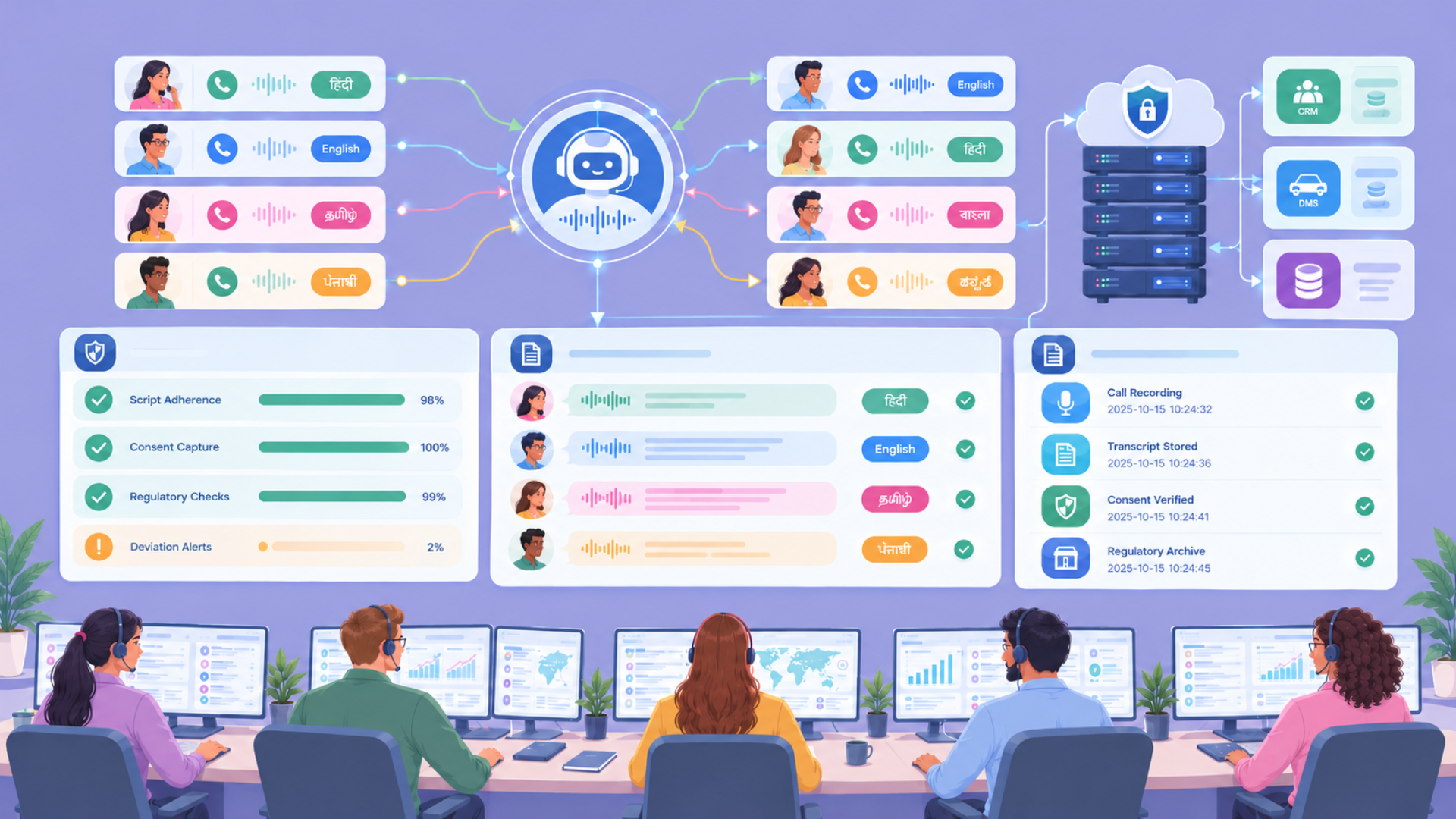
Imagine a pan-India bank running thousands of verification calls every month. Each call asks the customer to confirm who they are, understand why the bank is calling, and agree to something. Many of those customers are most comfortable in Tamil, Kannada, Bengali, or Marathi, not in English or Hindi.
Indian regulators expect customers to understand what they are consenting to. Practitioners read that as a strong reason to run consent conversations in the customer’s own language. Consent given in a language the customer does not fully follow is hard to defend. Check the exact requirement for each workflow with your compliance team.
This is the context for AI voice agents in Indian financial services. The language question and the compliance question are closely linked. An English-first voice tool, however capable elsewhere, starts at a disadvantage.
The Compliance Landscape To Check First
Three areas shape how AI voice agents can be used in Indian financial services. Treat this as a checklist for your compliance team, not as legal advice.
Customer consent and comprehension. Rules on customer consent and KYC expect that the customer understands what they agree to. Confirm which workflows need consent captured, in which language, and how the record should be kept.
Data protection. The Digital Personal Data Protection Act governs how personal data, including call recordings and transcripts, is collected, stored, and used. Sector regulators add their own rules on where some financial data may be stored. Confirm which data rules apply to each call type.
Sector conduct and recordkeeping rules. Banks, NBFCs, insurers, and asset managers each follow their own regulator’s rules on customer conduct, collections practices, disclosures, and record retention. Calls tied to investment products carry extra documentation expectations in capital markets.
The common thread is evidence. Whatever the rule, the institution needs to show what was said, in which language, when, and with what outcome.
Where AI Voice Agents Fit
Product cross-sell. Banks and insurers hold large customer bases with products many customers do not know they qualify for. An AI voice agent can call eligible customers, explain a product in their language, answer basic questions, and pass interested customers to a human advisor with the conversation context already captured. The disclosures and product terms the agent may state are set in the call flow and guardrails, inside the boundaries the institution defines.
Inbound lead qualification. Enquiries arrive from websites, branches, and campaigns at all hours. An agent can answer, ask the qualifying questions, and route the lead to the right team. Fast response matters because customers often contact several providers.
Callbacks on abandoned applications. A customer who starts a loan or account application and stops is a warm lead. An agent can call back, find out what stopped them, help them finish, or hand them to a human.
Adjacent workflows to evaluate carefully. Payment reminders, loan servicing queries, and verification calls follow the same pattern: structured conversations that depend on live account data. They also carry the strictest rules. Collections practice, consent for verification, and calling-hours rules vary by regulator and product. A sensible approach is to start with the lower-risk workflows above and add these only after compliance has signed off on the call flows and guardrails.
What To Ask Of Any AI Voice Agent In A Regulated Setting
Ask for specifics on each of these.
Recording and transcripts. Is every call recorded and transcribed? Where is that data stored, who can access it, and how long is it kept?
Language handling. Does the agent converse natively in the customer’s language, or translate on top of an English core? How does it behave when a customer switches language mid-call?
Guardrails. Can the institution fix the exact wording of disclosures and set limits on what the agent may say or do? What happens when the customer asks something outside those limits?
Human handoff. When a conversation needs a person, does a human take over the live call with the context intact?
Audit trail. Can the institution retrieve the record of a specific call, including its outcome and any escalation, when a regulator or customer asks?
Data location and security. Where does call data live, and does that meet the institution’s own data rules and regulator expectations?
Telephony. Does the agent work with the institution’s existing numbers, or does it require a change of carrier?
Where Vidura Calling Fits
Vidura Calling is a multilingual AI voice agent built on the Vidura Agentic Platform. It is not a scripted IVR. It holds real conversations inside call flows and guardrails designed around the institution’s business.
It speaks with customers in their own language, so one agent can serve every market and region. It connects to CRM, ticketing, payment systems, and custom APIs, so calls draw on live data. The agent can create records, update status, and schedule appointments during the call. Every call is recorded and transcribed, with AI-generated summaries and logged outcomes. When a conversation needs a person, the agent hands off and the institution’s team takes over the live call. It connects to the phone number or SIP trunk the institution already owns, so no carrier change is needed.
Deployment follows a structured process: discovery, solution design, configuration, testing and UAT with the client team, go-live, and ongoing optimization. For regulated workflows, the institution’s own compliance team should review the call flows, guardrails, and data handling during design and UAT.
Vidura Calling is available now for financial services discovery conversations. Vishleshan AI's forward deployed engineers work inside client environments to build the system integrations, configure the call-flow guardrails, and support the institution’s compliance review. Book a Consultation