


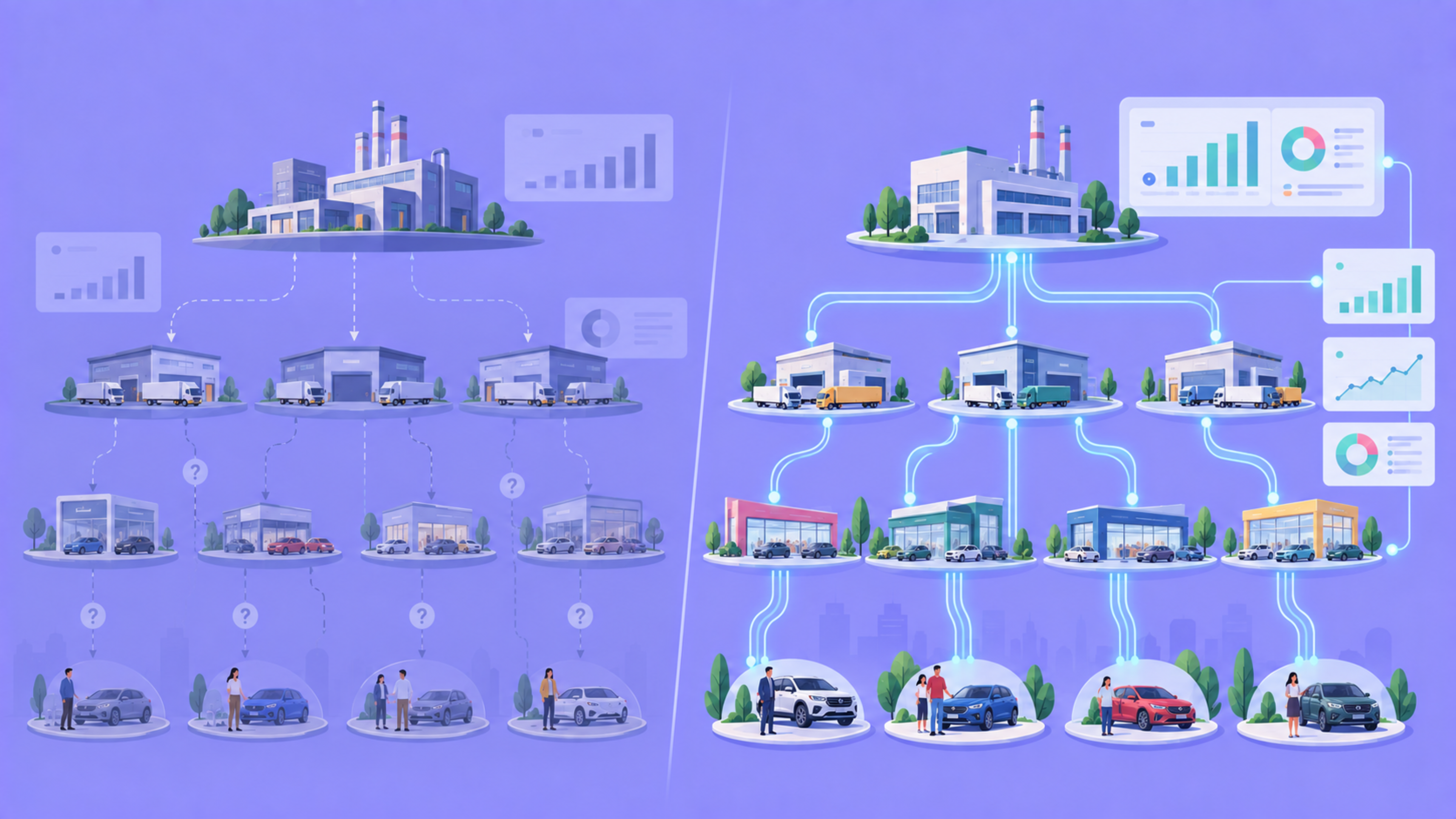
An OEM ships a consignment to its distributor. It records the sale. The primary sales data is updated. The revenue is recognised.
What happens next is largely invisible.
The distributor sells to dealers. The dealers sell to end customers. Each step in that chain generates data. What is selling and what is not, which products are moving in which regions, which dealers are growing and which are contracting, where inventory is accumulating and where it is running out. All of it is data that exists in the channel. Almost none of it reaches the OEM in a form and at a speed that allows it to be used for decisions.
By the time secondary sales data arrives, through monthly distributor reports, quarterly channel reviews, or periodic uploads from dealer management systems, weeks or months have passed. The market has moved. The inventory imbalances that were developing three weeks ago have already become stockouts in some locations and overstocking in others. The product that was gaining momentum in a specific region has already been purchased from a competitor because nobody saw it happening in time to respond.
This is the secondary sales blindspot. It is one of the most consequential data gaps in OEM channel management. And it is solvable with the right data architecture and the right channel intelligence infrastructure.
What Secondary Sales Actually Measures
Before describing the problem and the solution, it helps to be precise about what secondary sales data is and how it differs from what OEMs typically have.
Primary sales is the sale from the OEM to the distributor or the first-tier partner. The OEM records this data directly from its own order management system. It is accurate and timely because the OEM controls the data source.
Secondary sales is the sale from the distributor to the dealer or retailer. The OEM does not control this transaction. It happens in the distributor's system. The data only reaches the OEM if the distributor chooses to share it, in the format the distributor can export, on the schedule the distributor maintains.
Tertiary sales is the sale from the dealer or retailer to the end customer. This is the furthest from the OEM's direct visibility and the most important for understanding true market demand. Primary and secondary data tell the OEM what moved through the channel. Tertiary data tells it what the market actually bought.
The gap between primary sales and tertiary sales is where most OEM channel management runs blind. Primary sales can be strong while secondary and tertiary are stalling, indicating channel inventory building up rather than genuine market demand. Tertiary sales can be accelerating in a specific region while primary and secondary data shows nothing unusual, because the acceleration is drawing down existing channel inventory before it becomes visible in replenishment orders.
Managing a channel without secondary and tertiary visibility is, as one distributor management platform describes it, like driving a car blindfolded.
What the Gap Actually Costs
The secondary sales blindspot has four specific and measurable commercial consequences.
Inventory imbalances that develop invisibly:
Without secondary sales data, OEMs allocate inventory based on primary sales history and distributor forecasts. Distributors have their own incentives when forecasting. They may overstock to protect against stockouts or understock to manage working capital. The OEM's allocation decisions are built on a signal that reflects distributor behaviour rather than market demand.
The result is inventory that accumulates at some dealers while others run out. Stockouts damage the brand and send customers to competitors. Overstocking ties up dealer working capital and eventually requires price support or promotional spend to clear. Both outcomes have direct cost implications for the OEM.
Demand signals that arrive after the opportunity has passed:
A product gaining momentum in a specific region generates a demand signal at the tertiary level. That signal has to move from end customer purchases, through dealer ordering behaviour, through distributor reporting cycles, before it reaches the OEM. By the time the OEM sees it and can respond by increasing allocation or adjusting production, weeks have passed.
In that time, competitors who have better secondary visibility, or who happen to have stock in the region, have captured the demand. The OEM's late response either misses the opportunity entirely or captures it at a higher cost than an earlier response would have required.
Channel investment allocated to reported performance rather than actual performance:
OEMs invest in channel support through co-marketing funds, promotional schemes, training programmes, and priority stock access. Without secondary sales data, these investments are allocated based on what distributors and dealers report rather than what they actually achieved.
This creates a consistent distortion. Distributors who are good at reporting receive support that distributors who are performing but reporting poorly do not. The investment does not follow the performance. It follows the reporting.
Aftermarket parts planning that misses true demand:
Real-time channel visibility improves aftermarket parts planning by providing accurate information about dealer sales, inventory levels, and replenishment requirements across the distribution network. Instead of relying on shipment history or distributor forecasts, OEMs with secondary sales visibility can use actual sell-through data to predict demand more accurately, position inventory closer to customers, reduce stockouts, and improve parts availability.
For OEMs where aftermarket parts and service represent a significant share of revenue and margin, this is not a marginal improvement. It is a fundamental improvement in how the aftermarket business is managed.
Why the Gap Has Persisted
Secondary sales data has always been valuable. The reason most OEMs do not have it in a useful form is not lack of interest. It is the complexity of collecting it from a channel that the OEM does not control.
Distributors and dealers operate their own systems. Dealer management systems, ERP platforms, and point of sale systems that were chosen for the dealer's own operational needs, not for the OEM's reporting requirements. These systems vary across the network. The same data element, a sale of a specific product at a specific price on a specific date, is recorded differently in different systems.
Collecting secondary sales data requires either integrating with each dealer's system, which is technically complex and commercially sensitive, or requiring dealers to submit reports in a defined format, which is administratively burdensome and produces data that is only as timely as the reporting cycle.
Neither approach has produced the real-time secondary sales visibility that OEM channel management needs. Integration projects have been too complex to complete at network scale. Reporting requirements have been met with resistance and inconsistency from channel partners who see them as additional administrative burden.
The result is that most OEMs have some secondary sales data, but it is delayed, inconsistent, and incomplete. It is good enough for retrospective analysis. It is not good enough for real-time channel management decisions.
What Closing the Gap Requires
Three capabilities are required together to close the secondary sales visibility gap in a large OEM channel network.
Data collection that does not depend on dealer reporting:
The sustainable approach to secondary sales data collection is not asking dealers to report. It is connecting to the transaction signals that dealers generate naturally in the course of their operations, without requiring additional effort from dealer teams.
Modern approaches use a combination of methods. Integration with dealer management systems where technically feasible and commercially agreed. Point of sale data feeds where available. Product registration data that confirms an end customer has activated a product. Digital transaction signals from connected products. Scan-based verification from loyalty and scheme programmes where dealers confirm product movement through the app-based interaction they are already doing.
None of these requires dealers to generate new reports. Each captures data that already exists as a byproduct of normal dealer operations.
A data layer that normalises across heterogeneous dealer systems:
The data collected from different dealer systems arrives in different formats, with different field names, different date conventions, and different product codes. Making it comparable requires a normalisation layer that maps the data from each source to a consistent schema.
This normalisation is not a one-time exercise. Dealer systems change. New dealer management platforms are introduced. Product catalogues are updated. The normalisation layer needs to adapt to these changes without requiring a rebuild of the data collection architecture each time.
AI that identifies patterns across the normalised data in near real time:
Once normalised secondary sales data is available, AI can identify the patterns that matter for channel management decisions. Which products are selling through faster than replenishment can match. Which dealers are showing early signs of slowing sell-through that may indicate competitive pressure. Which regions are showing demand signals that are not yet reflected in primary sales data. Which inventory positions are developing into imbalances that will become stockouts or overstocking situations within weeks rather than months.
These patterns are identifiable from the data. They are not identifiable from the monthly reports that most OEM channel management teams rely on, because the patterns have already resolved by the time the report is reviewed.
What Real Secondary Sales Visibility Enables
OEMs with functioning secondary sales visibility make different channel management decisions from those without it.
Vehicle and product allocation is made against actual sell-through data rather than distributor forecasts. Products in high sell-through locations receive priority allocation. Products building up in low sell-through locations receive reduced allocation before the overstock becomes a commercial problem.
Channel support investment follows actual performance. Distributors and dealers who are selling through effectively receive support that compounds their performance. Those who are accumulating inventory receive different support, focused on sell-through activation rather than additional stock.
Demand signals from the end market reach the OEM in near real time rather than with a multi-week lag. The OEM can respond to emerging demand before competitors with less visibility have captured it.
Aftermarket parts planning uses actual consumption data rather than shipment history and distributor forecasts. Parts availability improves. Stockouts reduce. The aftermarket business generates better returns from the same inventory investment.
Vishleshan AI works with OEMs across automotive and consumer electricals channels to build the data infrastructure and AI intelligence layer that makes secondary sales visibility operational. Our forward deployed engineering (FDE) approach builds the channel data integrations inside the client's actual distribution environment, connecting the data that exists in the channel to the intelligence that the OEM needs to manage it effectively. Book a Consultation