


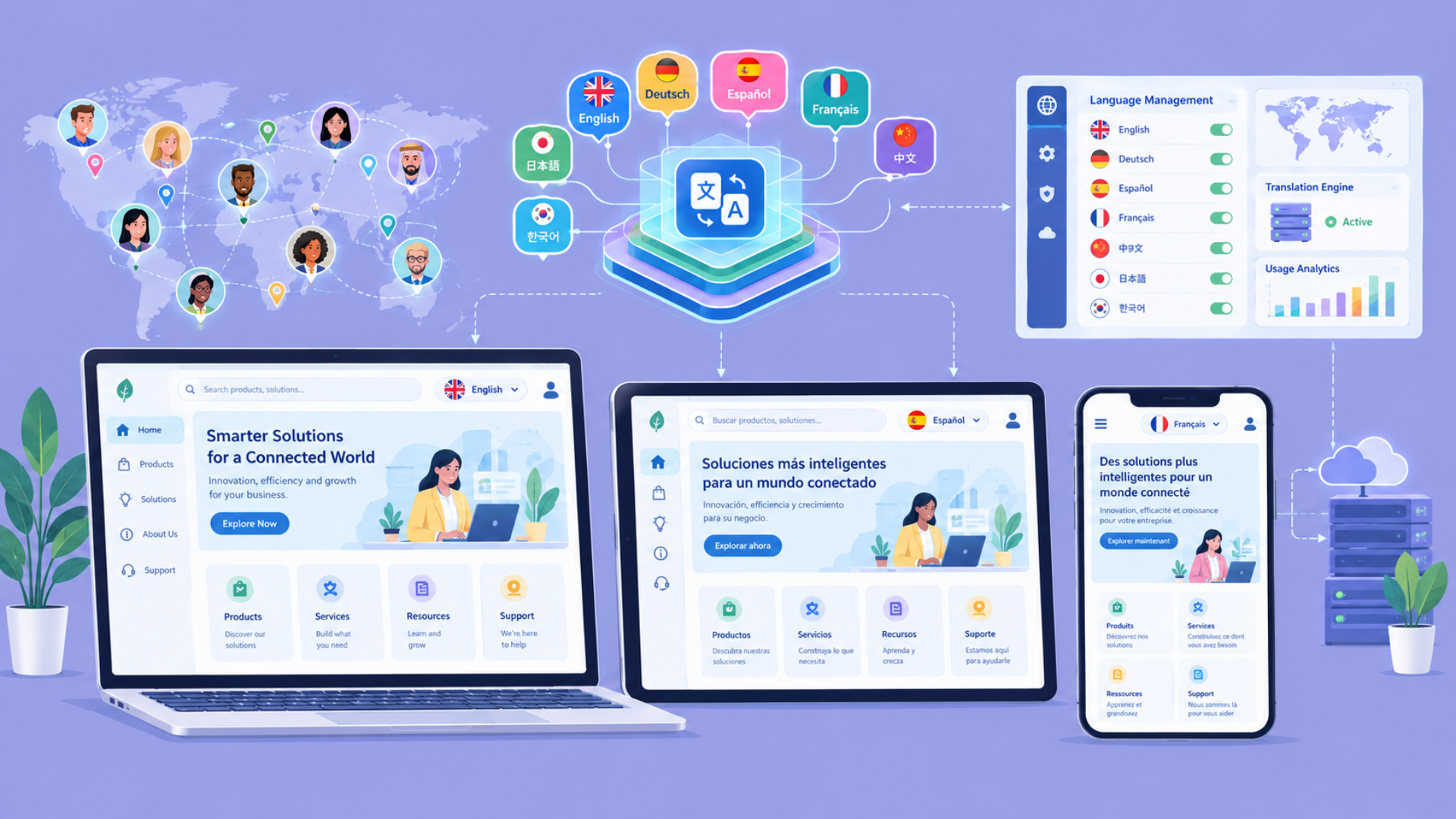
The enterprise translation market has fragmented. On one side are traditional localisation platforms built for managing translation workflows, extracting strings, routing them to translators, importing them back, and maintaining version consistency across markets. On the other side are real-time translation layers designed for dynamic enterprise applications that generate content on the fly and cannot be managed through a workflow.
Most enterprises that need real-time translation are evaluating static localisation platforms. They are solving the wrong problem with the wrong tool.
Vidura Translate is built for the real-time category. It translates any website, mobile application, or enterprise system as content loads, in place, without a separate build or a parallel version to maintain. One engine across Indic and international languages. Multiple integration paths. Production deployment that follows a defined five-step process rather than a multi-month rebuild project.
The Core Capability
Vidura Translate operates as an agentic AI layer between the enterprise application and the end user. The application generates content in its primary language. Vidura Translate detects that content, routes it through the translation engine, selects the right AI model for the specific context and language pair, and renders the translated content in place on the same page, in the same design, before the user sees it.
The detect-translate-render cycle happens as content loads. Not on a delay. Not through a separate translation page. The user sees their language. The application has no knowledge that any of this is happening.
This in-place rendering is the architectural property that separates Vidura Translate from browser-level machine translation tools that apply a generic translation layer on top of content the browser has already received. Vidura Translate operates at the application level with a translation engine that is contextually aware of the content it is processing, caches results for speed, and maintains the application's design integrity across all languages.
Multiple Integration Paths. One Engine Behind All of Them.
The integration path that makes most sense depends on the technical stack the enterprise runs. Vidura Translate supports multiple integration options, all running on the same underlying translation engine so quality and behaviour stay consistent regardless of which one is used.
Web snippet. A drop-in script for any website, framework-independent. Adds a language selector to the existing layout. Translates content in place with caching built in for speed. For most web deployments, this is the fastest path from decision to production.
SDKs for apps. Native options are available for React, Next.js, React Native, Flutter, iOS, and Android. They run on the same engine as the web snippet.
API. An API is available for other platforms and systems.
The consistency of the translation engine across all integration paths matters operationally. An enterprise running a web portal, a mobile app, and an internal ERP tool does not manage separate translation configurations or separate quality baselines. One engine, one language catalogue, one admin console.
Language Coverage
Vidura Translate supports a wide and growing range of Indian and international languages, with native-script rendering. You manage which languages are live from one place, and new languages can be added over time. Every language runs on the same engine, so quality and behavior stay consistent across all of them. Confirm the languages you need during discovery.
The Agentic Architecture Underneath
Most enterprise translation tools, even those marketed as AI-powered, apply a single translation model to content. The model translates. The content appears. If the model produces an awkward or inaccurate translation for a specific language pair or content type, the output is what it is.
Vidura Translate operates differently because it is built on the Vidura Agentic Platform rather than as a standalone translation tool. The agentic architecture means multiple language models operate within the system, each selected for accuracy in specific contexts and language pairs. The AI agent routes content through the translation engine and selects the right model for the context.
For enterprise content where translation accuracy matters commercially, specifically technical product content, financial information, legal terms, and compliance-related communications, this model selection matters. A single translation model applied uniformly performs well on common language pairs and common content types. It performs less well on less common language pairs and domain-specific terminology. An agentic system that routes by context produces more consistent quality across the full range of content an enterprise generates.
The caching layer built into this architecture also matters for performance at enterprise scale. A dealer portal that thousands of channel partners access daily would generate an enormous translation request volume if every page view triggered a fresh translation. Intelligent caching stores translation results and serves them from cache when the same content is requested again, which helps with speed and cost.
Security and Governance
Enterprise translation involves content that may be sensitive. Customer account data rendered in a portal. Supplier pricing in a procurement tool. Internal financial information in a management dashboard. The translation layer processes this content, which creates a data governance requirement that many enterprise teams underestimate when evaluating translation solutions.
Vidura Translate's security architecture addresses this with four properties.
Authenticated and encrypted. Every request runs through an authenticated, encrypted layer. Data is encrypted in transit.
Isolated per customer. Data is isolated for each customer and never mixed across tenants. Access is role-based.
Controlled access. On the web, requests work only from your approved domains. No access to your database, CMS, or internal systems is needed.
Audit logging. Every action is audit-logged, and no sensitive data is retained in the logs.
Your content is not used for training. Vidura Translate does not use your content to train Vishleshan’s own AI models.
Deploy where you need it. It can run hosted, or in a hybrid deployment where the translation runtime sits in your own cloud or data center. You keep your own database and manage your own AI engine credentials. This suits enterprises with strict data residency and privacy requirements.
How content is handled. The service receives the text to translate, along with basic technical details such as the page address. Translations are cached for a short, configurable period, and the cache can be cleared by page, site, or component. Where data is stored depends on how you deploy it, and the AI provider’s terms apply to the engine you use.
The Deployment Process
Vidura Translate follows a five-step deployment process from initial engagement to production.
Discovery. Confirm the application surfaces to be translated, the languages required, and the specific content types and technical integration requirements.
Configuration. Set up the organisation account, API keys, and the language catalogue. Define which languages are active and how content is handled for each.
Integration. Install the web snippet, SDK, or API package that matches the technical stack. This is typically the shortest phase for web deployments using the snippet.
Validation. Test translation accuracy across the relevant content types, validate layout integrity in each language, confirm native script rendering, and test caching behaviour under load.
Go live. Deploy to production, confirm monitoring is active, and expand to additional languages or surfaces as needed.
Where Vidura Translate fits
E-commerce and catalogs. Product listings, pricing, and descriptions are translated in real time as inventory changes.
Customer and partner portals. Support content and self-service tools are available in each user’s language without separate builds. This includes dealer and distributor portals.
Enterprise applications. Internal tools become accessible to a global workforce without translation backlogs.
Content platforms. Frequently updated content is translated as it publishes, not on a delay.
Vidura Translate is part of the Vidura Agentic Platform, Vishleshan AI's platform for enterprise-grade agentic AI. It works alongside Vidura Calling, Vidura Intelligent Gateway, Vidura Context Manager, and Vidura Governor as a component of the broader enterprise AI infrastructure that Vishleshan AI deploys and operates. Book a Consultation