


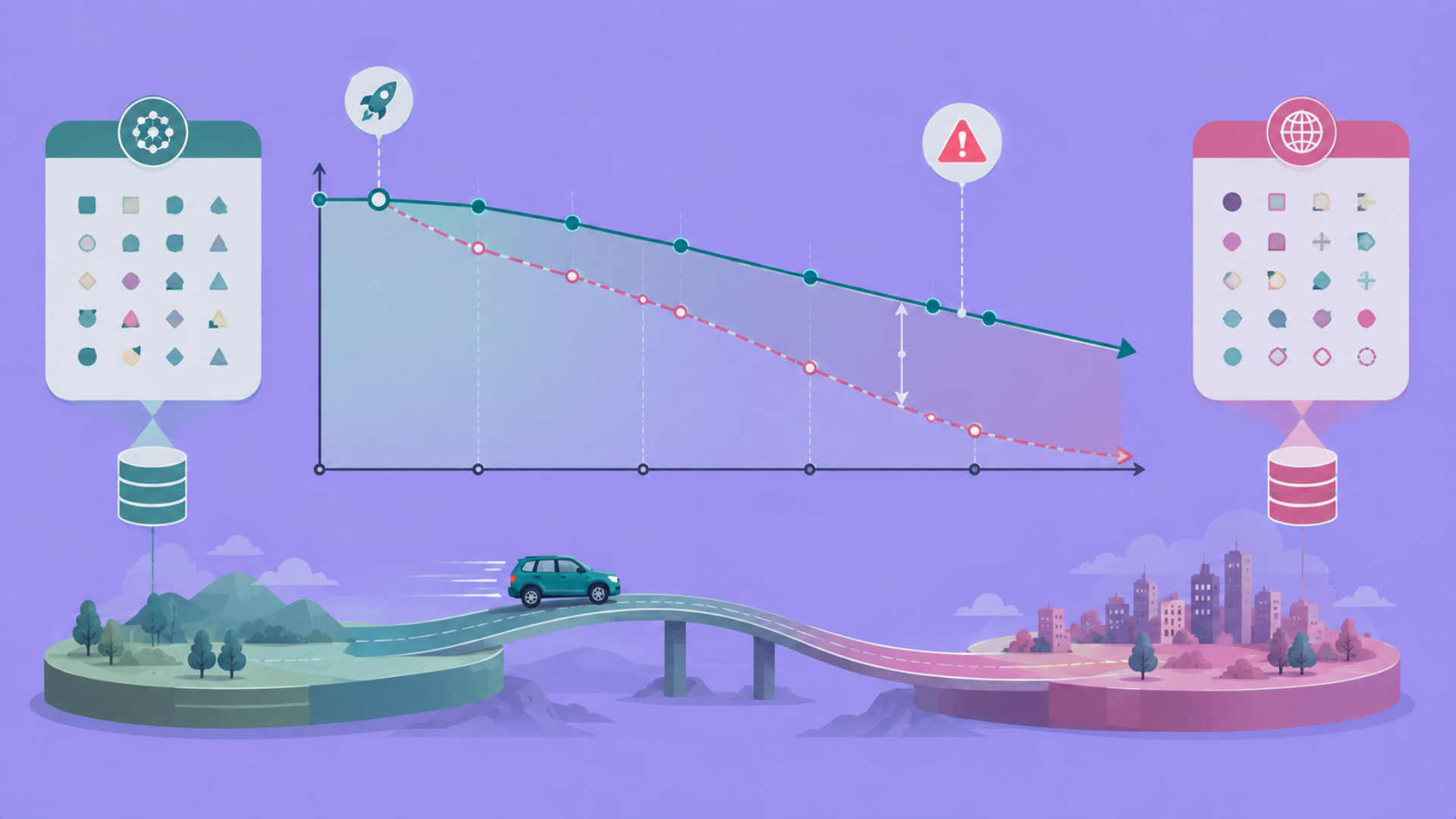
AI models do not fail dramatically. They fade.
A model is deployed. It works well. Months pass. The business environment changes. Customer behaviour shifts. Supply chain patterns change. A new product launches. A regulation comes in.
The model keeps running. Nobody notices anything is wrong. But slowly, the predictions get less accurate. The recommendations get less useful. The decisions the business makes based on those recommendations quietly get worse.
This is AI drift. And a peer-reviewed study found temporal degradation in 91% of AI model-dataset combinations tested across healthcare, finance, transportation, and weather. The researchers call it AI aging.
It is not an edge case. It is the norm.
What Causes AI Drift?
Every AI model is trained on data from a specific period. That data reflects how the world worked at that time.
The world keeps changing. The model does not automatically update.
When the gap between the world the model was trained on and the world it is now operating in gets large enough, performance drops. That gap is drift.
There are two main types.
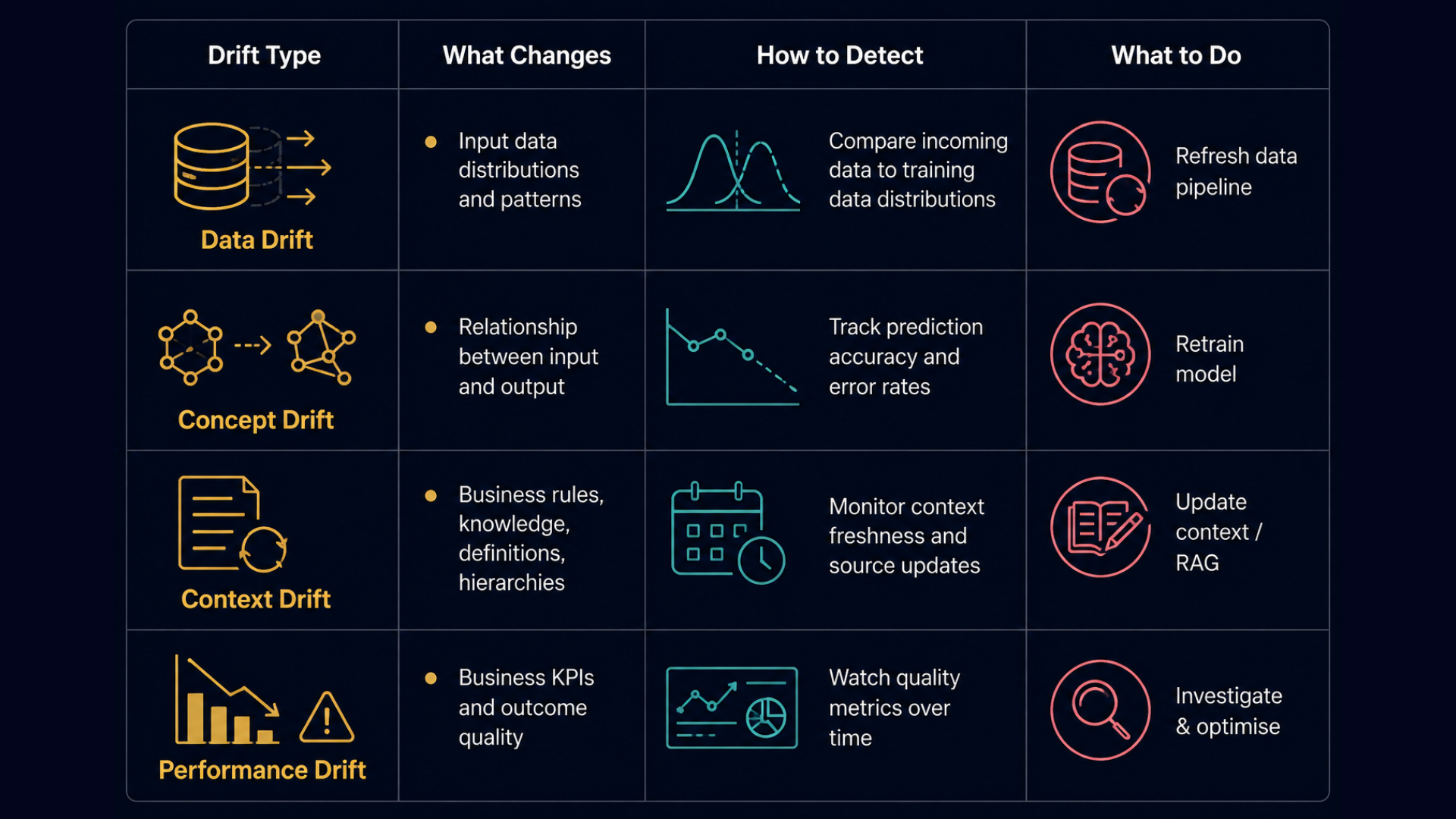
Data drift. The inputs the model receives start looking different from what it was trained on. A demand forecasting model trained before a product launch starts seeing purchasing patterns it has never encountered. A fraud detection model trained on one type of transaction sees a new payment method it does not recognise. The inputs have changed. The model has not adapted.
Concept drift. The relationship between inputs and outcomes changes. A credit risk model trained during a period of low inflation may have learned that certain income levels predict reliable repayment. When inflation rises sharply, that relationship breaks. The same inputs now predict different outcomes. The model does not know this.
Both types are common. Both are serious. Neither is visible without monitoring.
Why It Is Hard to Spot
AI drift is easy to miss because the model does not tell you it is struggling.
It keeps producing outputs. It keeps responding to queries. It keeps generating recommendations. Nothing breaks. There is no error message.
The only sign is a slow, quiet decline in quality. And that decline is often invisible unless someone is specifically looking for it.
In a large enterprise, the people using an AI output and the people who built the AI system are often different teams. The users notice something feels off. They stop trusting the tool. They work around it. The AI system keeps running but stops being used.
This is the failure mode that costs the most and gets diagnosed the least.
How Enterprise Teams Detect Drift
Detection requires monitoring. Monitoring requires knowing what to measure.
Here are the most practical approaches.
Monitor output quality over time. Track the metrics that matter for your specific use case. For a demand forecasting model, track forecast accuracy against actuals. For a fraud detection model, track false positive and false negative rates. For a customer service AI, track resolution rates and escalation rates. If these metrics are moving in the wrong direction, drift is a likely cause.
Compare incoming data to training data. Look at the data the model is receiving today. Compare it to the data it was trained on. If the distributions are shifting significantly, that is an early warning of data drift before it shows up in output quality.
Monitor for context drift. This is often overlooked. Context drift happens when the business definitions, rules, and knowledge that inform the AI start going stale. A product catalogue that changes. A pricing policy that updates. A dealer hierarchy that restructures. The model keeps operating on the old context. Monitoring the freshness of the context the model relies on catches this before it affects outputs.
Set up alerts before performance drops. Good drift monitoring is proactive. It flags warning signs before the performance decline is obvious. Setting thresholds for when to investigate, rather than waiting for complaints, is what separates reactive maintenance from proactive model health management.
When Is Drift Most Likely to Happen?
Some situations increase drift risk. Knowing them helps you monitor more carefully at the right times.
After a major market event. A pandemic. A tariff change. A competitor entering the market. Any event that changes customer or supplier behaviour will affect models trained before it.
After a significant business change. A new product line. A new channel. A new geography. The model was not trained on data from these contexts.
After a regulatory change. New rules change how decisions get made. A model trained under old rules may produce outputs that are no longer appropriate.
After system changes. A new data source gets added. An existing one gets modified. The schema changes. The model starts seeing data structured differently from what it learned on.
In each of these cases, do not wait for complaints. Run an active drift check.
What the EU AI Act Adds to This
From August 2026, continuous post-deployment monitoring of high-risk AI systems is a compliance obligation under the EU AI Act. This applies to AI used in credit decisions, insurance, employment, and access to essential services.
For enterprises in financial services, automotive, and other regulated sectors, drift monitoring is no longer just good practice. It is a legal requirement.
The monitoring needs to be documented. Alert thresholds need to be defined. Retraining decisions need to be recorded with a rationale. Regulators may ask to see evidence that the model is being monitored continuously, not just reviewed periodically.
This is one more reason to treat drift monitoring as infrastructure rather than as a maintenance task.
What to Do When Drift Is Detected
Detecting drift is step one. Responding to it is step two.
The response depends on how severe the drift is and what caused it.
Minor drift. Recalibrate the model. Adjust thresholds. Update the context the model relies on. This is often enough for early-stage drift.
Significant drift. Retrain the model on more recent data. This is a larger undertaking but necessary when the world has changed enough that the original training data is no longer representative.
Fundamental concept drift. In some cases, the relationship between inputs and outcomes has changed so significantly that the model architecture itself needs to be reconsidered. This is the most serious scenario and typically requires a full rebuild of the AI system for that use case.
The key is having a clear decision process before drift occurs. Who is responsible for reviewing drift alerts? What threshold triggers a retraining? Who approves the retrained model before it goes back into production? These are governance questions. They need answers before the model is deployed, not after it starts drifting.
The Simple Test for Your Current AI Deployments
For any AI system currently running in production, ask these three questions.
When was the model last retrained? If the answer is "when it was deployed," and significant time has passed, drift is likely.
Are you monitoring output quality against a business metric? If the answer is no, you will not know when performance drops until users stop trusting the system.
Has anything significant changed since training? A major market event, a business change, a system update. If yes, a drift check is overdue.
These are simple questions. But in most enterprises, they do not get asked systematically. The result is AI that is running but slowly failing.
Vishleshan AI's forward deployed engineering (FDE) approach builds monitoring into every AI deployment from day one. Drift detection, alert thresholds, and retraining triggers are part of the production architecture, not an afterthought. This is how AI stays useful after go-live, not just at launch. Book a Consultation