


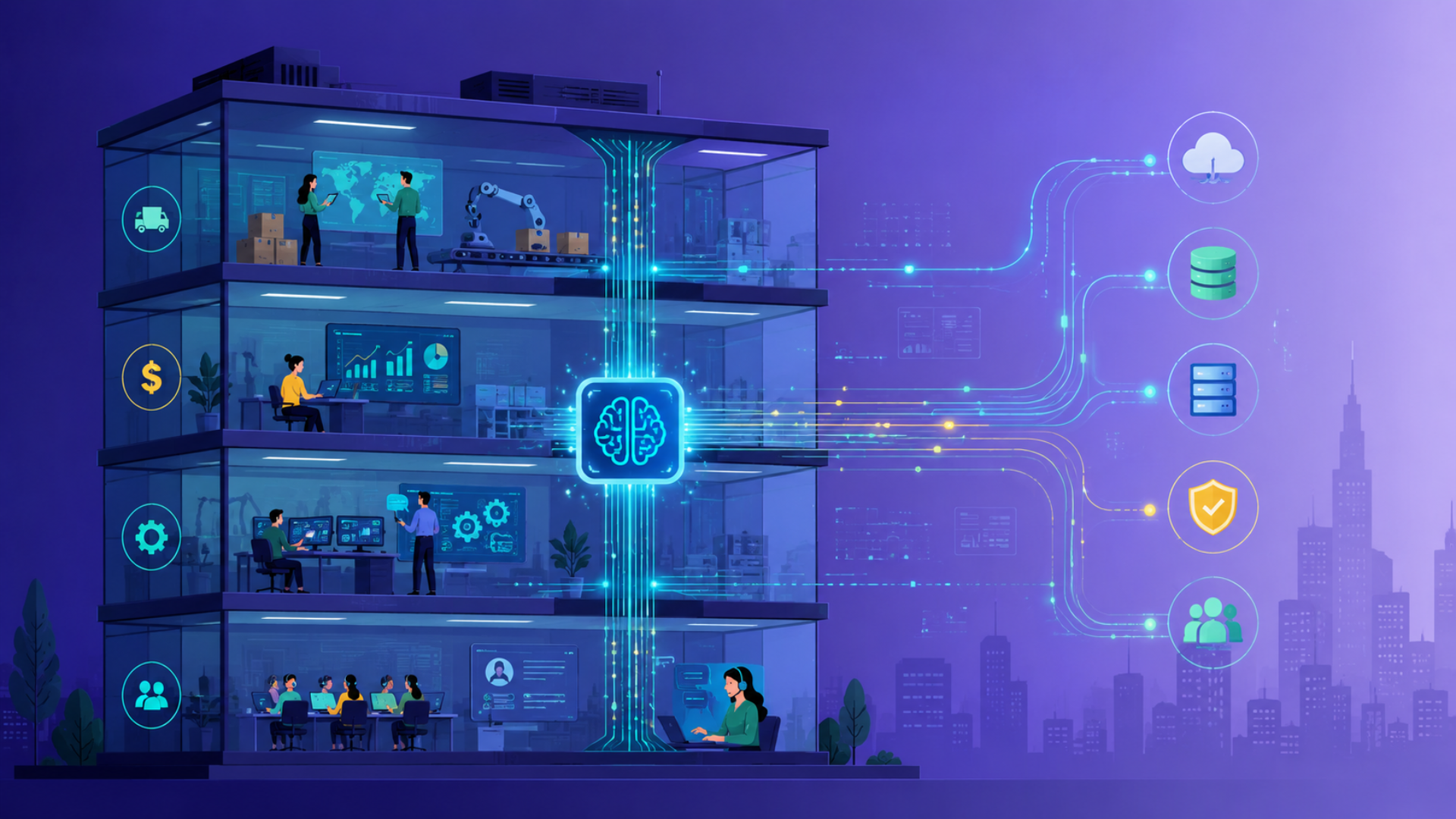
Enterprise AI is one of the most used and least defined terms in business technology today. Every software vendor claims to offer it. Every analyst report tracks its adoption. Every conference agenda features it prominently.
And yet a surprising number of enterprise leaders, when pressed, cannot give a precise answer to what separates enterprise AI from the AI that anyone can access on a consumer app. That gap in understanding creates real problems: misinformed vendor selection, unrealistic expectations about what AI can deliver without foundational work, and programmes that look like enterprise AI but produce consumer-grade results.
This piece gives a clear answer to the question. What enterprise AI actually is, how it differs from consumer AI, what makes it work, and why the distinction matters for how you invest in and evaluate it.
The Simple Definition
Enterprise AI is artificial intelligence deployed inside the systems, workflows, data environments, and governance structures of a large organisation, integrated with the operational infrastructure the business runs on, and held accountable to measurable business outcomes.
That definition has four components that each matter.
Inside the systems the business runs on. Enterprise AI connects to ERP, CRM, MES, supply chain platforms, dealer management systems, and the other operational infrastructure that the organisation depends on. It does not operate alongside these systems as a separate tool. It integrates with them, reads from them, and writes actions back into them.
Connected to real business data. Enterprise AI operates on the organisation's actual data, including transactional records, customer histories, operational signals, and proprietary knowledge, not on generic training data. The outputs are relevant to this specific business because the inputs are drawn from this specific business.
Governed for compliance and security. Enterprise AI operates within the regulatory, security, and governance frameworks that apply to the organisation. Access controls, audit trails, data privacy obligations, and approval hierarchies are built into the architecture, not bolted on as afterthoughts.
Accountable to business outcomes. Enterprise AI is evaluated against business metrics that appear on a profit and loss statement: fill rate improvement, unplanned downtime reduction, procurement cycle compression, dealer response time. Not against technical benchmarks or demonstration performance.
How Enterprise AI Differs From Consumer AI
The clearest way to understand enterprise AI is to contrast it with what most people experience as AI day to day.
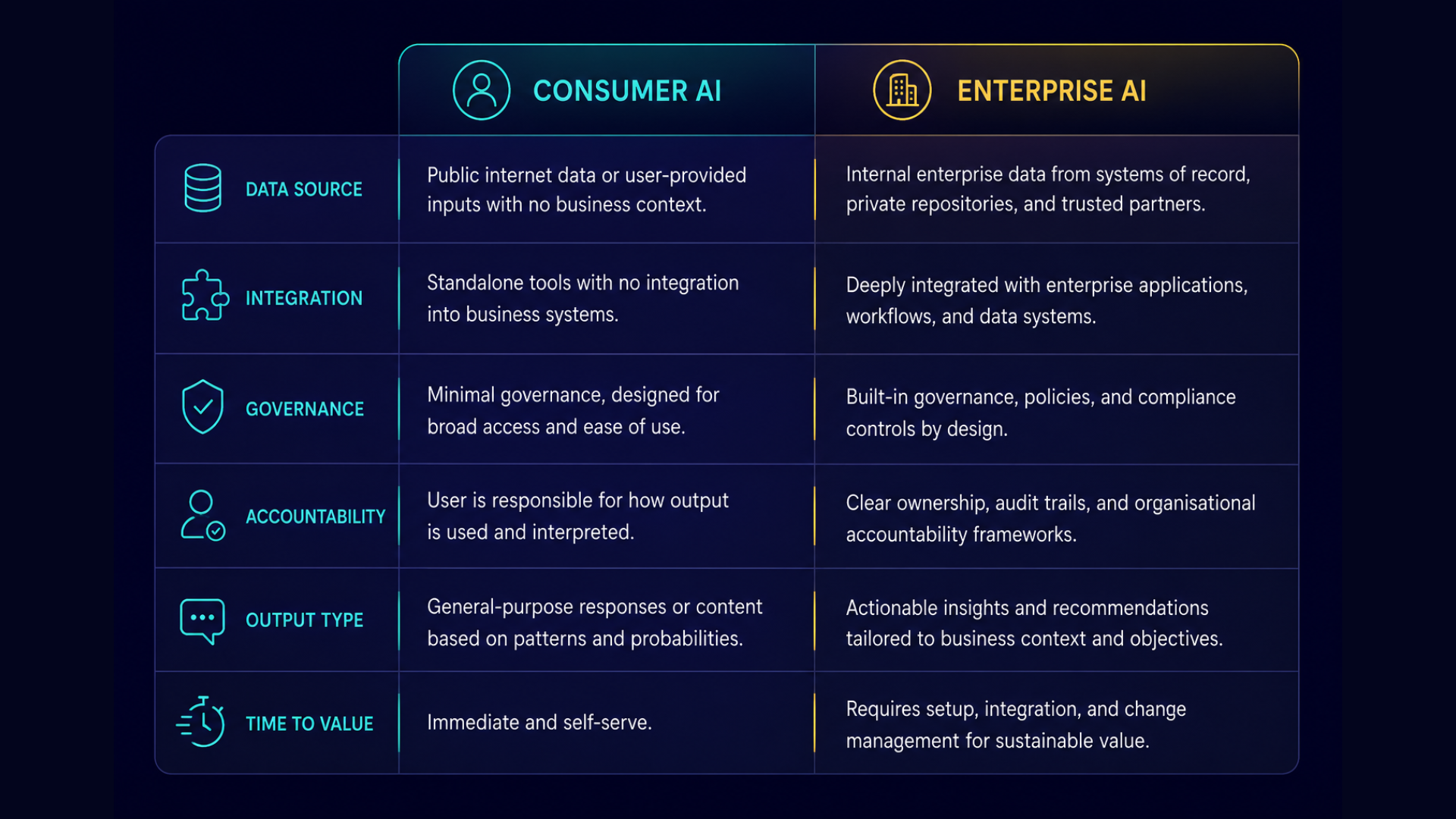
Consumer AI, whether it is a conversational assistant, a content generation tool, or a recommendation engine, is designed to be immediately useful to any user with no setup, no integration, and no organisational context. It is powerful, accessible, and deliberately general. It knows nothing specific about your business, your data, your customers, or your constraints.
Enterprise AI is the opposite. It is specific, integrated, and contextual by design. It knows your approval hierarchies because they were built into its context layer. It knows your supplier relationships because it reads from your procurement system in real time. It knows your compliance constraints because they were encoded into the governance architecture before deployment. It is not general intelligence made available to anyone. It is business intelligence built for this organisation.
An AWS report published in mid-2026 found that nearly two thirds of UK organisations had adopted AI in some form, but only 24 percent had reached the stage where AI was integrated into core business processes and decision-making. The gap between those two numbers is the gap between consumer-grade AI adoption and genuine enterprise AI deployment. Organisations in the first group have access to AI tools. Organisations in the second group have enterprise AI.
The Components of Enterprise AI
Enterprise AI is not a single technology. It is an architecture composed of several layers, each of which needs to be working for the whole to function in production.
The data layer connects to the source systems where the business's operational data lives: transactions, customer records, production signals, supplier data. This layer extracts, cleans, and contextualises that data, making it available to the AI layer in a form that is accurate, current, and business-rule-aware. Without a functioning data layer, the AI layer is operating on incomplete or outdated information, which is the most common reason enterprise AI produces impressive pilots and unreliable production results.
The AI reasoning layer takes the contextualised data and applies intelligence to it: pattern recognition, anomaly detection, recommendation generation, decision support, autonomous action within defined parameters. The specific AI techniques used, whether machine learning models, large language models, or agentic AI systems, depend on the use case. What is consistent across enterprise AI deployments is that the reasoning layer is receiving business-specific context rather than operating on generic training data alone.
The context layer carries the business rules, approval hierarchies, compliance constraints, and operational policies that define how this organisation works. This is what prevents an AI agent from recommending a supplier switch that violates a strategic partnership agreement, or approving a purchase order that exceeds an undocumented threshold, or generating a customer communication that is technically accurate but commercially inappropriate. The context layer is what separates AI that operates intelligently within a business from AI that operates intelligently in isolation from it.
The integration layer connects AI outputs back to the operational systems where action needs to happen. A supply chain recommendation that cannot trigger a purchase order in the ERP is not enterprise AI. A maintenance alert that cannot schedule a technician in the field service system is not enterprise AI. The integration layer is what closes the loop between AI intelligence and business action, and it is consistently the most technically demanding part of an enterprise AI deployment.
The governance layer provides the audit trails, access controls, cost management, and human oversight mechanisms that allow enterprise AI to operate within regulatory and organisational accountability frameworks. In sectors with specific compliance obligations, including financial services, automotive manufacturing, and healthcare, this layer is not optional. It is the condition under which deployment is permissible.
The Main Categories of Enterprise AI in 2026
Enterprise AI manifests in several distinct forms, each addressing different business problems and requiring different architectural approaches.
Process automation AI handles high-volume, rule-bound workflows: invoice processing, purchase order validation, compliance checking, data extraction from documents. This is the most mature category of enterprise AI and the one with the most established track record of measurable ROI. It is also the category most frequently confused with traditional automation, which executes predefined rules rather than reasoning through variable situations.
Decision support AI analyses data from multiple enterprise systems and surfaces recommendations that improve the quality and speed of human decisions: which supplier to use given current performance and availability data, which customers are at highest risk of churn, which production schedule optimises throughput against current demand. The human makes the decision. The AI ensures that decision is made with better information, faster.
Conversational and knowledge AI gives employees, customers, and partners a natural language interface to enterprise knowledge and workflows. A field technician asking a question about a specific piece of equipment and receiving an accurate answer drawn from the product manual and service history. A dealer querying order status and receiving a real-time response from the inventory system. A procurement manager asking about current supplier performance and receiving a summary generated from live data. These applications are powered by conversational AI connected to enterprise knowledge bases through RAG architecture.
Agentic AI goes beyond decision support and conversation to autonomous execution: agents that monitor operational signals, reason through situations, and take actions within defined guardrails without waiting for a human to initiate each step. Agentic AI represents the current frontier of enterprise AI deployment, and it is where the largest operational improvements are visible in organisations that have deployed it successfully in production.
Why Enterprise AI Is Hard to Deploy
If enterprise AI is this clearly defined and this valuable, why do so many programmes stall between pilot and production?
The core answer is that enterprise AI requires capabilities that are distinct from the capabilities required to build general AI. A team that can build an impressive AI demonstration using a powerful model and synthetic data may not have the skills to integrate that AI with a specific organisation's ERP configuration, data quality gaps, compliance obligations, and approval workflows in a way that performs reliably under production conditions.
An AWS report from 2026 estimated that closing the gap between basic AI adoption and genuine enterprise AI integration could unlock significant unrealised productivity gains, with skills shortages cited by half of organisations as the primary barrier to deeper deployment.
The deployment challenge is not primarily technical. It is contextual. Enterprise AI works when the people building it understand the specific environment they are deploying into well enough to discover the constraints that no requirements document fully captures. This is the problem that forward deployed engineering exists to solve: engineers embedded inside the client's actual environment, working against actual systems and data, accountable to production outcomes rather than delivery milestones.
What Good Enterprise AI Looks Like in Practice
The clearest signal that an enterprise AI deployment is working is not technical performance in a controlled environment. It is operational adoption in a production environment.
A supply chain team using AI-generated supplier recommendations in their daily workflow rather than waiting for a weekly report. A field service organisation where technicians are getting accurate, contextually relevant answers to service queries in the field rather than calling the support desk. A dealer network where inventory imbalances are being flagged and addressed in real time rather than discovered in a monthly review.
In each case, the AI is integrated into how work actually gets done, not available as an option that requires extra effort to access. That integration is the outcome of getting the architecture right across all five layers described above, and of deploying it with the engineering depth and operational understanding that real enterprise environments require.
Enterprise AI is not a feature you purchase or a model you deploy. It is an architecture you build, and an operating model you design around it. The organisations extracting the most value from AI in 2026 are the ones that understand this distinction clearly, and that have invested accordingly in the integration, governance, and deployment capability that makes the difference between AI that works in a demonstration and AI that works in production.
Vishleshan AI builds production-grade enterprise AI systems for large organisations across automotive, consumer electricals, financial services, and supply chain, using forward deployed engineers who work inside client environments until the AI is genuinely live and generating measurable outcomes. Book a Consultation