


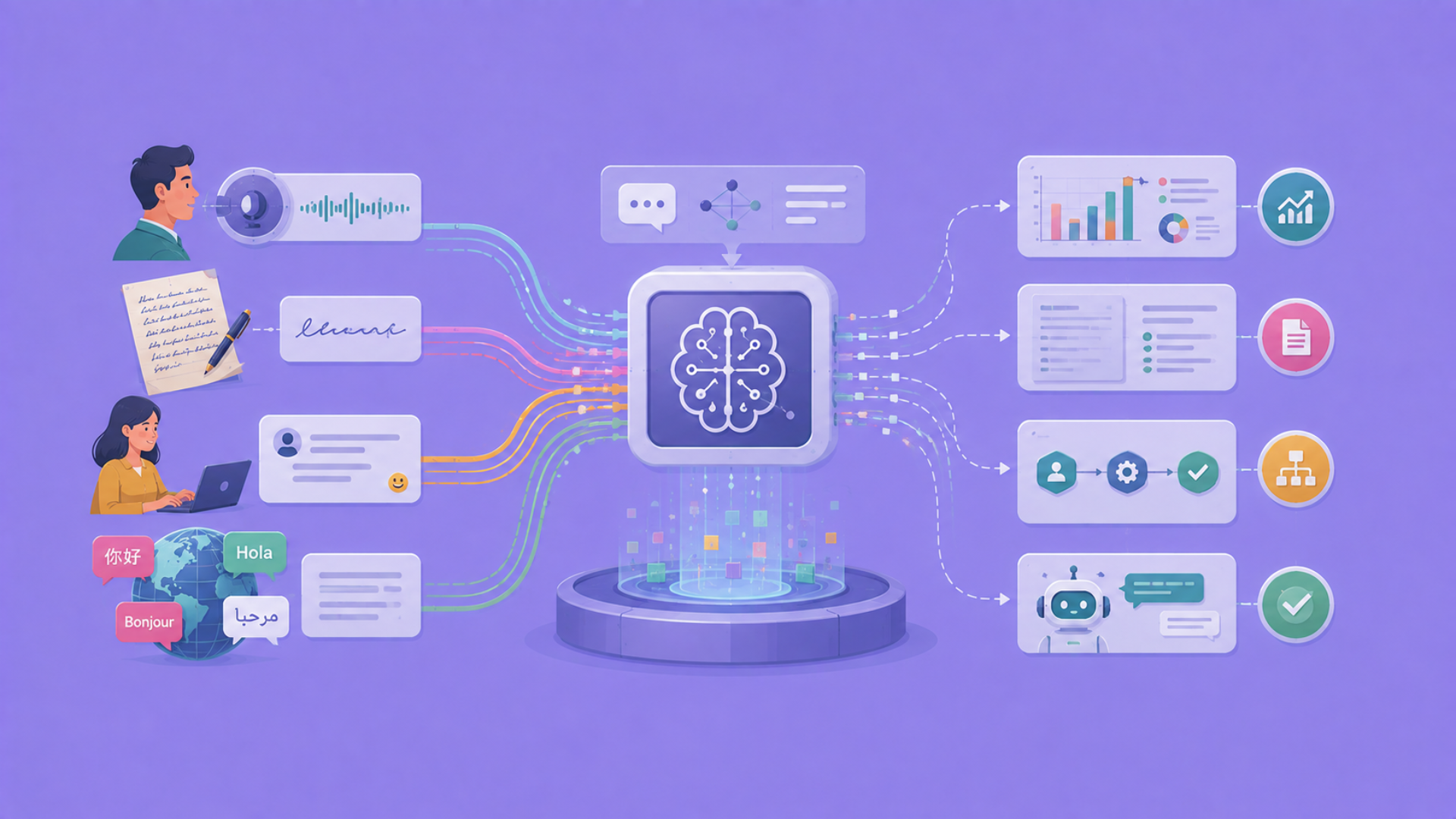
Human beings communicate in language. Every business runs on language. Documents, emails, customer queries, contracts, reports, call recordings, service tickets, and instructions. All of it is language.
For most of enterprise computing history, computers could only work with language if it was first converted into structured data. A number in a field. A code in a dropdown. A date in a formatted cell. Unstructured text was hard to process at scale.
Natural language processing (NLP) changed this. It gives AI systems the ability to read, understand, interpret, and generate human language. Not as a keyword match. As genuine understanding of meaning, intent, and context.
The NLP market reached $34.83 billion in 2026. It is projected to reach $93.76 billion by 2032. Financial services leads adoption, followed by healthcare, retail, and manufacturing. These are not sectors experimenting at the edges. They are sectors where NLP has become operational infrastructure.
What Natural Language Processing Actually Is
NLP is a branch of AI that deals specifically with human language. It combines linguistics, computer science, and machine learning to enable computers to understand text and speech the way humans do.
Earlier approaches to NLP relied on rules and pattern matching. If a sentence contains certain words, classify it as a complaint. If a document contains certain phrases, flag it for review. These approaches worked for narrow, well-defined tasks. They broke down when language was ambiguous, varied, or context-dependent.
Modern NLP is built on large language models. These models learn language by processing vast amounts of text. They learn grammar, vocabulary, meaning, context, and the relationships between ideas. They can understand the same concept expressed in different ways. They can interpret tone, sentiment, and intent. They can work across multiple languages.
The practical result is AI systems that can process unstructured text and speech at enterprise scale, with an accuracy and flexibility that rule-based systems could never achieve.
What NLP Can Do: The Core Capabilities
NLP encompasses a range of specific capabilities. Understanding which capability applies to which business problem is the starting point for practical application.
Text classification assigns categories to documents, messages, or records. A customer service system that reads an incoming email and routes it to the right team is doing text classification. A compliance system that reads communications and flags potentially sensitive content is doing text classification. A procurement system that reads invoices and assigns them to the right cost centre is doing text classification.
Sentiment analysis identifies the emotion or opinion in text. Is this customer review positive, negative, or neutral? Is this dealer feedback satisfied or frustrated? Is this employee survey response concerned or confident? Sentiment analysis makes it possible to process thousands of text responses and understand the overall pattern without reading every one.
Named entity recognition identifies and extracts specific types of information from text. Names, organisations, locations, dates, monetary values, product references. A contract review system that extracts all party names, effective dates, and payment terms from a contract is using named entity recognition.
Document summarisation condenses long documents into shorter summaries. A 40-page supplier contract summarised in two paragraphs. A 200-page regulatory document summarised by section. A week of call recordings summarised into key themes and action points. This is one of the highest-value NLP applications for knowledge workers in document-heavy industries.
Machine translation converts text from one language to another. Modern neural machine translation is significantly more accurate than earlier statistical approaches. It handles idiomatic language, technical terminology, and context-dependent meaning more effectively. For enterprises operating across multiple geographies, translation capability is increasingly a standard component of customer-facing and internal AI systems.
Speech recognition and voice AI converts spoken language into text. This is the foundation of voice interfaces, call centre AI, and the multilingual field technician support applications that make field service platforms genuinely useful for technicians who work in their local language rather than in the language the documentation was written in.
Question answering and conversational AI enables AI systems to understand questions and provide accurate answers drawn from a knowledge base. This is the foundation of enterprise AI assistants, customer service chatbots, and internal knowledge search systems that let employees find information by asking natural language questions rather than navigating document hierarchies.
Where Enterprises Are Getting the Most Value
Five application areas consistently generate the strongest returns from NLP investment in large enterprises.
Document intelligence in financial services and legal:
Financial services leads NLP adoption with 25% of institutions deploying NLP-based solutions for document processing, sentiment analysis, and regulatory compliance. Loan applications, insurance claims, compliance filings, and contract reviews all involve large volumes of unstructured text. NLP systems process these faster, more consistently, and at significantly lower cost than manual review. Near-perfect accuracy in document intelligence is achievable for structured documents in 2026.
Customer service and contact centre automation:
Voice AI reduces customer service operational costs by 60% within 12 months in well-implemented deployments. NLP-powered systems handle routine queries, understand customer intent, retrieve relevant information, and either resolve the issue or route it to the right human with full context. For enterprises with large contact centre operations, this is one of the highest-ROI AI applications available.
Compliance monitoring and risk management:
Enterprises in regulated industries generate enormous volumes of communications that need to be monitored for compliance. Manually reviewing a meaningful sample of these communications is expensive and misses most of what is there. NLP systems monitor all communications continuously, flagging anything that matches defined compliance risk patterns for human review. For financial services organisations, this is now standard operational infrastructure.
Knowledge search and internal AI assistants:
Enterprise knowledge is distributed across thousands of documents, manuals, policies, and databases. Finding the right information manually is slow. NLP-powered semantic search understands what an employee is looking for, not just which keywords they used. The result is significantly faster access to relevant information, with direct productivity benefits across customer-facing, technical, and operational roles.
Multilingual operations:
For enterprises operating across multiple countries and languages, NLP-powered translation and multilingual understanding removes a significant operational friction. Dealer communications in multiple languages. Customer queries in local languages. Technician knowledge base queries in the language the technician actually thinks in. The multilingual capability in field service deployments is built on NLP.
NLP and Large Language Models: What Is the Relationship?
This question comes up frequently because large language models (LLMs) have become the dominant AI topic in enterprise conversations.
LLMs are built on NLP. They are the most powerful and most general NLP systems ever built. When an enterprise deploys an LLM for document summarisation, contract review, or customer service, they are deploying a very powerful NLP system.
Before LLMs, NLP tasks required separate specialised models. One model for sentiment analysis. Another for named entity recognition. Another for translation. Each required its own training data and its own deployment.
LLMs changed this by developing general language understanding that can be applied to a wide range of NLP tasks without retraining. A single LLM can summarise a document, answer a question about it, translate it, and classify its content. This dramatically simplified the deployment of NLP capabilities in enterprise applications.
The practical implication is that most NLP capability in 2026 is delivered through LLMs rather than through the specialised models that preceded them. Understanding NLP is understanding the foundational capability that LLMs implement at scale.
What to Consider Before Deploying NLP in Your Organisation
Three considerations determine whether an NLP deployment succeeds in production.
Data quality and availability:
NLP systems that process your organisation's documents and communications need training data or retrieval data that reflects your specific language, terminology, and context. A general model may struggle with industry-specific terminology, proprietary product names, or the particular way your organisation describes its processes. The quality of the data the NLP system draws on determines the accuracy of its outputs. This is the same data foundation principle that applies across all enterprise AI.
Language and dialect coverage:
If your operations span multiple languages or regions with significant dialect variation, verify that the NLP system handles them reliably. General models perform well on major languages. They can perform less reliably on regional dialects, low-resource languages, and highly technical terminology in any language.
Accuracy requirements and human oversight:
Different NLP applications have different tolerance for error. A document routing system that occasionally misclassifies an email is a minor inconvenience. A compliance monitoring system that misses a regulatory breach is a material risk. Define the accuracy requirement before deployment and design the human oversight mechanism that catches errors the system misses, particularly in high-stakes applications.
Vishleshan AI's forward deployed engineering (FDE) approach builds NLP capabilities across automotive, consumer electricals, financial services, and supply chain environments. From multilingual field service support to document intelligence in regulated industries, we build NLP that works in your specific language environment and operational context, not just in a demonstration. Book a Consultation