


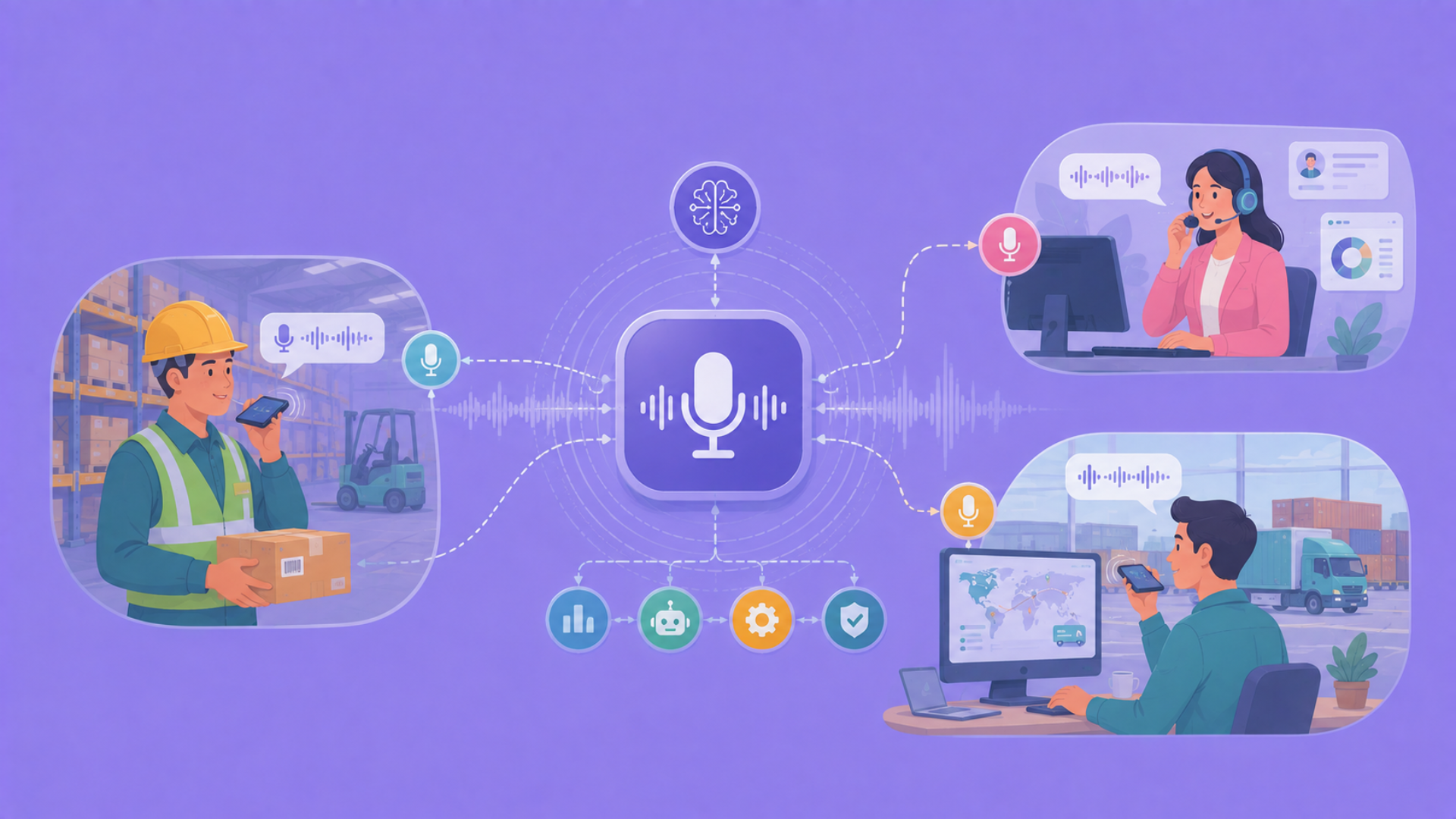
82% of companies are already using voice technology in some form. That number comes from Deepgram's State of Voice Report. 66% say voice-enabled experiences are critical to their future business strategy.
Voice AI has arrived in enterprise operations. The question for most organisations is no longer whether to use it. It is where to use it, how to implement it well, and what the realistic return looks like.
This piece answers those questions in plain terms.
What Voice AI Actually Is
Voice AI is the combination of three capabilities working together.
Speech recognition converts spoken language into text. When a customer calls and says "I want to check my order status," the speech recognition system converts those words into digital text that other systems can process. Modern speech recognition handles real-world conditions accurately. Background noise, regional accents, natural interruptions, and domain-specific vocabulary are all handled reliably in enterprise-grade systems in 2026 in ways that were not commercially viable two years ago.
Natural language understanding interprets the meaning and intent of the converted text. It is not enough to know what words were spoken. The system needs to understand what the speaker wanted. "Check my order" and "where is my delivery" and "has my package shipped" all express the same intent in different words. Natural language understanding identifies that intent regardless of how it was expressed.
Conversational AI manages the dialogue. It decides how to respond, what information to retrieve, what action to take, and how to handle the conversation across multiple turns. When a customer says "actually, make that for next Tuesday instead," conversational AI understands that this refers to something mentioned earlier in the conversation and updates accordingly.
Together, these three capabilities produce a system that can hear a human being, understand what they mean, and respond or act appropriately. Without a human operator in the loop for routine interactions.
Voice AI vs Traditional Interactive Voice Response
Most enterprises have experience with traditional interactive voice response (IVR). Press 1 for billing. Press 2 for technical support. Say "yes" or "no."
Voice AI is not an improved version of IVR. It is a different class of system.
IVR follows rigid, pre-programmed paths. Every possible interaction must be anticipated and scripted in advance. When a caller says something the system did not expect, it fails. The experience is frustrating precisely because it has no flexibility.
Voice AI does not follow scripts. It understands intent and responds contextually. A caller can explain their situation in their own words and the system can understand it, ask clarifying questions where needed, and resolve the issue without the caller navigating menus.
A US regional bank that replaced its legacy IVR with voice AI across more than one million annual customer calls automated 2.6 million sessions, delivered over five million AI voice minutes, and achieved an 86% containment rate. Human agents moved from handling repetitive queries to managing high-value customer relationships. That is the operational shift voice AI enables, and it is not achievable with IVR regardless of how well it is designed.
The Enterprise Use Cases That Are Generating Returns
Customer service and contact centre automation
This is the most mature voice AI use case and the one with the clearest documented returns. Voice AI handles routine customer service interactions end to end. Account queries, order status, appointment booking, payment processing, standard complaints. The system understands the customer, accesses the relevant data, completes the action, and confirms it, without transferring to a human.
Financial services leads adoption with 32.9% market share. This makes sense. Banks and insurers handle enormous volumes of routine customer calls. The economics of voice AI in high-volume contact centre environments are compelling. Enterprises implementing voice AI are reporting 3.7x return on every dollar invested when the implementation is well-designed and the use cases are appropriate.
The important distinction is containment versus deflection. Voice AI that resolves customer queries is containment. Voice AI that tells customers to call back later or use the website is deflection. Containment generates returns. Deflection generates complaints. Designing for genuine resolution rather than cost reduction is the design principle that separates successful implementations from disappointing ones.
Field technician support
This is the use case most relevant to automotive, consumer electricals, and industrial equipment service networks. And it is one of the least commonly discussed in mainstream voice AI coverage.
A field technician in the middle of a repair does not want to stop work, unlock a phone, type a search query, and scroll through results. They want to ask a question and get an answer while their hands are on the equipment.
Voice AI that allows a technician to ask a question in their own language, retrieves the relevant information from the technical knowledge base, and delivers it as a spoken response closes a genuine operational gap. The multilingual and low-connectivity field service challenge is directly addressed by voice AI that works in local languages and handles offline scenarios.
For Technician Plus deployments, voice input for job documentation is a specific capability that reduces the friction of recording job notes, parts used, and completion status. A technician who can speak their job notes rather than type them on a small screen completes documentation faster and more completely. Better documentation means better data. Better data means better AI.
Sales and dealer operations
Field sales teams and dealer managers spend significant time updating CRM systems, logging call outcomes, and recording customer interactions. Much of this happens retrospectively, from memory, at the end of the day. The data quality is lower than it would be from real-time capture.
Voice AI that allows field sales representatives to update CRM records, log dealer visit notes, and create follow-up actions by speaking naturally while driving between calls captures better data at the moment it is most accurate. The CRM record is created as the call ends rather than reconstructed hours later.
For dealer network management, voice-enabled reporting tools that allow regional managers to query dealer performance data and receive spoken summaries reduce the time spent navigating dashboards and reports. The intelligence is delivered in a form that fits how these roles actually work.
Logistics and warehouse operations
Warehouse voice picking is one of the most established voice AI applications in enterprise operations. Workers receive spoken instructions and confirm picks by voice, with hands and eyes free to work efficiently. Accuracy rates and productivity both improve relative to paper-based or screen-based picking systems.
The same principle extends to other logistics operations. Receiving and put-away workflows guided by voice. Vehicle load confirmation by voice. Delivery confirmation and exception reporting by voice. In environments where workers are moving, carrying loads, or wearing protective equipment that makes screen interaction difficult, voice is the most efficient interface available.
What Makes Voice AI Work in Production
The gap between a voice AI demonstration and a voice AI system that works reliably in production is real and significant.
Accuracy in real conditions:
Demonstrations happen in quiet rooms with prepared speakers. Production deployments happen in contact centres with background noise, on factory floors with machinery, and in vehicles on motorways. The speech recognition system needs to handle these conditions accurately. Testing in realistic conditions before deployment is not optional.
Domain vocabulary:
General speech recognition models are trained on general language. Enterprise deployments involve specific product names, technical terminology, internal process language, and industry jargon that general models may not recognise reliably. Domain adaptation, where the model is trained or fine-tuned on vocabulary specific to your context, significantly improves accuracy on the terms that matter most.
Integration with enterprise system:
Voice AI that can hear and understand a customer but cannot access the systems where their account information lives cannot resolve their query. The integration between voice AI and ERP, CRM, order management, and field service systems is what determines whether the system can complete actions rather than just understand requests. This is the same integration principle that applies across all enterprise AI deployment.
Clear escalation design:
Not every interaction should be handled by voice AI. Complex complaints, emotionally charged situations, and edge cases that fall outside the system's competence need to be transferred to a human quickly and smoothly. The escalation path needs to be designed explicitly, tested thoroughly, and made easy for users to trigger. Systems that trap users in voice AI loops when they need human help generate more dissatisfaction than the systems they replaced.
What Enterprises Should Expect in Terms of Returns
The returns from voice AI vary significantly by use case, implementation quality, and how clearly the success metric was defined before deployment.
Contact centre deployments with well-designed containment logic and genuine end-to-end resolution capability consistently report 40 to 60% reduction in cost per interaction and significant improvement in customer satisfaction for interactions handled by the AI. The human agent workforce shifts toward higher-value interactions rather than shrinking in headcount, in most well-implemented deployments.
Field service voice support does not generate the same cost reduction as contact centre automation, because the use case is different. The return is in technician productivity, first-time fix rates, and documentation quality, all of which affect the service metrics that matter for OEM service operations.
The universal principle is the one that applies to all enterprise AI ROI measurement. Define the business outcome before deployment. Measure it before and after. The technology is not the return. The changed business outcome is.
Vishleshan AI builds voice AI capabilities as part of forward deployed engineering (FDE) engagements across automotive, consumer electricals, financial services, and supply chain environments. From multilingual field technician support to dealer network voice interfaces, we build voice AI that works in your operational context, not in a controlled demonstration. Book a Consultation