


A quality inspection vision AI deployment in a manufacturing plant costs between $50,000 and $250,000. The range depends on the number of inspection stations, the complexity of the defect taxonomy, the edge computing infrastructure required, and the integration work that connects the system to the plant's existing MES and ERP.
At that price point, the investment looks straightforward. The defect detection improvement justifies it. The payback period, typically seven to seventeen months in manufacturing environments with meaningful scrap and warranty costs, supports it. The deployment proceeds.
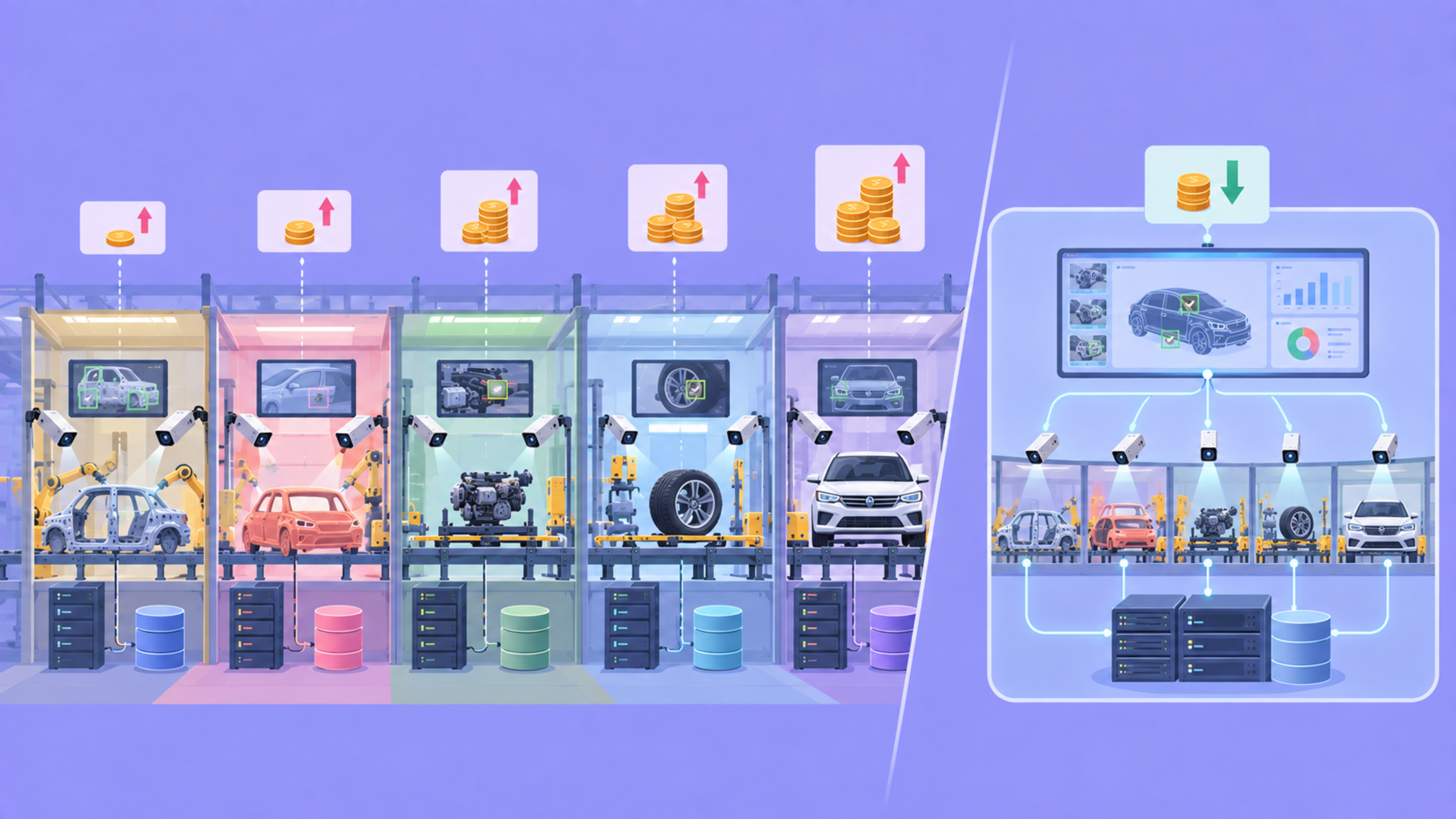
Three years later, the plant has ten vision AI applications deployed across the body shop, paint shop, assembly area, press shop, and logistics zone. Each was approved individually. Each delivered a return individually. Together, they have created an infrastructure problem that nobody planned for and nobody has a budget to fix.
This is the hidden cost of fragmented vision AI. It does not appear in any single line item. It accumulates across hardware, maintenance, integration debt, and the missed commercial return of AI systems that cannot communicate with each other.
How Fragmentation Happens
Vision AI fragmentation is not caused by poor planning. It is caused by how manufacturing AI investment decisions are typically made.
Quality improvement projects are approved at the zone level. The body shop quality team identifies a defect detection problem, builds a business case, gets budget approved, and deploys a vision AI system. The paint shop does the same six months later, independently. The assembly team follows a year after that.
Each decision is rational. Each delivers a return. But each team procures hardware independently, contracts with a vendor independently, and builds an integration to the MES independently. Nobody is looking at the cumulative infrastructure footprint across all zones, because nobody owns it.
By the time the plant has ten applications running, the fragmented infrastructure is already established. It is expensive to maintain, difficult to upgrade, and impossible to change without disrupting multiple teams with different systems and different vendors.
Where the Hidden Costs Actually Accumulate
Hardware duplication
Each independent vision AI deployment procures its own edge computing infrastructure. Servers, cameras, networking hardware, and power and cooling infrastructure are each sized for the specific application they serve.
The result is hardware that sits idle in one zone while another zone is running at capacity. A press shop inspection system that runs at peak load during stamping operations sits mostly idle during shift changes. The body shop inspection system runs at capacity simultaneously. The compute resources cannot be shared because each system runs on dedicated hardware.
In a consolidated architecture, shared compute infrastructure serves multiple applications and load-balances across them. The hardware utilisation is higher. The total hardware cost for the same inspection capacity is lower. Studies of AI infrastructure consolidation consistently show 30 to 50% reduction in infrastructure cost when moving from fragmented to shared architecture.
Maintenance overhead that scales with application count
Each vision AI application requires maintenance. Cameras need cleaning and calibration. AI models need retraining when defect taxonomies change or new product variants are introduced. Edge hardware needs software updates and eventually hardware replacement. Integration connections to MES systems need to be updated when the MES changes.
In a fragmented environment, this maintenance is multiplied by the number of applications. Ten applications mean ten maintenance contracts, ten retraining processes, ten integration update events when the MES is updated. The maintenance burden scales linearly with application count.
In a centralised architecture, maintenance is managed once and applied across all applications. A model retraining process produces a new model version that is validated once and deployed to all relevant edge devices through the centralised management layer. A MES integration update is made once in the centralised data layer rather than in ten separate application integrations.
Infrastructure costs surpass development costs within 12 to 18 months in manufacturing vision AI deployments. This is the point at which fragmented maintenance overhead becomes visible in operations budgets. It rarely appeared in the original business cases because it was not calculated at the portfolio level.
Integration debt
Each vision AI application in a fragmented environment has its own integration to the plant's MES, ERP, and quality management systems. These integrations are typically custom-built for each application.
Integration engineering and quality testing together account for 40 to 60% of total build cost in enterprise AI deployments. In a fragmented environment, this cost is incurred repeatedly. Each new application rebuilds a version of the same integration with the same underlying systems.
Over time, each integration becomes a maintenance liability. When the MES is upgraded, the integration breaks and needs to be updated for every application that connects to it. When a new quality management system is introduced, every application's integration needs to be assessed and potentially rebuilt.
The integration debt accumulates invisibly until a system change forces it into view. At that point, the cost and effort of updating ten separate integrations is significantly larger than was anticipated when the applications were deployed individually.
The missed value of connected data
The most commercially significant hidden cost of fragmentation is not infrastructure. It is the value that fragmented applications cannot generate because their data is isolated from each other.
A defect detected at the paint shop exit has a root cause. That root cause may be visible in body shop welding data, in incoming material inspection records, or in process parameter data from the coating application stage. Identifying it requires correlating data from multiple manufacturing zones.
In a fragmented environment, this correlation is not possible. Each application's inspection data lives in its own database. The cross-zone pattern is invisible to any individual application. The root cause remains unidentified. The defect recurs.
In a connected architecture, all inspection data from all manufacturing zones flows into a common data layer. The cross-zone correlation is possible. The root cause becomes identifiable. The defect can be prevented at its source rather than caught at the inspection point.
This is the value that fragmentation prevents: AI that learns across the whole plant rather than within a single zone. The 1-10-100 rule in manufacturing quality tells us that defects caught upstream cost a fraction of defects caught downstream. Cross-zone intelligence enables upstream prevention. Fragmentation prevents it.
Governance and compliance complexity
As described in the context of IATF 16949 requirements, automotive and industrial manufacturers need to maintain traceability records for quality inspections. Each independent application maintains its own audit trail in its own format.
A regulatory audit that requires inspection traceability across all manufacturing zones in a fragmented environment requires assembling documentation from ten separate systems with ten different formats. The process is slow and the gaps in documentation consistency are inevitable.
A centralised architecture maintains all inspection records in a single data layer with a consistent format. Compliance documentation is generated from the central system. Audit preparation is a query, not a multi-week manual assembly exercise.
What Consolidation Actually Requires
Consolidation is not a rip-and-replace exercise. Most manufacturers cannot afford to shut down existing vision AI applications while a new centralised architecture is built. Nor should they. The individual applications are working. The problem is the infrastructure they sit on, not the applications themselves.
The practical approach is progressive consolidation. New applications are deployed to the centralised architecture from the start. Existing applications are migrated to the shared infrastructure as they reach natural hardware or software refresh points. The centralised management layer is built first and applications are connected to it over time rather than simultaneously.
This approach requires three investments that are typically not in the budget of any individual zone team but deliver returns across the entire plant.
Shared compute infrastructure:
The GPU and edge computing resources that currently sit independently in each zone are replaced with a shared pool. Load balancing across applications means the same hardware serves more applications at higher utilisation.
A unified data layer:
All inspection data from all applications flows into a common storage and processing layer. This is the prerequisite for cross-zone intelligence and for centralised compliance reporting.
Centralised model lifecycle management:
Model training, validation, versioning, and deployment management are handled centrally. Model updates are pushed to edge devices through a managed process rather than applied independently to each application.
These investments are made once and benefit every subsequent vision AI application the plant deploys. The marginal cost of adding a new application to a centralised architecture is significantly lower than deploying the same application independently.
How to Make the Business Case for Consolidation
The business case for vision AI consolidation requires calculating the total cost of the current fragmented state and comparing it to the total cost of the consolidated alternative over a five-year horizon.
The current state cost includes hardware acquisition and replacement across all applications, annual maintenance contracts across all applications, integration update costs each time a core system changes, the cost of compliance documentation assembly for regulatory audits, and the opportunity cost of quality improvement value that cross-zone intelligence would generate.
The consolidated state cost includes the shared infrastructure investment, the centralised management platform, the migration effort for existing applications, and the reduced ongoing maintenance cost.
In most manufacturing environments with five or more independent vision AI applications, this calculation shows consolidation delivering a lower five-year total cost of ownership than maintaining the fragmented state, with the crossover typically occurring in year two or three.
The business case also needs to include the value of capability that consolidation enables. A plant that can deploy new vision AI applications at the marginal cost of adding an application to existing infrastructure will deploy them faster and more broadly than a plant that incurs the full cost of a new independent deployment each time. The compounding capability that a well-designed centralised architecture enables is a commercial advantage that compounds over time.
Vishleshan AI's forward deployed engineering (FDE) approach works inside manufacturing client environments to assess the total cost of current vision AI infrastructure, design the consolidation architecture that serves the plant's full application portfolio, and manage the migration process without disrupting production. Our manufacturing AI experience spans automotive and industrial production environments where the fragmentation problem is already visible in operations budgets. Book a Consultation