


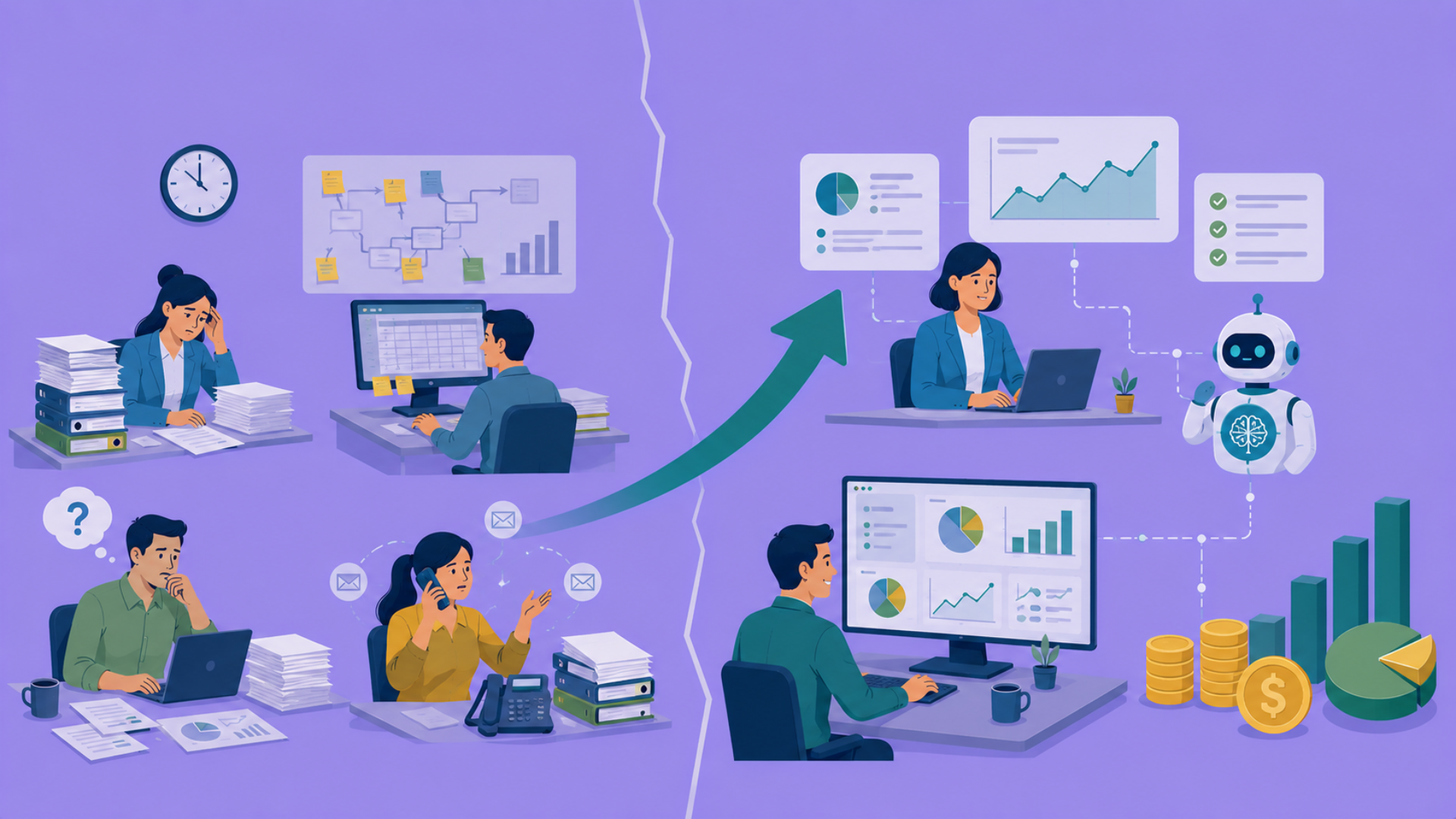
Boards no longer ask whether to invest in AI. They ask what the last round of investment actually delivered.
Most enterprises cannot answer that question well. Not because the value is not there. Because they are measuring the wrong things.
Adoption rates. Hours saved. Number of use cases deployed. These are activity metrics. They tell you AI is being used. They do not tell you whether it is working in a way that matters to the business.
This piece covers what AI ROI measurement actually requires in 2026. What metrics matter. What a board needs to see. And what separates enterprises that can prove AI value from those that cannot.
Why "Hours Saved" Is No Longer Enough
For a long time, productivity was the main argument for AI. Save four hours a week per employee. Multiply by headcount. Show the number to the board.
This worked when AI was a novelty. It does not work now.
The shift from productivity metrics to direct financial impact is the defining change in AI ROI measurement in 2026. Boards and CFOs want to see a direct line from AI investment to revenue, margin, or cost reduction. "Hours saved" does not give them that line unless those hours translate into a cost avoided or revenue generated.
A procurement team that saves ten hours a week using AI has not proven ROI. A procurement team that has reduced supplier onboarding time by 60% and cut the number of late deliveries by a third has.
The metric needs to connect to a number that appears on a financial statement.
The Three Types of AI ROI Worth Tracking
1. Direct cost reduction
This is the easiest type of AI ROI to measure and the fastest to appear.
It includes reduced headcount cost from automation, lower error rates that reduce rework and rework cost, fewer manual process steps that reduce time and therefore labour cost, and reduced waste in operations where AI improves precision.
Finance has the fastest AI payback at an average of 8 months. Manufacturing follows at 12 to 14 months. Both are sectors where cost reduction from AI is specific, measurable, and directly traceable to the investment.
2. Revenue impact
This is harder to measure but more valuable to prove.
It includes higher conversion rates where AI is used in sales or dealer management, faster quote-to-close cycles, improved AMC renewal rates from proactive service AI, and incremental revenue from products or services that AI makes possible to offer at scale.
The key is to run a controlled comparison where possible. A group of dealers using an AI-powered channel management tool versus a group that is not. A cohort of customers receiving AI-driven proactive service outreach versus one that is not. The difference in outcomes is the revenue case for AI.
3. Risk reduction
This is the least visible type of ROI and the most underreported.
It includes avoided regulatory penalties from AI-powered compliance monitoring, reduced fraud losses from AI detection systems, fewer safety incidents from predictive maintenance, and avoided customer churn from early warning systems.
Risk reduction ROI is real. It is also hard to present because it is the value of things that did not happen. The way to make it credible is to calculate the historical cost of the incidents being avoided and show the reduction rate clearly.
What a Good Baseline Looks Like
You cannot measure ROI without a baseline. This sounds obvious. It is consistently skipped.
Before deploying AI, measure the current state of the process it will improve. How long does supplier onboarding take today? What is the current first-time fix rate? How many AMC contracts are lapsing without renewal contact? What is the false positive rate in the fraud detection process?
These numbers are your denominator. Without them, any improvement claim after deployment is unverifiable. With them, the ROI case is specific, credible, and defensible.
The baseline does not need to be complex. It needs to be documented before the AI goes live. That is the step most enterprise AI programmes miss.
The Metrics That Actually Matter to a Board
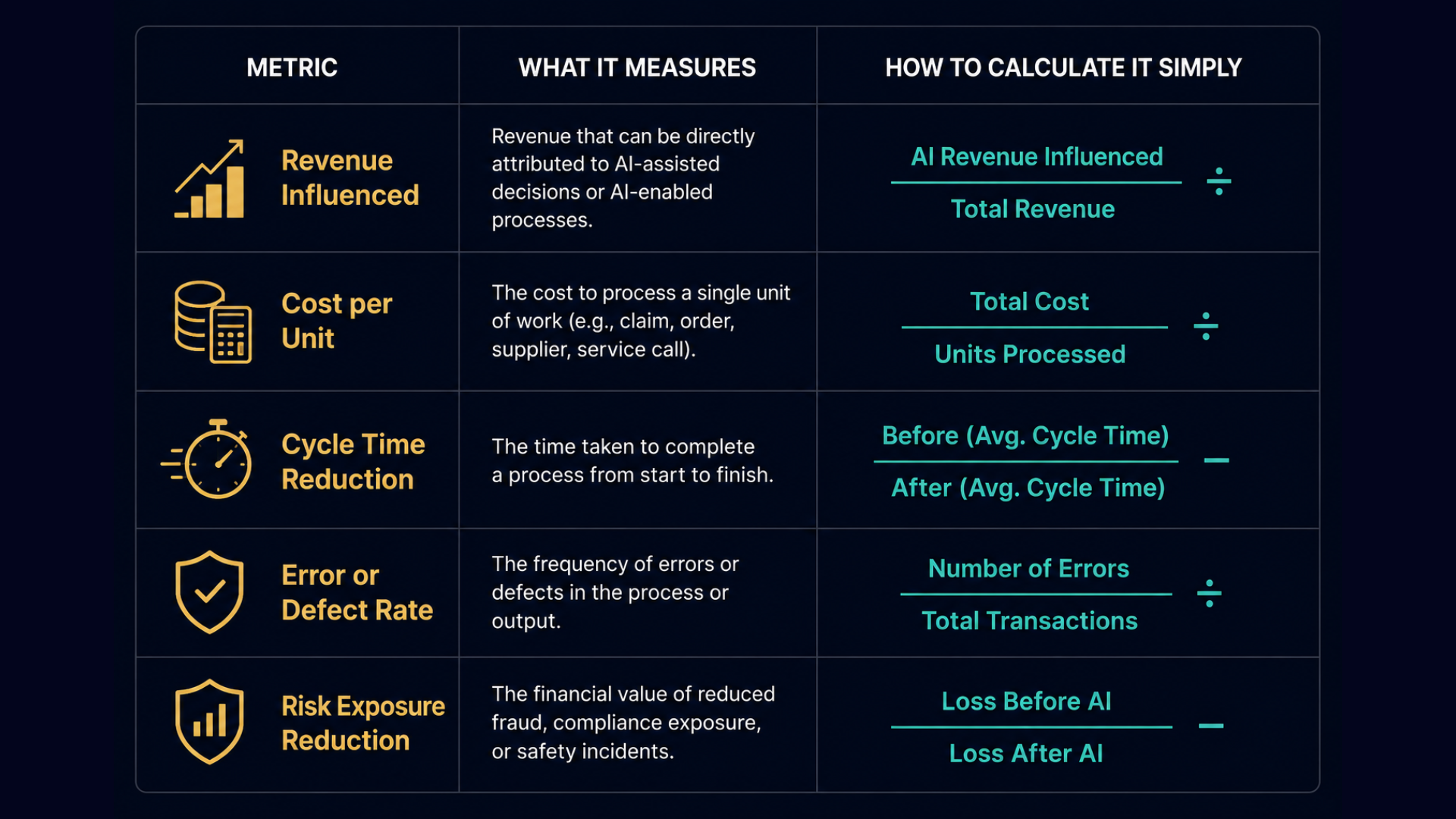
Boards do not need 46 KPIs. They need a small number of metrics that connect AI to outcomes they already care about.
Here are the ones that consistently land in a board conversation.
Revenue influenced or generated:
How much revenue can be directly attributed to AI-assisted decisions or AI-enabled processes? This is the strongest ROI metric and the one boards respond to most clearly.
Cost per unit of output:
How much does it cost to process a claim, onboard a supplier, resolve a service call, or fulfil an order? AI should reduce this over time. Tracking it before and after shows the direction of travel clearly.
Cycle time reduction:
How long does a process take now versus before? Faster cycles mean faster revenue recognition, lower working capital requirements, and better customer experience. All of these translate to financial outcomes.
Error or defect rate:
Fewer errors mean less rework, fewer returns, lower warranty costs, and better customer satisfaction. This is measurable and directly linked to cost.
Risk exposure reduction:
What is the financial value of reduced fraud, reduced regulatory exposure, or reduced safety incidents? Quantify it with historical data.
The Mistake Most Enterprises Make With AI Metrics
Most enterprises measure AI at the tool level instead of the outcome level.
They track how many employees are using the AI tool. How many queries it handles per day. How fast it responds. These are operational metrics for managing the system. They are not business metrics for proving value.
The shift required is simple. Stop asking "how is the AI performing?" Start asking "what changed in the business since we deployed AI here?"
If the answer is "not much," that is useful information. It means either the AI is not working as intended or the workflow around it has not changed enough to capture the value. Both are fixable. Neither is fixable if you are only watching tool-level metrics.
How to Structure the ROI Report for Your Board
A board-ready AI ROI report does not need to be long. It needs to answer four questions clearly.
What did we invest?
Total cost of the AI programme including software, implementation, integration, training, and ongoing maintenance. Not just the licence fee.
What changed?
Specific before-and-after comparisons for the metrics that matter. Not a list of features deployed. The actual numbers.
What is the financial value of what changed?
Translate the operational improvements into financial terms. Faster cycle time means lower working capital. Fewer errors means lower rework cost. Higher renewal rate means more revenue. Show the maths.
What is the trajectory?
AI ROI compounds over time as more deployments build on earlier ones. Show the board where this is heading, not just where it is today. This is the FDE feedback loop argument made financial: each deployment makes the next one more valuable.
When to Expect Returns
Timelines vary by use case and sector. But the data in 2026 is specific enough to set realistic expectations.
Finance and procurement AI pays back fastest, typically within 8 months. Manufacturing and field service AI returns in 12 to 14 months. Customer service and compliance AI is in a similar range. Strategic use cases like demand forecasting and supply chain intelligence take longer to show clear financial returns but build competitive advantage that compounds over time.
If an AI deployment has been live for more than 18 months and cannot show a clear financial return, something is wrong. Either the use case was not the right one, the deployment did not reach production effectively, or the measurement framework is not capturing the value that is actually being generated.
All three are common. All three are diagnosable if the right metrics were set up from the start.
The Simple Test for Any AI Programme
Before any AI deployment, ask one question: what specific number will be different 12 months from now if this works?
If you cannot answer that question before deployment, you will not be able to prove ROI after it.
If you can answer it, you have your measurement target. Everything else, the baseline, the tracking, the board report, follows from that one answer.
Vishleshan AI's forward deployed engineers define the business metric before any build starts. Every engagement is measured against the outcome it was designed to produce, not against the activity of deploying it. Book a Consultation