


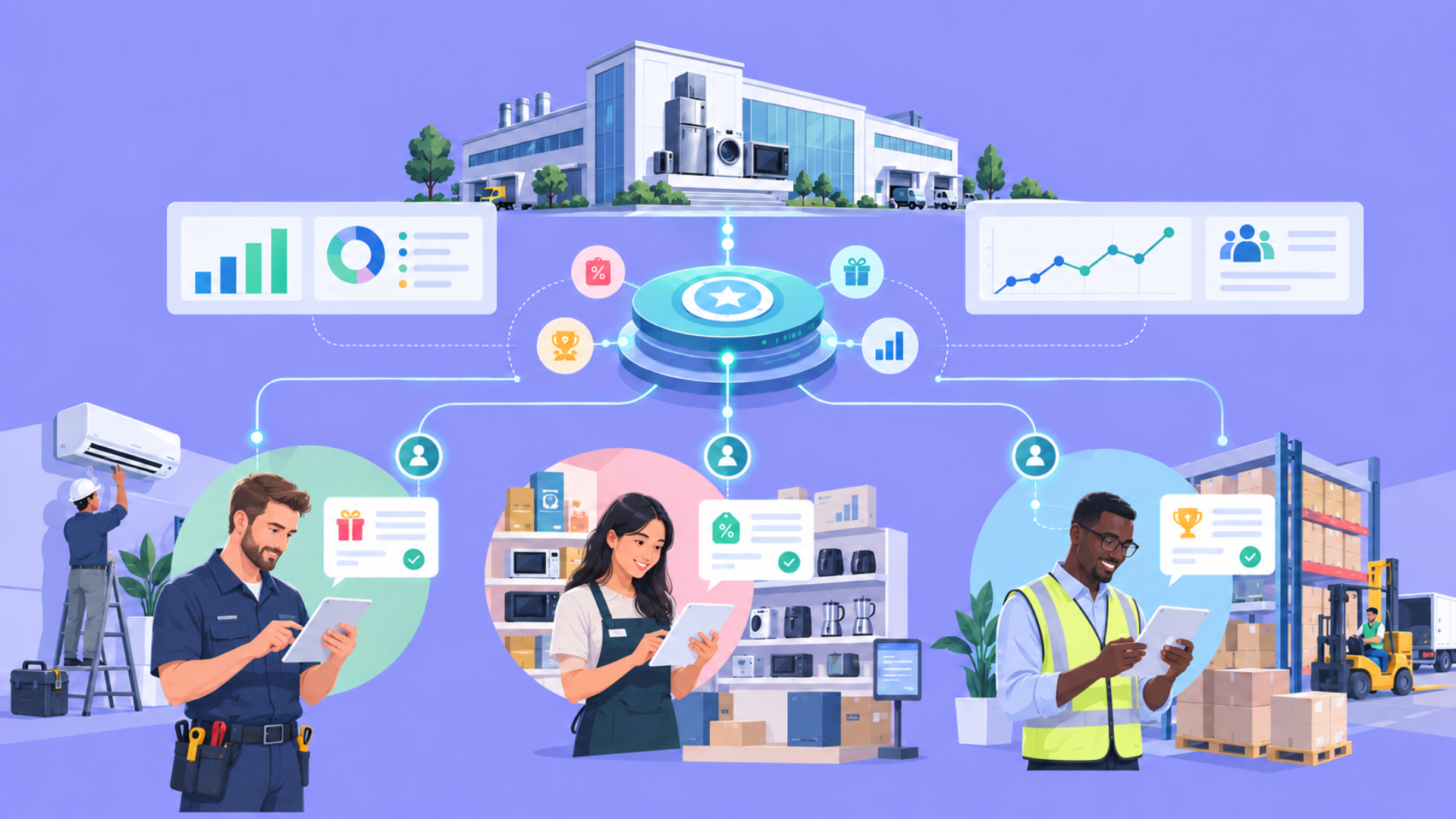
Consumer electricals is one of the most competitive distribution environments in manufacturing. An electrician, retailer, or distributor who carries your switches, wiring accessories, or lighting products also carries three or four competing brands. Every time they face a customer, they make a choice about which brand to recommend first.
Winning that choice consistently is the core commercial challenge of channel management in consumer electricals. And it cannot be won through product quality alone, because at the level most professional channel partners operate, product quality differences are narrow. What drives recommendation preference is the quality of the relationship with the manufacturer. Training support, scheme clarity, redemption speed, and the sense that the manufacturer understands and values this specific partner's business.
A 5% improvement in channel partner retention can boost profits by 25 to 95%. Enrolled partners consistently outperform non-enrolled partners at the same distributor by 20 percentage points. These numbers reflect something specific: partners who feel the programme is working for them behave differently from those who do not.
The question for consumer electricals manufacturers is what it takes to build a programme that partners actually feel is working for them, at the scale of a national distribution network with hundreds of thousands of participants.
Why Consumer Electricals Channel Retention Is Harder Than It Looks
Consumer electricals distribution has three structural characteristics that make channel retention more complex than most manufacturers anticipate.
The partner population is extremely diverse:
A single manufacturer's channel network spans large retail chains who place bulk orders monthly, small independent electrical shops who order weekly, licensed electricians who buy individual project quantities, and distributors who serve all of the above. Each partner type has different commercial needs, different decision-making processes, and different motivations for brand preference.
A programme that works for a large retail chain, volume-based rebates and co-marketing funds, will not motivate an independent electrician whose primary need is technical support and quick access to product information. A programme that works for an electrician, training certifications and project support, will not move the needle for a distributor whose primary interest is margin and payment terms.
Most channel loyalty programmes address this diversity by creating tiers. Platinum, gold, silver. The problem with tiers is that they segment by size rather than by need. A large partner with the wrong programme design underperforms relative to their potential. A small partner who is perfectly served by the programme outperforms expectations. Tier-based segmentation optimises for the easy-to-measure variable, volume, rather than the commercially relevant variable, behaviour change.
Product codes create a specific fraud and data integrity challenge:
Consumer electricals loyalty programmes typically use product code scanning as the mechanism for point accumulation. Electricians and retailers scan codes from product packaging to claim points. This approach works well when the codes genuinely represent product movement. It is susceptible to code aggregation, where codes are collected from multiple sources and submitted without the product ever reaching the end customer.
At the scale of a national programme with hundreds of thousands of participants, code fraud is not a marginal problem. It is a structural one. Manual fraud detection through periodic audits catches fraud after it has been paid out. AI-powered real-time detection catches it before.
The electrician population is mobile, multilingual, and not desk-based:
A significant portion of the professional electrician community operates through mobile devices, works across multiple locations, and communicates in regional languages. A loyalty programme that requires desktop access, English language proficiency, or time-consuming registration processes will not reach this population effectively.
The mobile interface, the onboarding experience, and the communication language are not peripheral decisions in consumer electricals loyalty programme design. They are the determinants of whether the programme reaches the partners it is intended to reach.
What Good Channel Retention Looks Like in Practice
The consumer electricals manufacturers generating strong channel retention results share a consistent programme architecture. It is not defined by the rewards they offer. It is defined by the experience they create for each partner type.
Self-service registration that captures quality data:
Partners who register through a mobile app in a process that takes under five minutes, in their preferred language, provide more complete and more accurate information than those who register through a form that a sales representative fills in on their behalf. The registration quality determines the intelligence quality of everything that follows.
A programme with self-service mobile registration in multiple languages reaches the professional electrician population that manual registration processes consistently underserve. This population is often the most commercially valuable in consumer electricals distribution, because electricians recommend products to end customers at the point of installation, which is the last moment before the purchase decision is made.
Real-time point crediting that builds trust:
The most consistent predictor of channel partner disengagement from a loyalty programme is delayed point crediting. Partners who scan a code and do not see a credit within minutes conclude either that the system does not work or that their claim was rejected without explanation. Both conclusions lead to the same outcome: they stop scanning.
Real-time crediting changes the experience fundamentally. A partner who scans a code and sees their balance update in seconds understands immediately that the system is working and that their activity is being recognised. This feedback loop sustains engagement through the scheme period rather than requiring repeated reminders and communications to maintain participation.
OTP-secured redemption that processes in minutes:
The delay between point accumulation and reward redemption is the second most consistent predictor of partner disengagement. A partner who has accumulated significant points and then waits weeks for redemption to process loses confidence in the programme's value before they receive the reward they earned.
OTP-secured redemptions that process in minutes rather than weeks change how partners value their point balance. Points that can be redeemed quickly are worth something today. Points that take weeks to redeem are worth something eventually, which is not the same commercial signal.
Fraud monitoring that protects programme economics:
Consumer electricals loyalty programmes processing millions of code scans annually across large partner networks generate fraud patterns that are impossible to detect manually at the required speed. AI systems monitoring claim patterns in real time, comparing each claim against the partner's order history, geographic data, and temporal patterns, identify anomalies before they result in fraudulent redemptions.
The commercial case for real-time fraud monitoring is direct. Every fraudulently redeemed point is programme budget paid out without a corresponding commercial outcome. At the scale of large consumer electricals programmes, this is a meaningful share of total programme cost that effective fraud monitoring recovers.
The Video Below Shows Loyalty Plus in Action Across a Live Consumer Electricals Channel Network
See how Loyalty Plus manages partner onboarding, real-time point crediting, scheme management, and fraud detection across a national electrician and retailer network.
What Loyalty Plus Delivers for Consumer Electricals Manufacturers
Loyalty Plus is built for the specific operating environment of consumer electricals channel loyalty at enterprise scale. It addresses the structural characteristics of consumer electricals distribution rather than applying a generic loyalty platform to a context it was not designed for.
Mobile-first, multilingual onboarding reaches the professional electrician population that desktop-based programmes consistently underserve. Self-service registration in regional languages with a process designed for completion in under five minutes produces higher quality partner data and higher activation rates than representative-assisted registration.
Real-time point crediting from code scanning delivers the immediate feedback that sustains programme engagement. Points appear in the partner's account within seconds of a valid scan. The connection between action and recognition is immediate rather than delayed.
AI-powered personalised scheme activation identifies the scheme most likely to change each partner's behaviour based on their product mix, their historical scheme responsiveness, and their current position in their purchase cycle. The right scheme at the right moment for each partner is not achievable through manual scheme assignment at the scale of hundreds of thousands of participants. It requires the AI to be doing that assignment continuously and automatically.
Comprehensive fraud detection monitors code scanning patterns across the full network in real time. Anomalies that suggest fraud are flagged for review before redemption rather than identified in a monthly audit after points have been paid out.
Full admin visibility gives programme administrators real-time access to partner engagement data, scheme performance metrics, and exception alerts. The decisions that affect programme economics, scheme adjustments, partner interventions, fraud investigations, are informed by current data rather than last month's report.
The Commercial Case for Better Channel Retention
The investment in channel loyalty is growing at 23.7% annually, from $6.47 billion globally to a projected $28.65 billion by 2030. That growth reflects genuine commercial conviction that channel loyalty programmes generate returns when they are well-designed and well-executed.
The returns are specific and measurable. Enrolled partners outperform non-enrolled partners in the same network by 20 percentage points. A 5% improvement in partner retention can boost profits by 25 to 95% through the compound effect of sustained volume, reduced cost of replacement, and the commercial relationship depth that long-term channel partnerships create.
The consumer electricals manufacturers capturing these returns are not spending more on channel loyalty than their competitors. They are spending it more effectively, on programmes that reach the right partners with the right incentive at the right moment, verified by real-time data rather than periodic reports.
Vishleshan AI's Loyalty Plus is deployed by forward deployed engineers (FDE) who build the data integrations that connect the programme to the channel activity it is designed to recognise and reward. Every engagement starts with the commercial outcome the manufacturer wants to achieve and works backwards to the programme architecture that produces it. Book a Consultation