


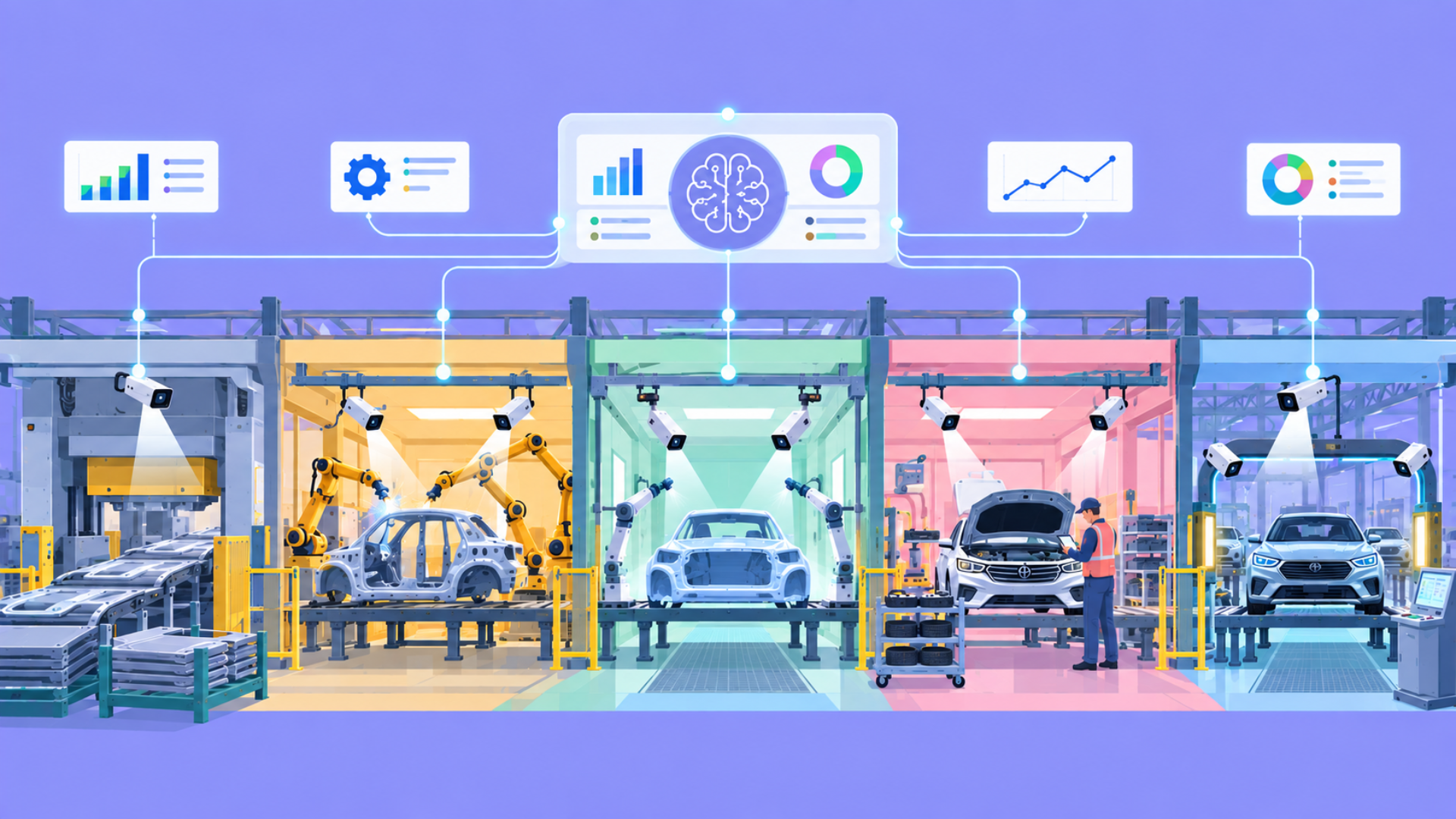
77% of AI vision implementations in manufacturing never advance beyond the pilot phase. The technology is not the reason.
The high failure rate of AI vision pilots is not primarily a technology problem. It is an implementation problem. Pilots run in controlled conditions against curated images. Production lines run in variable conditions against whatever the camera sees. The gap between these two environments is where most AI vision projects stall.
The manufacturers that have crossed that gap successfully share a common characteristic. They integrated vision AI into closed-loop quality systems rather than deploying it as a monitoring overlay. The camera does not just observe. It triggers. A defect detected stops the line or diverts the unit. A component absence generates a hold before the vehicle progresses. The intelligence connects to the production decision, not to a dashboard that someone reviews later.
This is why the documented three-year ROI for automated defect inspection runs at 374% with payback at seven to eight months. The cost of poor quality is approximately 20% of revenue at a typical manufacturer. Vision AI that catches defects earlier in the production process, before they compound at downstream stations, reduces that cost directly and measurably.
Here is how automotive manufacturers are deploying vision AI across each zone of the shop floor in 2026.
Press Shop: Stamped Component Inspection
The press shop is the first manufacturing zone in most automotive production lines. Sheet metal is stamped into the panels, structural members, and sub-components that feed every subsequent process.
Defects introduced at the press shop, scratches, dents, cracks, surface contamination, and dimensional deviations, propagate through every subsequent process. A scratch on a stamped panel that passes the press shop exit becomes a paint adhesion problem in the paint shop and a visible surface defect in final inspection. Catching it at the press shop costs a fraction of catching it downstream.
AI vision cameras trained on defect image datasets detect scratches, dents, porosity, cracks, and surface contamination on stamped components with sub-millimetre resolution at full line speed. Unlike rule-based machine vision systems that require separate configurations for each defect type, deep learning models classify multiple defect types simultaneously, including novel variants not present in the original training data.
Automotive Tier 1 suppliers using AI vision at stamped component inspection report false reject rate reductions of 70 to 85% compared to legacy vision systems, with defect escape rates approaching zero across full production coverage.
The integration that produces the strongest results connects vision AI outputs with upstream process variables: tool wear data, material batch records, and machine thermal state. Manufacturers that make this connection achieve defect reduction results two to three times greater than those using vision AI as a standalone inspection gate. The camera sees the symptom. The connected process data reveals the cause.
Body Shop: Weld Inspection and Dimensional Verification
The body shop produces the vehicle's structural foundation. The quality of welding and dimensional accuracy in this zone determines fit, finish, NVH performance, and structural safety downstream. Every weld and every dimensional tolerance carries implications for every subsequent process.
AI vision applications in the body shop cover three primary use cases.
Weld inspection detects weld spatter, incomplete fusion, geometric deviations, and porosity at production speed. Automotive bodies contain thousands of spot welds. Manual inspection at production speed is not feasible. AI vision systems process each weld in milliseconds and connect the result to the line control system. A substandard weld triggers an alert or a stop before the body moves to the next station.
Dimensional measurement and gap analysis monitors panel alignment, door gaps, and joint geometry continuously at production speed. AI vision systems using structured light and 3D reconstruction detect process drift before it produces a batch of out-of-tolerance bodies. The measurement is continuous rather than sampled, which means drift is caught when it starts rather than after it has produced rejects.
Component presence and assembly verification confirms that every sub-component, clip, and fastener is present and correctly positioned before the body progresses. Missing components at the body shop stage cost a fraction of what they cost to detect and correct at final assembly or in the field.
A vision agent monitoring body shop quality can detect a recurring defect pattern and identify that it correlates with a specific robot calibration drift, triggering an automatic correction before the defect affects a further production run. Scrap and rework costs in body shop operations using integrated AI vision agents drop 18 to 30%.
Paint Shop: Surface Defect Detection and Process Intelligence
The paint shop is the highest-visibility quality zone in automotive manufacturing. Surface defects invisible in earlier zones become apparent after paint. The paint shop also introduces quality variables specific to coating processes: chemistry interactions, film thickness variation, environmental sensitivity, and the sheer surface area requiring inspection.
Human visual inspection at the paint exit catches between 78 and 84% of surface defects on a good day shift. By hour ten of a night shift, that rate drops below 70%. AI vision achieves consistent detection accuracy regardless of shift time.
AI vision in the paint shop addresses three specific challenges.
Surface defect detection identifies runs, sags, dry spray, nibs, cratering, and contamination inclusions at line speed. Structured lighting systems designed to reveal specific defect types, combined with deep learning models trained on paint defect taxonomies, detect consistently at sensitivity levels that human inspectors cannot maintain across a full shift.
Process anomaly detection moves beyond end-of-line inspection into the coating process itself. AI systems monitoring coating process parameters in real time identify deviations before they produce visible defects. Dosage anomalies in pre-treatment, deviations in cathodic dip coating parameters, and applicator performance variations are detected as they develop rather than after they have propagated into visible surface defects.
Film thickness monitoring measures paint coverage continuously across the painted body, detecting inconsistencies that affect appearance, durability, and adhesion at a granularity that manual measurement at production speed cannot achieve.
Electric Vehicle Battery Manufacturing: A Specific High-Stakes Application
The growth of EV production has created a vision AI use case that did not exist at significant scale five years ago. EV battery pack assembly requires inspection precision that conventional methods cannot reliably deliver.
Vision AI verifies cell stacking and alignment within battery modules, checks insulation integrity and coating quality, identifies foreign particle contamination, and ensures accurate rotor-stator alignment in electric motor manufacturing. It detects winding irregularities that could affect performance or create safety risks.
Battery defects are not the same category of problem as a panel surface scratch. A contaminated battery cell can cause thermal runaway with serious safety consequences. The stakes of missed defects in EV battery manufacturing are categorically higher than in conventional vehicle manufacturing. AI vision that provides comprehensive inspection coverage across 100% of production rather than a sample is the appropriate response to this risk profile.
Assembly: Component Verification, Torque Confirmation, and Safety Monitoring
The assembly zone brings together body, powertrain, interior, and electrical systems. It is also the zone with the highest number of quality checkpoints, the greatest variety of inspection requirements, and the most significant consequences for escaped defects.
Component presence and orientation verification confirms at every assembly station that each component is present, correctly oriented, and correctly positioned. AI vision systems trigger holds before defective assemblies progress, applying the 1-10-100 rule cost logic: a missing component detected at the assembly station costs the time to install it correctly. The same defect at final assembly or at the customer costs 10 and 100 times more respectively.
Torque and fastener verification provides an auditable record for every critical fastener. AI vision combined with smart tooling data confirms correct tightening across every safety-relevant fastener in every vehicle. IATF 16949:2027 now accepts AI-generated traceability records as audit-compliant, which makes automated fastener verification both a quality and a compliance capability.
Safety monitoring for worker protection runs continuously across the assembly floor. Workers entering restricted zones without required PPE, vehicles moving too fast in pedestrian areas, and workers in unsafe proximity to operating machinery are detected in real time. Alerts trigger before incidents occur rather than generating reports after them.
What Connects These Applications: The Closed-Loop Principle
The vision AI deployments generating the strongest returns across all manufacturing zones share one architectural characteristic. The intelligence connects to the production decision rather than to a monitoring dashboard.
Camera systems are instruments of production accountability integrated directly into closed-loop quality systems. The vision agent monitoring paint quality detects micro-scratches, identifies that a recurring defect pattern is caused by a misaligned robot nozzle, and triggers the correction automatically. The assembly inspection system detects a missing component and holds the vehicle at that station. The body shop weld inspection triggers a stop or a divert before the defective body progresses.
This is the difference between vision AI as observation and vision AI as control. Observation generates data. Control generates outcomes. The manufacturers that have integrated vision AI into their quality and production control infrastructure are operating with the closed-loop capability that observation-only deployments cannot deliver.
Vishleshan AI's forward deployed engineering (FDE) approach builds vision AI systems inside automotive manufacturing environments, from press shop through assembly. We design the integration with MES, ERP, and quality management systems that closes the loop from detection to action, and we build to the governance requirements that IATF 16949 and customer-specific quality standards impose. Book a Consultation