


Deploying an AI model is not the end of the process. It is the beginning of an ongoing operational commitment.
Most enterprises treat AI deployment as the finish line. The model is built, tested, and released. The project is marked complete. The team moves on.
Months later, the model's accuracy has declined. The data it was trained on no longer reflects the data it is seeing in production. A regulatory audit asks for documentation of model version history that does not exist. A cost review reveals that several models are consuming compute resources without generating measurable business value. Nobody knows who owns them or whether it is safe to turn them off.
These are lifecycle failures. Not launch failures. And they are the most common form of AI failure in large enterprises in 2026, because most organisations have invested in deploying AI but not in managing it over time.
AI model lifecycle management is the discipline that prevents this. Here is what it is and what it requires.
What AI Model Lifecycle Management Actually Is
AI model lifecycle management is the structured governance of an AI model from the moment development begins to the moment it is retired from production.
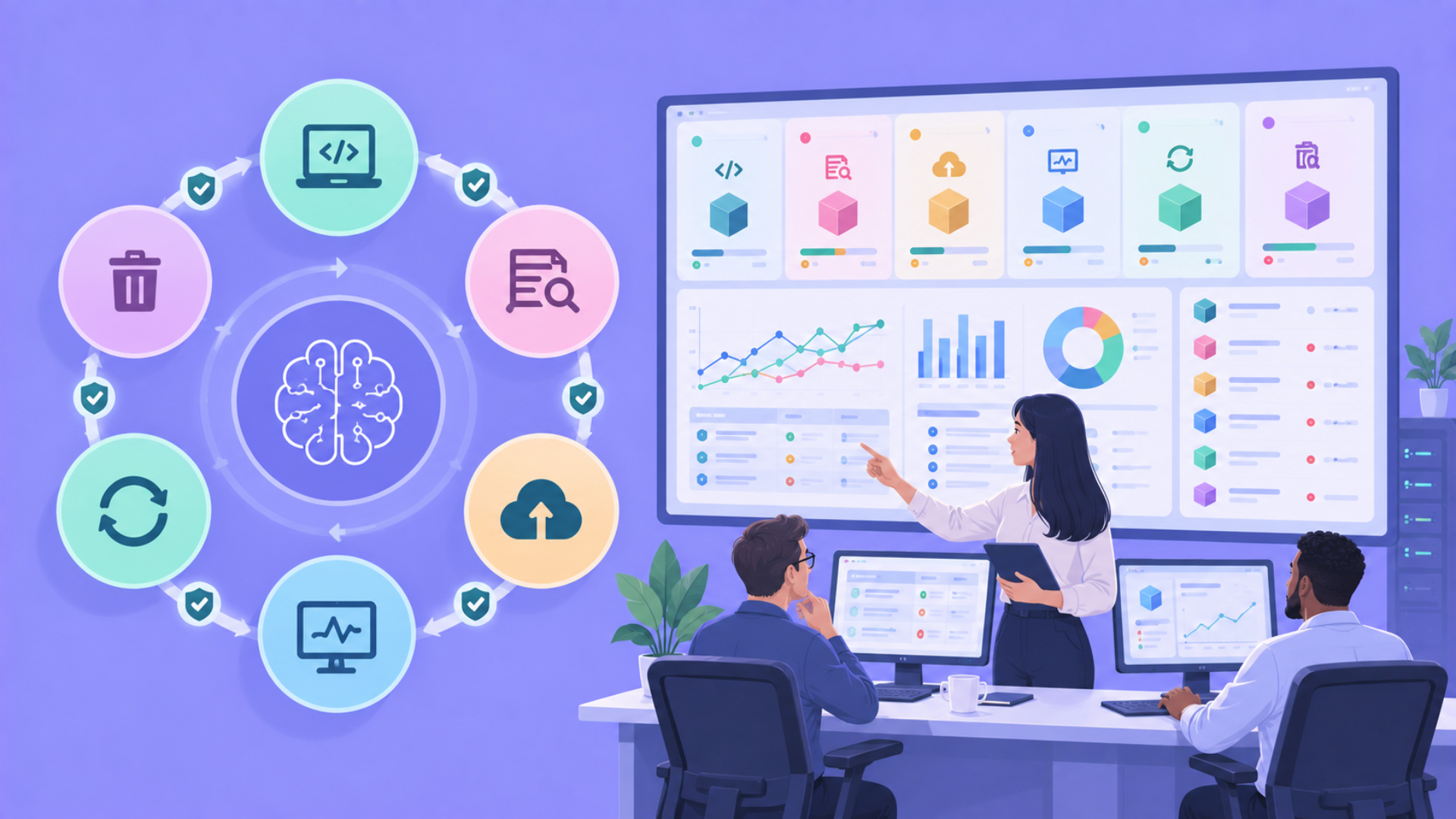
It covers six stages.
Development. The model is designed, trained, and evaluated before it ever reaches production. Lifecycle management at this stage means documenting the training data sources, the model architecture decisions, the evaluation criteria, and the performance benchmarks that the model achieved before deployment. This documentation is the foundation of the audit trail that compliance and governance frameworks require later.
Evaluation. Before deployment, the model is tested against production-representative data to confirm that its performance in a controlled environment predicts its performance in the real environment it will operate in. Lifecycle management at this stage means defining pass/fail criteria before the evaluation rather than interpreting results after, and recording the evaluation outcomes in a way that can be retrieved for compliance purposes.
Deployment. The model moves from the development environment to production. Lifecycle management at this stage means versioning the deployed model so that every production instance is identified by a specific version, and maintaining the ability to roll back to a previous version if the new one behaves unexpectedly.
Monitoring. The model is in production and generating outputs. Lifecycle management at this stage means continuously tracking the performance metrics that indicate whether the model is working as intended, detecting drift before it causes significant quality degradation, and maintaining the audit trail of what the model produced and when.
Retraining. The model's performance has degraded to the point where it needs to be updated. Lifecycle management at this stage means having a defined retraining process, a clear trigger that initiates it, a validation process for the retrained model before it replaces the current version, and version control that maintains the record of what changed and why.
Retirement. The model is no longer needed, has been replaced by a better version, or has been determined to carry unacceptable risk. Lifecycle management at this stage means having a defined process for safely retiring the model, archiving the relevant documentation, and confirming that no systems that depend on the model are broken by its removal.
Without structure at each of these stages, the lifecycle accumulates risk that surfaces as incidents, compliance gaps, or zombie models.
Why This Matters More as Enterprises Scale AI
A single AI model deployed by a single team can be managed informally. The team knows what the model does, when it was last updated, and what it is connected to. If something goes wrong, the team can investigate and fix it.
An enterprise operating dozens or hundreds of models simultaneously across multiple business functions cannot be managed this way. The knowledge of what each model does, who owns it, when it was last retrained, and what it connects to cannot be held informally across a large organisation.
Gartner expects 40% of enterprise applications to include task-specific AI agents by end of 2026, up from less than 5% in 2025. Each of these agents is an AI model in production that needs to be monitored, maintained, and eventually retired. The operational burden of managing this population of models without a structured lifecycle framework is what creates the zombie model problem.
A zombie model is an AI model that is consuming compute resources in production without delivering measurable business value. It may be a model that was deployed for a use case that has since changed. It may be a model that has drifted to the point where its outputs are no longer reliable but nobody has detected this. It may be a model that was superseded by a better version but was never formally retired.
Effective lifecycle management identifies zombie models through cost attribution and performance monitoring. Cost control is an explicit function of lifecycle management: identifying models that consume compute without delivering value and retiring them. An enterprise with structured lifecycle management can account for every model in production, what it costs, what it delivers, and whether that ratio justifies its continued operation.
The Governance Dimension That Regulators Are Now Requiring
AI model lifecycle management has moved from an engineering best practice to a regulatory requirement for enterprises in certain industries.
The EU AI Act requires documented lifecycle management for high-risk AI systems. This includes records of training data provenance, model version history, performance monitoring results, and the human oversight mechanisms that were active during each production deployment. It requires the ability to produce this documentation on demand for regulatory review.
Financial services regulators in the UK, EU, and US have issued guidance on model risk management that extends to AI models, requiring validation, ongoing monitoring, and documentation of model changes. IATF 16949:2027, the automotive quality management standard, now accepts AI-generated traceability records as audit-compliant, which both enables AI inspection systems and sets expectations for how those systems are documented and maintained.
Enterprises in these industries that do not have structured AI model lifecycle management face a specific regulatory risk. Not from the AI systems themselves but from the inability to demonstrate how those systems are governed. The model may be performing correctly. If the governance documentation does not exist, the compliance answer is the same as if it were not.
What Structured AI Model Lifecycle Management Requires in Practice
Four capabilities are required for lifecycle management to function across a large AI programme.
A model registry:
A centralised record of every AI model in production, including its version, its training data, its deployment date, its current performance metrics, its ownership, and its connected systems. The registry is the foundation of lifecycle governance. Without it, the organisation does not know what models it is running.
Automated monitoring and alerting:
Performance metrics for every production model are tracked continuously. When metrics fall below defined thresholds, alerts are generated before the degradation becomes visible to users. This is distinct from periodic reviews that catch problems after they have already affected production quality.
Defined retraining triggers and processes:
The conditions that trigger a model retraining are defined before deployment, not discovered during an incident. The retraining process is documented and repeatable. The validation criteria for accepting a retrained model are defined in advance. Version control ensures that both the old and new model versions are retained and that the rollback path is tested before it is needed.
Retirement and archiving processes:
Models have defined retirement criteria. When those criteria are met, a structured retirement process removes the model from production, archives the relevant documentation, and confirms that dependent systems are handled. The retirement is recorded in the model registry so that the full history of the model's operational life is available for compliance review.
The Connection to MLOps
MLOps, short for machine learning operations, is the engineering discipline that implements AI model lifecycle management in practice. It applies DevOps principles to machine learning: automation, version control, continuous monitoring, and repeatable deployment processes.
MLOps has matured in 2026 from experimental tooling into a full enterprise discipline that integrates machine learning practices with DevOps methodologies. The focus has shifted from model accuracy alone to reliability, scalability, governance, and business impact.
For enterprise leaders, the distinction between MLOps and AI model lifecycle management is practical. MLOps is what the engineering team implements. AI model lifecycle management is the governance framework that MLOps serves. The engineering team needs MLOps tooling. The governance team needs the lifecycle framework that defines what the tooling is supposed to enforce.
Both are required. MLOps without a lifecycle framework produces automation without accountability. A lifecycle framework without MLOps produces policy without implementation.
What to Prioritise First
For enterprises at the early stages of building AI model lifecycle management capability, three priorities consistently produce the most immediate risk reduction.
Build the model registry first:
Before anything else, establish a record of every AI model currently in production. Who built it, when it was deployed, what it is connected to, who owns it, and when it was last reviewed. This inventory frequently produces surprises. Models that were believed to have been retired are still running. Models that were deployed for a specific project are still consuming resources after the project ended. The inventory is the foundation for everything that follows.
Define monitoring and alerting for the highest-risk models:
Not every model requires the same level of monitoring oversight. Models that make or influence decisions with significant commercial, compliance, or safety consequences require continuous monitoring with defined alert thresholds. Start with these and build outward.
Establish version control and rollback capability before the next major model update:
The most immediately painful lifecycle failure is deploying an updated model that behaves unexpectedly and not being able to roll back quickly. Ensuring that version control and rollback capability are in place before the next significant model update removes this risk at low incremental cost.
Vishleshan AI's forward deployed engineering (FDE) approach builds AI model lifecycle management into every production deployment from the start. Model registries, monitoring frameworks, retraining triggers, and retirement processes are architectural components of the engagement, not additions made when a compliance requirement surfaces. This is how AI programmes scale without accumulating the technical debt and governance gaps that most enterprises discover after the fact. Book a Consultation