


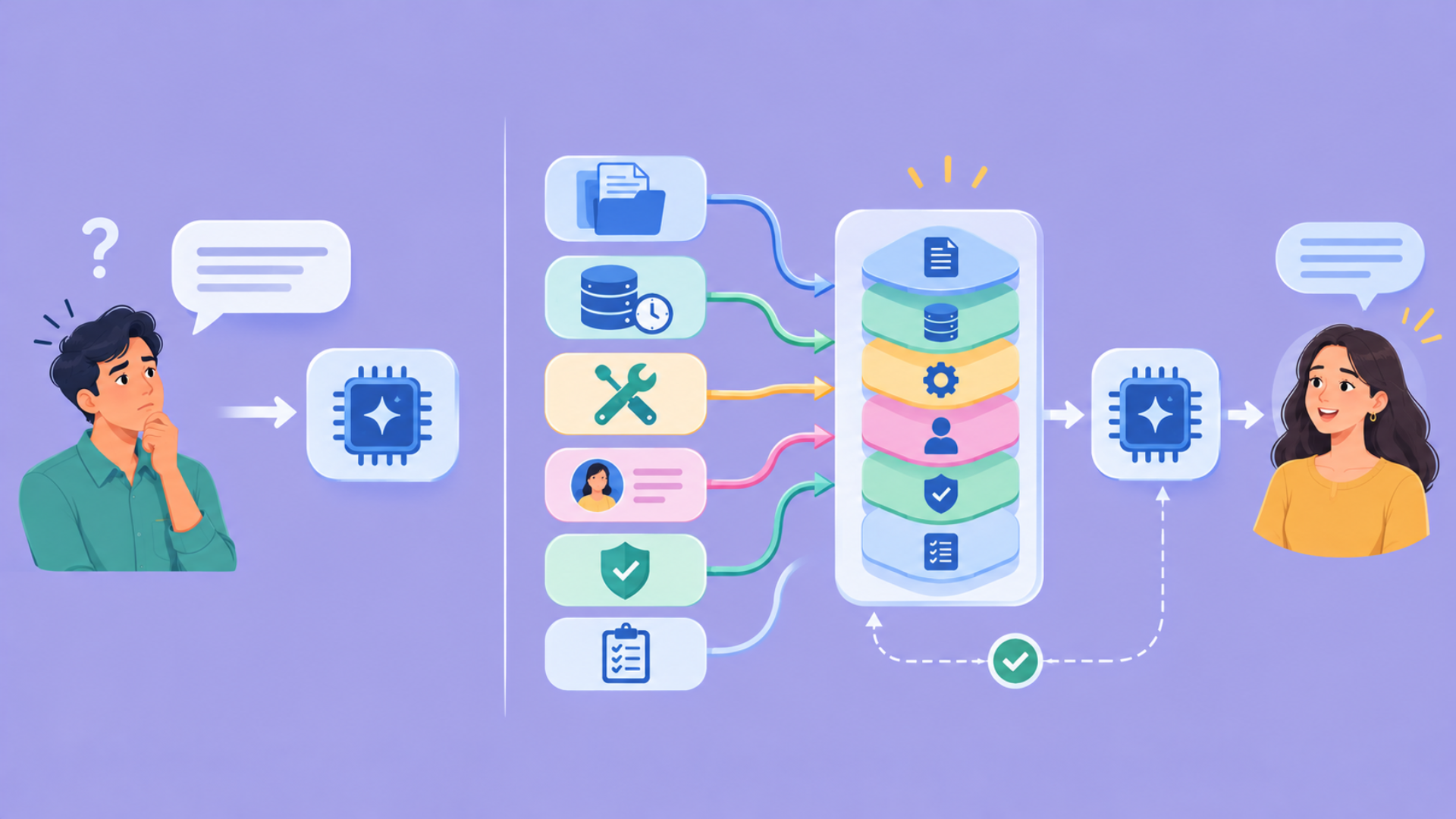
In 2023, writing the perfect prompt felt like a superpower. Phrase your instruction carefully enough and the AI would produce remarkable results.
By 2025, prompt engineering was a job title. Teams hired specialists to write and optimise prompts for their AI applications.
In 2026, Gartner declared context engineering in and prompt engineering out. 82% of IT and data leaders say prompt engineering alone is no longer sufficient to power AI at scale. 32% of teams cite context quality as the top reason their AI agents are failing in production.
Prompt engineering has not disappeared. It has been absorbed into a larger discipline. Context engineering is that discipline. Understanding what it is, and why it matters for enterprise AI, is now a practical necessity for anyone building or deploying production AI systems.
What Changed
Two years of deploying AI in enterprise environments taught teams a consistent lesson. A better-worded prompt does not fix a system that hands the model the wrong information.
The models got smarter. Modern large language models understand what you want even when your phrasing is clumsy. The bottleneck moved. It is no longer how you ask the question. It is what the model knows when it answers.
An AI agent helping a procurement team evaluate suppliers needs access to the current supplier database, the relevant contract terms, the current inventory position, the open purchase orders, and the budget approval thresholds for the decision it is being asked to support. If any of those inputs are missing, stale, or irrelevant to the specific query, the response will be wrong regardless of how well the prompt is written.
Context engineering is the discipline of ensuring the model has the right information, from the right sources, in the right format, at the right moment. Prompt engineering optimises the wording of the question. Context engineering builds the information architecture that makes the answer reliable.
What Context Engineering Actually Is
Context engineering is the systematic design, curation, and management of everything an AI model sees before it generates a response.
A model receives a context window. That window contains everything it will use to generate its response. The instruction. The relevant retrieved documents. The output of tools it has called. The memory of previous interactions. The business rules and constraints that govern its behaviour. The governance filters that determine what it is allowed to say.
Prompt engineering focuses on the instruction part of that window. How to phrase the request so the model understands clearly what is being asked.
Context engineering focuses on the entire window. Which documents should be retrieved and included? How current does the information need to be? What memory should persist across interactions? Which tools should the model have access to? What governance constraints should be enforced regardless of what the user asks?
Anthropic's engineering team frames context engineering as curating the smallest high-signal token set that reliably produces the desired outcome. Not the most information. The right information. The distinction matters because context window size affects cost, speed, and the model's ability to focus on what is relevant. A context window that contains everything the system might theoretically need is expensive and produces worse results than one that contains exactly what this specific query needs.
The Seven Layers of Context
A research paper published in September 2026 describes context engineering across seven layers. Each layer addresses a different dimension of what the model sees.
Instruction context. The system prompt and the user instruction. This is what prompt engineering primarily addresses. It tells the model what to do and how to behave.
Retrieval context. The documents, records, and data retrieved from external sources to inform the response. This is what retrieval-augmented generation (RAG) provides. The quality of retrieval determines whether the model has accurate, current, relevant information or outdated, irrelevant, or missing information.
Tool context. The tools the model can call and the outputs of those calls. An AI agent that can query a database, call an API, or run a calculation uses tool outputs as context for subsequent reasoning steps. Managing which tools are available, what their outputs look like, and how those outputs feed into the model's reasoning is tool context engineering.
Memory context. What the model remembers from previous interactions. Short-term memory is what happened earlier in the current conversation. Long-term memory is accumulated knowledge about the user, their preferences, their history, and the context of their work. Designing what gets stored, for how long, and how it is retrieved and formatted for use in future interactions is memory context engineering.
Execution context. The state of the task the model is working on. For multi-step agentic workflows, what has already been done, what remains, and what constraints apply at each step. This is the context that allows an agent to maintain coherent behaviour across a complex workflow rather than treating each step as an independent interaction.
Interaction context. Who the user is, what their role is, what they have authority to request, and what the history of their interactions with the system looks like. This context shapes not just what the model knows but what it is permitted to share and do for this specific user.
Governance context. The constraints that apply regardless of what the user asks. What information the model is not allowed to include in responses. What decisions it is not authorised to make autonomously. What compliance requirements apply to its outputs. Governance context is what prevents the model from producing responses that are accurate but inappropriate, compliant issues, or operationally dangerous.
Why It Matters More at Enterprise Scale
At small scale, a skilled prompt engineer can compensate for a weak context architecture. They can write prompts specific enough to guide the model toward reliable responses even when the surrounding context is inconsistent.
At enterprise scale, this compensation breaks down. There are too many use cases, too many users, and too many variations in the queries being processed for hand-crafted prompts to maintain reliable performance across all of them.
95% of data teams plan to invest in context engineering training during 2026. Data leaders cite AI-ready metadata as their top priority (62%), followed by context quality (55%). These investments are driven by production failures, not theoretical concerns.
The production failure pattern is consistent. An AI agent performs well in testing, where the context is controlled and the queries match what was anticipated during development. It degrades in production, where the context is less controlled and the queries vary in ways that were not anticipated. The solution is not better prompts. It is a more robust context architecture that handles variation reliably.
For enterprise AI specifically, three dimensions make context engineering critical.
Security and access control:
Different users in an enterprise have different permissions. A customer service agent should not see pricing exceptions that only account managers have access to. A junior analyst should not see board-level financial projections. Context engineering enforces these permissions at the information layer, not just at the application layer. The governance context layer ensures that what the model is allowed to see varies by user and role.
Accuracy and hallucination reduction:
An AI model that does not have access to the current, accurate information it needs will either hallucinate or produce responses based on stale training data. A well-designed retrieval context that surfaces current, relevant information from the organisation's actual systems dramatically reduces both failure modes.
Cost management:
Every token in the context window costs money at inference. A poorly designed context architecture that includes everything that might be relevant rather than what is actually relevant for the specific query is generating unnecessary inference cost at every interaction. At enterprise scale, the difference between a well-designed and a poorly designed context architecture is a material cost difference. This connects directly to the AI inference cost management challenge that is the primary concern of enterprise AI finance teams in 2026.
Prompt Engineering Is Not Dead
The "prompt engineering is dead" framing overstates the shift. Prompt engineering is a component of context engineering, not something it replaces.
The best enterprise AI teams use both. Context engineering for what the model sees. Prompt engineering for how the model communicates. The distinction is architectural. Context engineering designs the information environment. Prompt engineering designs the instruction within that environment.
What has changed is the leverage. In 2023, a clever prompt could dramatically improve AI performance because the primary constraint was how clearly the question was framed. In 2026, the primary constraint is the quality of the information the model has access to. Context engineering addresses that constraint. Prompt engineering alone cannot.
What This Means for Enterprise AI Teams
For enterprise teams building or deploying AI in 2026, context engineering has three practical implications.
Treat context as infrastructure, not as a configuration detail:
The pipelines that retrieve documents, the memory systems that persist information across interactions, the governance filters that enforce business rules, and the tool integrations that give models access to enterprise data are all infrastructure. They need to be designed, tested, monitored, and maintained with the same rigour as any other enterprise infrastructure component.
Measure context quality, not just output quality:
When AI performance is poor, the instinct is to improve the prompt. The first diagnostic question should be: is the model receiving the right context? Measuring retrieval quality, checking whether retrieved documents are current and relevant, and monitoring whether governance constraints are being applied correctly will identify context failures that prompt changes cannot fix.
Build context governance from the start:
Permissions, provenance tracking, and audit trails for what information entered the context are governance requirements that are significantly harder to retrofit than to build in from the start. For enterprises in financial services, automotive, and other sectors with audit obligations, context governance is not optional.
Vishleshan AI's forward deployed engineering (FDE) approach designs context architecture alongside AI application architecture from the start. Retrieval pipelines, memory systems, governance filters, and tool integrations are built as production infrastructure rather than configuration details, across financial services, automotive manufacturing, and supply chain deployments where context quality determines whether the AI works reliably in production. Book a Consultation