


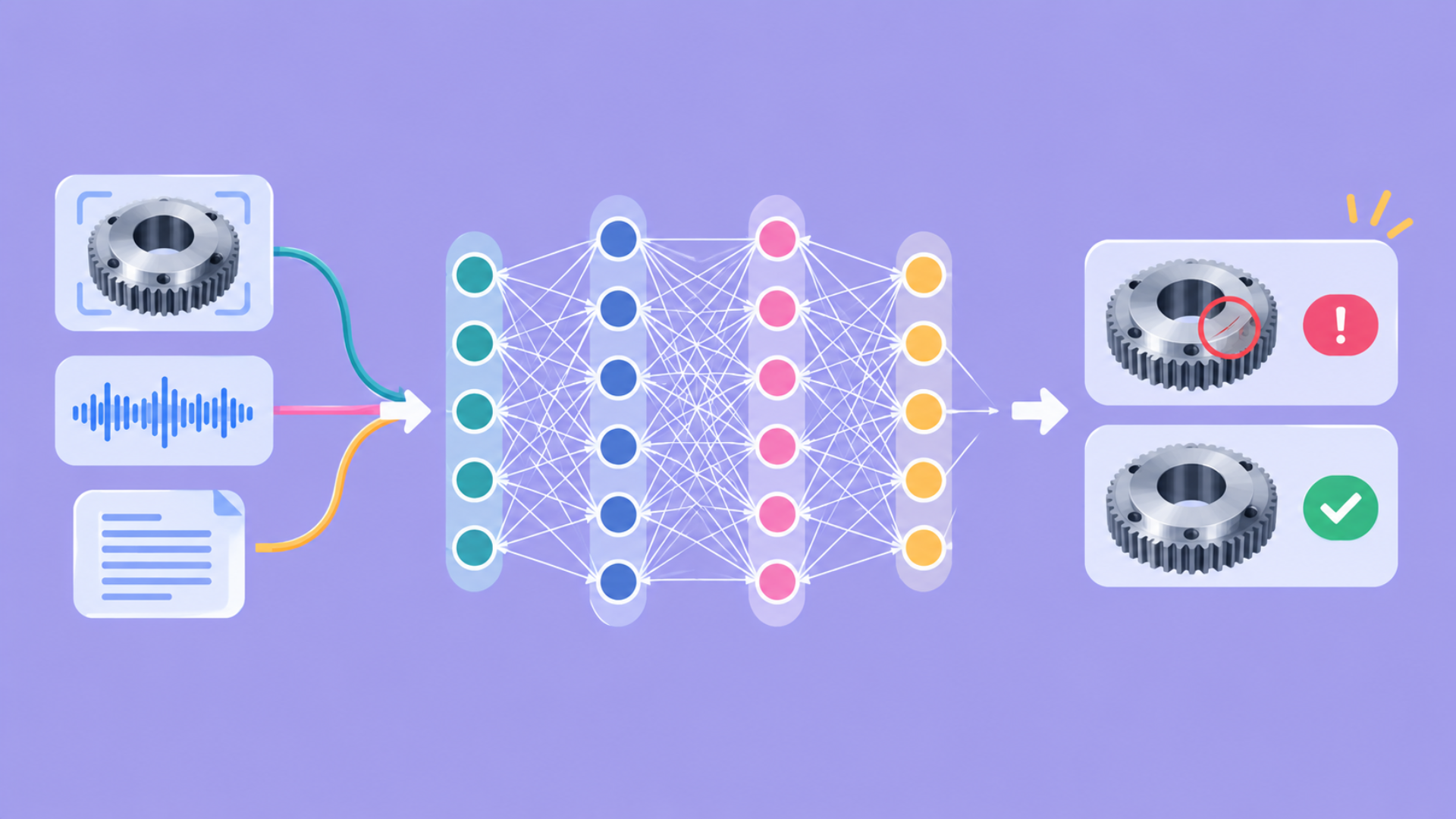
Most of the AI that enterprises are deploying in 2026 runs on deep learning. Vision AI that inspects production lines. Voice AI that handles customer service calls. Language models that process documents. Fraud detection that screens transactions in milliseconds. All of these are deep learning applications.
Deep learning is also consistently overapplied. Teams reach for it because it is what the most visible AI systems use. They use it for problems that a simpler statistical model would solve faster, cheaper, and with results that are easier to explain to a regulator or a board.
Understanding what deep learning actually is, where it genuinely outperforms simpler approaches, and where it does not, is one of the most practically useful things an enterprise AI leader or architect can know.
What Deep Learning Actually Is
Deep learning is a type of machine learning. It uses artificial neural networks with many layers to learn patterns from data.
The word "deep" refers to the number of layers. A shallow neural network has one or two layers. A deep neural network has many, sometimes dozens or hundreds. Each layer learns to recognise increasingly complex features from the data it receives.
Here is a concrete example. A deep learning model trained to detect surface defects on manufactured components learns at the first layer to recognise edges and colour variations. At the second layer it recognises shapes. At deeper layers it recognises specific defect patterns. At the final layer it produces a classification: defect or no defect. The model learns all of these features automatically from the labelled training data. Nobody programmed the rules. The model discovered them.
This automatic feature learning is what makes deep learning powerful for complex, unstructured data. It is also what makes it different from earlier machine learning approaches, where a human expert had to identify and engineer the relevant features before the model could learn from them.
How Deep Learning Differs From Machine Learning
Deep learning is a subset of machine learning. All deep learning is machine learning. Not all machine learning is deep learning.
The practical distinction matters for enterprise decisions.
Classical machine learning methods, including gradient boosting, random forests, and logistic regression, work well on structured tabular data. The kind of data that lives in ERP systems, CRM databases, and financial records. Sales figures, customer attributes, transaction amounts, inventory levels.
These methods are faster to train, require less data, are easier to interpret, and cost less to run. For structured data problems, they often outperform deep learning or match it at a fraction of the cost.
Deep learning methods work well on unstructured data. Images. Audio. Video. Raw text. Long sequences with complex temporal dependencies. For these data types, classical machine learning struggles because it cannot automatically learn the relevant features. Deep learning excels because feature learning is exactly what it does.
The decision between the two is not about which is more advanced. It is about which fits the data type and the problem.
The Four Enterprise Deep Learning Use Cases With the Clearest ROI
Computer vision and visual inspection
This is where deep learning has generated the most consistent and most well-documented commercial returns in enterprise settings. Visual defect detection in manufacturing. Document understanding. Identity verification. Shelf intelligence in retail.
The reason deep learning is specifically required for these use cases is that visual data is unstructured. A pixel is a number. A defect is a pattern of numbers that differs from a non-defect in ways that are not easily described in explicit rules. Deep learning learns those patterns automatically from thousands of labelled examples. Classical machine learning cannot do this reliably.
Visual quality control in manufacturing using deep learning consistently achieves detection accuracy above 95%. In the highest-ROI category, the documented three-year ROI runs at 374% with payback at seven to eight months.
Natural language processing and document intelligence
Large language models are deep learning systems. So is the transformer architecture that powers document understanding, contract analysis, and conversational AI. The shift to deep learning for text processing has made natural language AI dramatically more capable than the statistical approaches it replaced.
For enterprise teams processing large volumes of documents, the specific value of deep learning is its ability to understand meaning in context rather than matching keywords. A classical text analysis system that looks for the word "penalty" in a contract will find every instance. A deep learning system understands that "liquidated damages not to exceed 10% of contract value" is a penalty clause even if the word penalty does not appear.
Fraud and anomaly detection on sequential data
Fraud detection on transaction sequences, network intrusion detection, and equipment anomaly detection are all problems where the relevant pattern is temporal. The sequence of events matters, not just the presence of specific features.
Recurrent neural networks and long short-term memory networks are deep learning architectures designed for sequential data. They are the standard approach for fraud detection at financial institutions processing millions of transactions daily. Deep learning reduces false positives in fraud detection significantly compared to rule-based systems, saving institutions meaningful amounts in both fraud losses and the cost of investigating false positive alerts.
Demand forecasting with complex seasonality
Classical time series forecasting methods work well when demand follows predictable patterns. They work less well when demand is influenced by many interacting external factors simultaneously. Weather. Economic indicators. Competitor promotions. Social media trends. Event calendars.
Deep learning architectures including temporal fusion transformers can incorporate these diverse external signals alongside historical demand data and learn the complex relationships between them. For manufacturers and retailers with demand driven by multiple interacting factors, deep learning forecasting consistently outperforms classical approaches on forecast accuracy.
When Deep Learning Is Not the Right Tool
This is the part that most vendor-produced deep learning content skips.
When the data is structured and tabular:
If your data lives in a database and is organised in rows and columns, classical machine learning is almost always faster to build, cheaper to run, easier to explain, and competitive in accuracy. A credit risk model built on financial transaction records does not need deep learning. A gradient boosted tree model will match or exceed deep learning performance at a fraction of the cost and with explainability that satisfies regulatory requirements.
When you have limited training data:
Deep learning needs data. Typically thousands to millions of labelled examples for visual tasks. Hundreds of thousands for language tasks. When labelled data is scarce, classical machine learning or transfer learning, where a pre-trained deep learning model is fine-tuned on a smaller dataset, is a more practical starting point.
When explainability is a hard requirement:
Deep learning models are harder to explain than classical machine learning models. For high-risk decisions in financial services, healthcare, or employment, where regulators require an explanation of why a specific decision was made for a specific individual, a deep learning model may not be appropriate unless additional explainability layers are built on top of it. This adds cost and complexity that may not be justified when a simpler, inherently interpretable model would meet the accuracy requirement.
When compute budget is constrained:
Deep learning training requires GPU infrastructure. Inference also requires more compute than classical machine learning. For use cases where a classical model would perform adequately, the additional infrastructure cost of deep learning is not justified.
What This Means for Enterprise AI Architecture Decisions
The practical implication of understanding deep learning's strengths and limitations is that most enterprise AI programmes need both deep learning and classical machine learning, applied to the right problems.
Computer vision applications need deep learning. Document intelligence needs deep learning. Voice AI needs deep learning. These are the unstructured data problems where deep learning is not optional.
Structured data forecasting, scoring, and classification often do not need deep learning. Demand forecasting on clean structured data. Credit risk scoring. Customer churn prediction. Channel partner performance scoring. These are problems where classical machine learning is faster to build, cheaper to run, and produces results that are easier to explain.
Building an AI programme that uses deep learning where it is genuinely required and classical machine learning where it is sufficient produces better results at lower cost than applying deep learning uniformly. It also produces models that are more explainable where explainability matters, which is a commercial and regulatory advantage in financial services, automotive, and other sectors with audit obligations.
Vishleshan AI's forward deployed engineering (FDE) approach selects the right AI architecture for each specific use case rather than defaulting to the most prominent approach. Across automotive manufacturing, consumer electricals, financial services, and supply chain deployments, we apply deep learning where unstructured data and pattern complexity require it, and classical machine learning where it produces better results at lower cost. Book a Consultation