


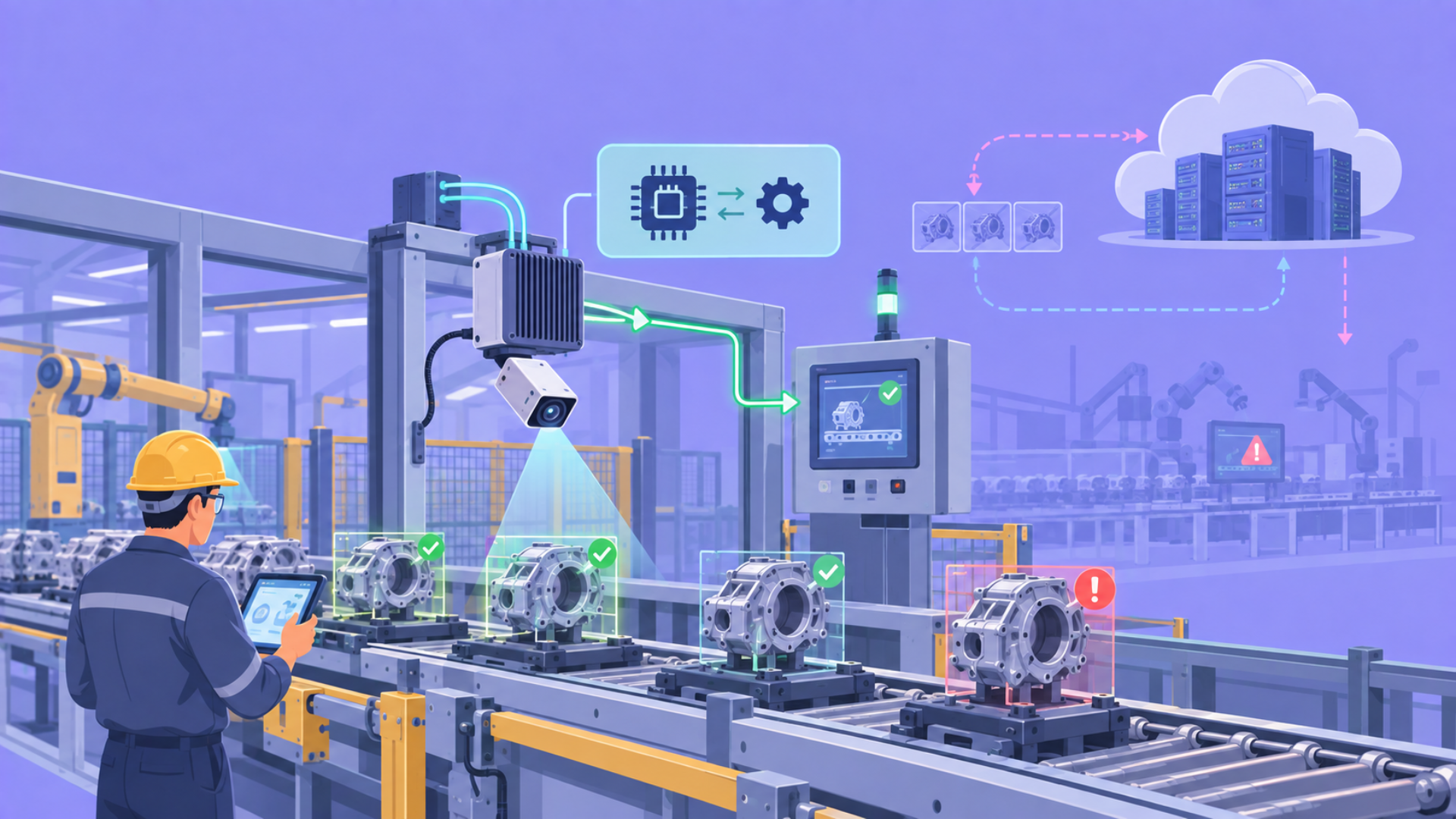
Every AI model produces two types of computational work. Training is the work of building the model. Inferencing is the work of running it.
Training happens once, or periodically when the model is updated. It requires enormous compute resources and produces the model weights that encode what the AI has learned.
Inferencing happens continuously in production. Every time the model receives an input and generates an output, that is inferencing. A quality inspection camera examining a component on a production line is inferencing thousands of times per minute. A predictive maintenance system monitoring sensor data from a machine is inferencing continuously.
Where that inferencing happens determines how fast the result arrives, and in manufacturing, that timing difference is often the difference between catching a defect before it progresses and logging it after it already has.
Edge inferencing means running the model at or near the point where the data is generated. Not in a cloud data centre hundreds or thousands of kilometres away. On a device at the production line, in the factory, or in the plant.
The Latency Problem That Makes Edge Inferencing Essential in Manufacturing
Cloud AI works through a straightforward sequence. Data is captured by a sensor or camera. It is transmitted over a network to a cloud server. The model processes it. The result comes back. An action is triggered.
In many enterprise contexts, this sequence works fine. A customer service AI that takes half a second to respond to a query is perfectly acceptable. A document processing system that takes two seconds to summarise a contract is fast enough.
In manufacturing, the sequence breaks down at specific points.
A vision inspection camera mounted above a production line in an automotive body shop is examining welds as the body moves through at production speed. The camera captures an image. If that image needs to travel to a cloud server, be processed, and return a result before the line control system can act on it, the body has already moved past the inspection point. The defect that should have triggered a stop or an alert has already progressed to the next station.
The round-trip latency for cloud inference is typically one to two seconds. The time between inspection points on a high-speed production line can be measured in milliseconds. The physics do not allow cloud-based inspection to close the loop in time.
Edge inferencing solves this. When the AI model runs on a device mounted next to the camera, on the production line, the round trip is measured in milliseconds rather than seconds. The result arrives before the part moves. The action can happen in real time.
This is not a theoretical problem. It is why Dell's 2026 edge AI predictions explicitly state that manufacturing environments will deploy computer vision systems for quality control and safety monitoring at the edge. It is why IDC expects half of all enterprise AI inference workloads to run on endpoints or edge nodes by 2030.
How Edge Inferencing Works
The components of an edge inferencing system are different from a cloud AI system, but the logic is similar.
The edge device:
This is the hardware that runs the AI model locally. It can be a dedicated edge AI server installed in the plant, an industrial PC with AI acceleration hardware, or a compact embedded device mounted directly on the equipment being monitored.
The key hardware characteristic is the AI accelerator chip. Traditional processors (CPUs) are general-purpose. Graphics processing units (GPUs) are powerful for AI but power-hungry and physically large. Neural processing units (NPUs) are purpose-built for AI inference. They consume 10 to 20 times less power than GPUs while delivering faster inference times for the specific type of calculation that AI models perform. For manufacturing deployments where edge devices run continuously in industrial environments, the power efficiency of NPUs matters practically.
The AI model:
Edge inferencing requires models that are efficient enough to run on edge hardware. Full-scale cloud AI models are too large to run on edge devices at the required speed. Edge AI models are smaller and more efficient, either purpose-built for edge deployment or compressed versions of larger models through a process called quantisation that reduces the model's precision while preserving most of its accuracy.
The development of smaller, task-specific AI models (sometimes called Small Language Models or edge-optimised vision models) is one of the key enablers of the current growth in edge inferencing. These models perform specific, well-defined tasks at high accuracy on modest hardware.
The connection to central systems:
Edge inferencing does not mean complete isolation from central systems. The edge device processes data locally and generates results locally. Those results are then sent to the relevant central systems: the manufacturing execution system, the quality management system, the ERP. The data transmitted is the result, not the raw data. A camera that captures images at 30 frames per second and inspects each one locally sends a quality result and an alert flag to the MES, not 30 frames of video data per second to a cloud server. This significantly reduces the bandwidth required and the cost of transmitting data.
Edge Inferencing vs Cloud AI: When Each Is Right
Edge and cloud inferencing are not competing approaches. They are complementary, and the right architecture uses both for the workloads each handles best.
Use edge inferencing when:
Latency is critical. The decision needs to happen in milliseconds, not seconds. Real-time quality inspection, safety system triggers, autonomous equipment control.
Data volume is high and connectivity is limited. A production line generates enormous volumes of sensor and camera data continuously. Transmitting all of it to the cloud is expensive and often impractical. Processing locally and sending only results is more efficient.
Data cannot leave the facility. Some manufacturing data, particularly in defence, pharmaceuticals, and certain automotive programmes, is subject to data residency requirements that prohibit it from leaving the site. Edge inferencing keeps it local.
Connectivity is unreliable. Manufacturing environments, particularly older facilities, may have inconsistent network connectivity. Edge inferencing that does not depend on a continuous cloud connection is more resilient.
Use cloud AI when:
The task is not time-critical. Analysis and reporting workloads that do not need a real-time result can run in the cloud without the latency constraint mattering.
The model is large and complex. Frontier AI models that require significant compute are better served from cloud infrastructure than from edge hardware.
Training and model updates are required. Model training, fine-tuning, and version management are cloud workloads. The edge device runs the trained model. The cloud is where new model versions are developed and validated before being pushed to the edge.
What Edge Inferencing Enables in Manufacturing Specifically
Real-time quality inspection:
A vision AI model running on an edge device at a production line inspection point processes each image and generates a pass or fail result before the part moves. The result connects to the line control system, which triggers a stop, a divert, or an alert. No human needs to be watching. No cloud round trip introduces delay. The detection is immediate.
Predictive maintenance at machine level:
An edge device mounted on a critical machine processes sensor data continuously and runs a predictive maintenance model locally. When the sensor pattern matches the signature that precedes a failure, it generates an alert. The alert reaches the maintenance system in seconds, not minutes. For machines where an undetected failure causes a line stop, this latency difference translates directly to uptime.
Safety monitoring without network dependency:
A safety monitoring system that depends on cloud connectivity is a safety system that fails when the network fails. An edge-based safety system that processes camera feeds locally and triggers alerts independently of network connectivity is more reliable in the environments where safety monitoring matters most. Industrial facilities are not always the most network-friendly environments.
Local AI for field technicians:
In field service operations, edge inferencing enables AI support tools that work without reliable connectivity. A technician in a location with poor connectivity can still access AI-powered diagnostic support, technical documentation queries, and job guidance if the AI is running on the device rather than requiring a cloud connection. This is directly relevant to large service networks where technicians operate across diverse connectivity environments.
The Central Management Challenge
Edge inferencing creates a management challenge that does not exist in cloud AI. Instead of managing one set of models on central infrastructure, an enterprise with edge inferencing deployed across a manufacturing facility is managing models on dozens or hundreds of edge devices.
When the model needs to be updated, the update needs to reach every edge device. When a device fails, it needs to be detected and replaced without disrupting the production process. When performance degrades on one edge device, the monitoring system needs to identify which device and why.
This is the management overhead that centralised AI vision platform architecture is designed to address, as described in the centralised AI vision platform piece. The edge devices run models deployed and managed from a central platform. The central platform handles model version control, device monitoring, performance tracking, and update distribution. The edge handles the low-latency local inferencing that production requires.
The architecture separates where inferencing happens from where management happens. Inferencing is at the edge, close to the data and the production process. Management is central, with visibility across all edge devices and control over what each one runs.
What to Assess Before Deploying Edge Inferencing in Manufacturing
Four questions determine whether edge inferencing is the right architecture for a specific manufacturing AI application.
What is the required response time?
If the application can tolerate one to two seconds of latency, cloud AI may be simpler and more cost-effective. If it needs to act in under 100 milliseconds, edge inferencing is the only viable approach.
How much data is being generated?
High-resolution cameras generating continuous video streams, sensors producing thousands of readings per second. If the data volume makes cloud transmission impractical or expensive, edge processing is the right default regardless of latency requirements.
What is the connectivity environment?
Assess the reliability and bandwidth of network connectivity in the specific manufacturing zone where the application will run. If connectivity is unreliable, edge inferencing provides operational resilience that cloud-dependent systems cannot.
What is the model complexity required?
If the application requires a large, complex AI model, assess whether an edge-optimised version of that model achieves the required accuracy. If not, the application may need to run in the cloud with results delivered to the edge, rather than running the full model locally.
Vishleshan AI's forward deployed engineering (FDE) approach designs edge inferencing architectures for manufacturing environments that integrate with the centralised management and governance infrastructure that production-scale AI requires. Our manufacturing AI experience spans automotive and industrial production environments where the latency, connectivity, and data volume requirements of edge inferencing are real operational constraints, not theoretical considerations. Book a Consultation