


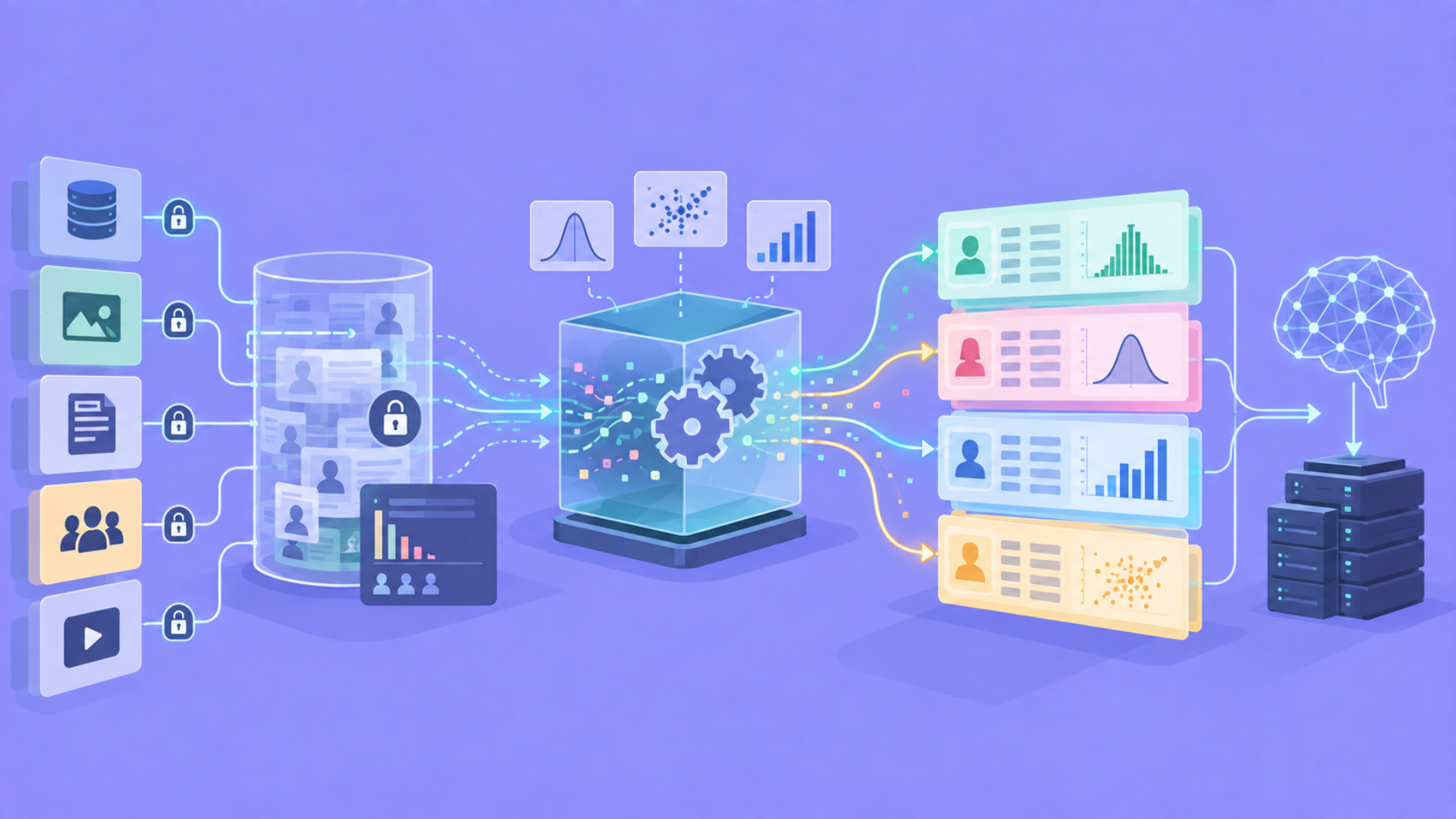
Two years ago, synthetic data was a niche technique discussed mostly in academic papers and privacy-focused startups. In 2026 it is a core part of the AI training pipeline at every major AI lab and 75% of large enterprises.
Gartner predicted in 2022 that 75% of businesses would use synthetic data for AI training by 2026. That prediction now looks conservative. Microsoft trained Phi-4 on 400 billion synthetic tokens. NVIDIA acquired Gretel AI for $320 million and folded it into its enterprise AI platform. Anthropic uses AI-generated feedback to align Claude. Meta uses synthetic reasoning traces to fine-tune Llama. Google DeepMind generates synthetic data to improve Gemini's reasoning.
The question has shifted from whether to use synthetic data to how to use it without breaking your models.
What Synthetic Data Actually Is
Synthetic data is artificially generated data that preserves the statistical properties of real data without containing real information about real people, real transactions, or real events.
It is created by a generative model or a simulation system that has learned the patterns in a real dataset and can produce new data that looks statistically identical to the original. A synthetic customer dataset has the same distribution of ages, purchase frequencies, and spending patterns as the real customer dataset. But none of the records corresponds to a real customer. There is nobody to re-identify. There is no personal information to expose.
This is the core value of synthetic data for enterprises with data privacy obligations. You can use it to train AI without the regulatory exposure that comes from training on real customer, patient, or financial records.
But privacy is not the only reason enterprises are using synthetic data. Three other drivers are equally significant in 2026.
Why Enterprises Are Using Synthetic Data
The internet is running out of high-quality training data
This is the most consequential driver of synthetic data adoption in 2026. The public internet contains roughly 300 trillion tokens of text. That sounds enormous. It is not, for the scale at which frontier AI models are trained. GPT-4 was trained on somewhere between 6 and 13 trillion tokens. The models coming after it are larger and need more data. The supply of high-quality public data is finite and most of it has already been used.
Synthetic data generation is the solution the industry has converged on. If real data is running out, generate more. A large teacher model generates high-quality synthetic training data that a smaller student model is trained on. The student model learns from AI-generated data that reflects the quality and diversity of the teacher's knowledge. Microsoft's Phi series of small models matched the performance of much larger models by training on synthetically generated data described as textbook-quality, where the content was carefully designed to be educational, diverse, and high-fidelity.
For enterprises building domain-specific AI, this approach means that the scarcity of labelled real data in your specific domain is no longer an absolute constraint. Synthetic data can fill the gaps.
Real data is insufficient for rare events
AI models learn from examples. If a type of event is rare in the real world, it is underrepresented in real datasets. A fraud detection model trained on real transaction data will see millions of legitimate transactions and thousands of fraudulent ones. The imbalance makes it harder to train the model to detect the rare event reliably.
Synthetic data generation lets you manufacture the tail of the distribution. You can generate as many synthetic fraud examples as you need to train a model that detects them reliably. You can generate synthetic safety incident scenarios for a manufacturing AI that needs to recognise dangerous conditions it has never encountered in real operation. You can generate synthetic edge cases for an autonomous system that needs to handle scenarios that occur rarely enough in the real world that waiting for real examples would take years.
This is the application that Waymo uses for autonomous vehicle training. In February 2026, Waymo announced synthetic data generation specifically for the rare, high-consequence scenarios that are too dangerous or too infrequent to capture reliably from real driving. A model trained only on normal driving does not learn how to handle abnormal situations well. Synthetic generation of abnormal situations produces the training data that normal operation cannot.
Privacy regulations restrict real data use
GDPR, CCPA, and sector-specific regulations in financial services, healthcare, and government restrict how personal data can be collected, stored, and used for AI training. Training an AI model on customer records or patient data requires either explicit consent from every individual in the dataset, complex anonymisation that often degrades data quality, or operating under research exemptions that are not available for commercial AI training.
Synthetic data sidesteps these constraints. There are no real individuals in the dataset to protect. The synthetic records are not derived from any specific real person. They preserve the statistical properties of the population without containing personal information about any member of it.
For enterprises in financial services, healthcare, and government, this is the most significant practical benefit of synthetic data. The data governance barrier to AI training is removed without losing the training signal that makes the AI useful.
How Synthetic Data Is Generated
Three main approaches produce synthetic data for enterprise AI training.
Generative AI models. A large generative model is trained on real data and then used to produce new synthetic examples. This approach works well for text, images, and structured tabular data. The synthetic data inherits the statistical properties and domain knowledge of the real data the generator was trained on. This is the approach that every major AI lab is using for their own training pipelines.
Simulations. In manufacturing, automotive, and robotics applications, synthetic data is generated by physically accurate simulations of the real environment. NVIDIA's Omniverse platform generates photorealistic synthetic images of manufacturing scenes, warehouse environments, and driving scenarios that vision AI models can be trained on. The simulation produces infinite variations of conditions that would be impossible or expensive to capture through real photography.
Rule-based generation. For structured data like transaction records, sensor readings, and customer profiles, rule-based systems can generate synthetic records that follow defined statistical distributions and business logic. This approach is less flexible than generative AI but is faster, more predictable, and easier to validate.
Where Enterprises Are Getting the Most Value
Manufacturing and quality inspection:
Vision AI systems for defect detection need to be trained on examples of every defect type they will encounter. Some defect types are rare. Others are destructive to produce intentionally for training purposes. Synthetic generation of defect images in physically accurate manufacturing simulations produces the training data that real production cannot.
Financial services fraud detection:
Fraud is rare and evolves constantly. Fraudsters change their methods to avoid detection. A fraud model trained only on historical fraud patterns may not detect new patterns. Synthetic generation of fraud scenarios that extend beyond historical examples produces more robust detection models.
Healthcare AI:
Patient data is among the most tightly regulated data in any jurisdiction. Synthetic patient records that preserve the statistical properties of real patient populations enable AI training for clinical decision support without the consent and governance requirements that real patient data carries.
Customer service and conversational AI:
Training conversational AI on real customer interactions requires consent and creates privacy exposure. Synthetic conversation generation produces training data that reflects the diversity of real customer language and intent without using real customer conversations.
The Risks That Enterprises Need to Manage
Synthetic data is not a free pass. Three specific risks need to be managed.
Model collapse. When AI models are trained repeatedly on AI-generated data without anchoring on real data, they tend to converge toward the centre of the distribution and lose coverage of rare but valid patterns. Each generation of synthetic data loses a little of the diversity of the original. Over successive training runs, the model becomes less capable of handling unusual situations. The solution is maintaining a foundation of real human data and using synthetic data to extend and augment it rather than replace it entirely.
Fidelity gaps. Synthetic data that does not accurately preserve the statistical properties of real data will train models that do not perform well on real data. A synthetic customer dataset that slightly misrepresents the age distribution of the real customer base will produce a model that is subtly miscalibrated for real customers. Validation of synthetic data quality against real data statistical properties is not optional.
Regulatory uncertainty. The legal status of AI training on synthetic data is still being established. In some jurisdictions, synthetic data derived from personal data may still be subject to data protection regulations even if no individual can be re-identified from the synthetic records. The US government is actively drafting AI agent governance rules that attempt to distinguish legitimate synthetic data distillation from unauthorised data extraction. Legal review of synthetic data generation processes is warranted for enterprises in tightly regulated sectors.
What to Start With
For enterprises evaluating synthetic data for the first time, the practical starting point is a use case where real data is clearly insufficient.
A defect type that is too rare to provide enough real training examples. A fraud scenario that has not yet appeared in real transaction history but is known to be possible. A customer service conversation type that represents a small fraction of real interactions but causes disproportionate problems when handled incorrectly.
Start with that use case. Generate synthetic examples. Train and evaluate a model on a mix of real and synthetic data. Measure whether the model performs better on the rare event than a model trained on real data only.
The result of that experiment will tell you more about whether synthetic data is viable for your specific domain than any general guidance can. And it will be a concrete production test rather than a theoretical evaluation.
Vishleshan AI's forward deployed engineering (FDE) approach includes synthetic data generation where real data is insufficient for training reliable AI in client environments across automotive manufacturing, consumer electricals, financial services, and supply chain operations. Book a Consultation