


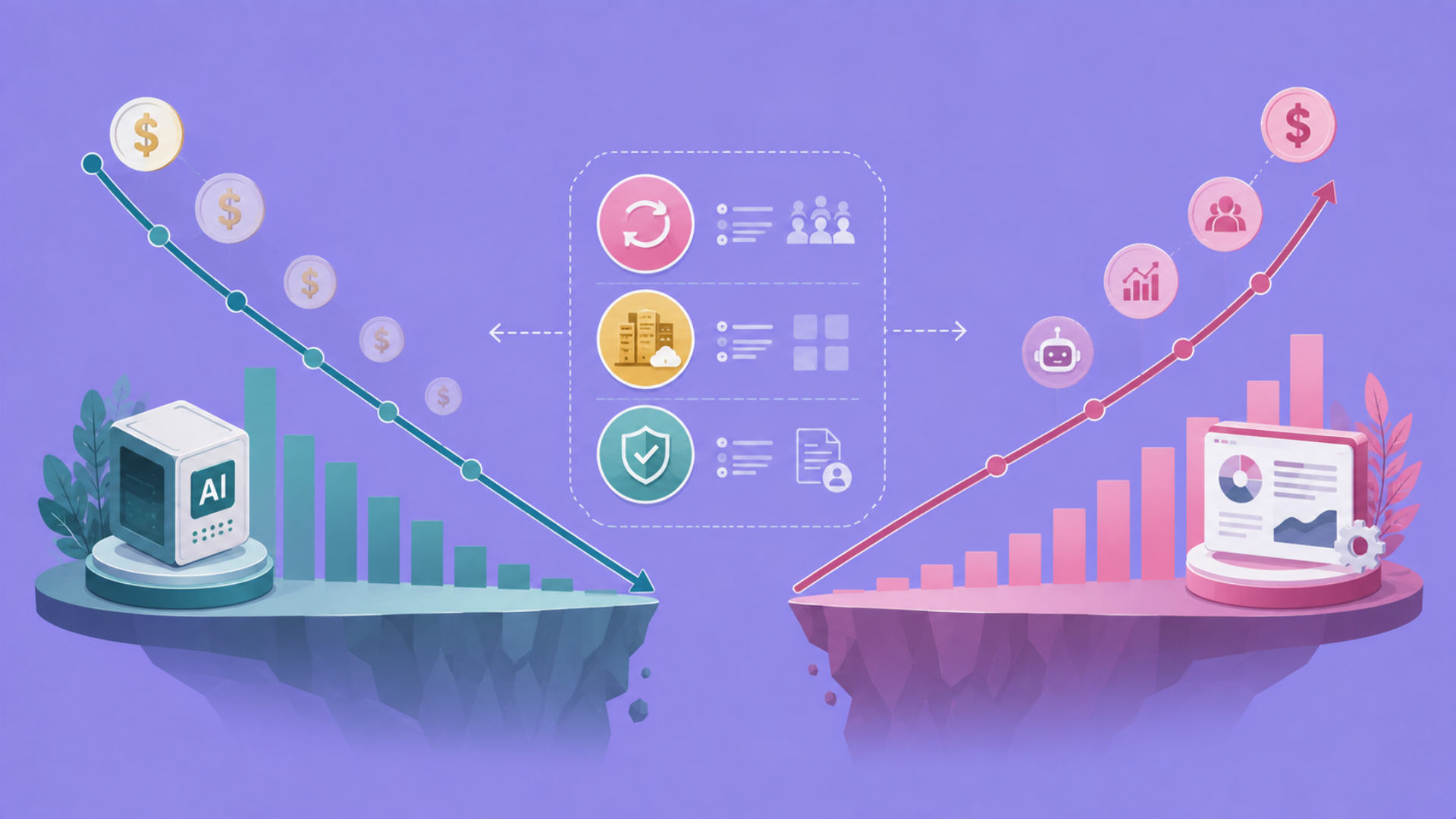
Model prices have fallen significantly in 2026. OpenAI, Meta, and others have cut prices multiple times. A lightweight model that cost $0.20 per million input tokens now offers significantly more capability per dollar than it did a year ago.
Enterprise AI budgets are rising sharply regardless.
McKinsey's May 2026 Enterprise AI FinOps Survey found that 93% of enterprise AI teams are over budget. One in five organisations has already constrained AI use specifically because of AI-related operating costs. The average enterprise AI budget reached $186 million in 2026, yet only 8% of those companies report tangible return on investment.
The boards and executive teams that approved these budgets expected declining model costs to keep total spend manageable. They underestimated something important. Model costs are one line in the total cost equation. They are not the largest one.
Where the Money Is Actually Going
McKinsey's research is specific about where agentic AI spend goes. Response refinement accounts for 60% of total agentic AI expenditure.
Response refinement is what happens when an AI agent does not get the right answer on the first attempt. It generates a response, checks it against a quality threshold, refines it, generates again, checks again. Each pass consumes tokens. Each token costs money. In a complex agent workflow, the refinement loops multiply across every step in the process.
This is not a model quality problem that will be fixed in the next model release. It is an architectural problem. An agent that is poorly scoped, operating on low-quality data, or tasked with a workflow that has too many ambiguous decision points will consume more tokens per completed task than one that is well-designed. The model price is largely irrelevant. The number of tokens consumed per useful output is what determines the cost.
The other major cost driver is infrastructure. IT infrastructure costs for agentic AI workloads are projected to increase two to three times by 2030 while budgets remain flat. Agents require orchestration layers, memory systems, tool integrations, and governance infrastructure that do not appear in the model pricing conversation but add up significantly in production.
The development cost, which is typically the most visible budget line, is actually the smallest part of the three-year total. McKinsey's 2026 analysis puts initial development at 25 to 35% of three-year total cost. If an enterprise spends $80,000 building an agent, the realistic three-year budget is closer to $230,000 to $320,000.
The Scaling Surge That Is Catching Finance Teams Off Guard
At the same time as costs are rising, adoption is accelerating. McKinsey's State of AI 2026 survey of 1,719 executives across 97 nations found that 40% of respondents at organisations with more than $1 billion in annual revenue are now scaling AI agents. That is up from 27% last year.
32% of organisations have decided against buying one or more software products because they can now build the functionality internally using agentic coding tools. This is a meaningful shift in how enterprise software budgets work.
Both trends are pushing AI costs upward simultaneously. More agents are being deployed. Each agent is consuming more resources than the procurement model anticipated. The finance teams that signed off on AI investment based on model pricing were not shown the full cost picture.
This is not a vendor transparency problem. It is a new cost category problem. Organisations that have managed software licensing costs for decades are now managing consumption-based costs that behave differently. Consumption pricing rewards output volume. More agents, more tasks, more refinement loops. The bill scales with usage in ways that fixed software licensing did not.
What Only 6% of Enterprises Are Getting Right
McKinsey defines AI high performers as organisations that attribute at least 5% of earnings before interest and taxes to AI use and describe the technology's impact as significant. Only 6% of the 1,719 respondents qualify.
What separates the 6% from the 94% is not access to better models. It is how they manage the economics of AI deployment.
High performers focus agents on high-value workflows with large pools of repeatable work. Small improvements compound over thousands or millions of transactions. A 2% efficiency gain on a process that runs 500,000 times per year generates meaningful returns. The same 2% gain on a process that runs 200 times per year generates nothing significant.
High performers right-size model selection. Using a frontier model for every task is the fastest way to generate an unsustainable cost structure. Frontier models cost roughly $5 per million input tokens and $30 per million output tokens. Lightweight models cost a fraction of that. High-performing enterprises route tasks to the smallest model that can complete them reliably, using more capable models only for tasks that genuinely require them.
High performers treat agent governance as part of the cost structure, not an addition to it. Poorly governed agents generate costs in two ways. They produce outputs that require more human review, which creates a hidden labour cost that does not appear in the AI budget. And they create compliance and remediation costs when they operate outside their intended boundaries. Governance built into the agent architecture from deployment reduces both.
The Refinement Loop Problem and How to Fix It
60% of agentic AI spend going to response refinement is both a problem statement and a diagnostic tool.
If your agents are spending most of their cost budget on refining their own outputs, three things are likely to be true. The agent is poorly scoped, being asked to do things that require too many ambiguous judgments per task. The data it is operating on is insufficient in quality or coverage, forcing more refinement to compensate for information gaps. Or the quality threshold it is being measured against is too high for the task value it is generating.
Each of these is fixable. None of them is fixed by waiting for model prices to fall further.
Scoping agents tightly, against specific well-defined tasks with clear completion criteria, reduces refinement loops significantly. An agent that knows exactly what a successful output looks like does not need to refine as many times to get there. This is the AI deployment principle that separates enterprises seeing returns from those accumulating costs.
Data quality is the other lever. An agent operating on clean, current, well-structured data makes better first-pass decisions. It refines less. It consumes fewer tokens per useful output. Getting the data foundation right before scaling agents is not a preparation step. It is a cost management decision.
What This Means for Enterprise AI Investment Decisions
The question McKinsey describes as the core executive question for 2026 is deceptively simple: are the AI agent capabilities being built and run worth the value being extracted from them?
This question requires a different evaluation framework from the one most enterprises used to approve the initial AI investment. That framework compared model capabilities and licence fees. This one compares total deployment cost, including infrastructure, governance, and refinement, against the specific business value generated.
Value in this context means revenue influenced, costs avoided, or risk reduced. It does not mean time saved by individual users or number of prompts submitted. The metrics that connect AI to business outcomes are not the same as the metrics that measure AI activity.
The enterprises that are managing agentic AI economics well are the ones that started with the business outcome and worked backwards to the agent design. They know what a completed task is worth. They know how many tokens it should consume. They know the threshold at which the agent is generating value and the threshold at which it is generating cost.
The enterprises that are over budget are the ones that started with the AI capability and worked outward. They deployed agents, measured adoption, reported usage volume, and discovered the cost structure as invoices arrived.
The Infrastructure Conversation That Has Not Happened Yet
The 2 to 3 times increase in IT infrastructure costs projected by 2030 has not yet entered most enterprise AI conversations at the budget level.
Agentic AI requires infrastructure that does not exist in most enterprise technology stacks today. Orchestration layers that coordinate multiple agents working on the same task. Memory systems that allow agents to maintain context across long-running workflows. Tool integration frameworks that allow agents to act on enterprise systems safely. Monitoring and observability infrastructure that makes agent behaviour visible and auditable.
Building this infrastructure takes time and investment. It also creates the foundation that makes subsequent agent deployments significantly more cost-efficient, because the shared infrastructure does not need to be rebuilt for each new agent.
The enterprises investing in this shared infrastructure now are the ones whose agent economics will improve over time. The ones that are building point solutions for individual use cases are building costs that will multiply as they scale.
Enterprise AI agent costs will not come under control by waiting for model prices to fall further. The cost drivers are in the architecture, the data quality, the governance design, and the infrastructure. Getting these right from the start is significantly less expensive than optimising them after the bill has arrived.
Vishleshan AI's forward deployed engineering (FDE) approach designs agent architectures with cost governance built in from deployment. This includes right-sized model selection, scoped agent workflows, clean data infrastructure, and governance mechanisms that reduce refinement loops rather than monitoring them after the fact. Book a Consultation