


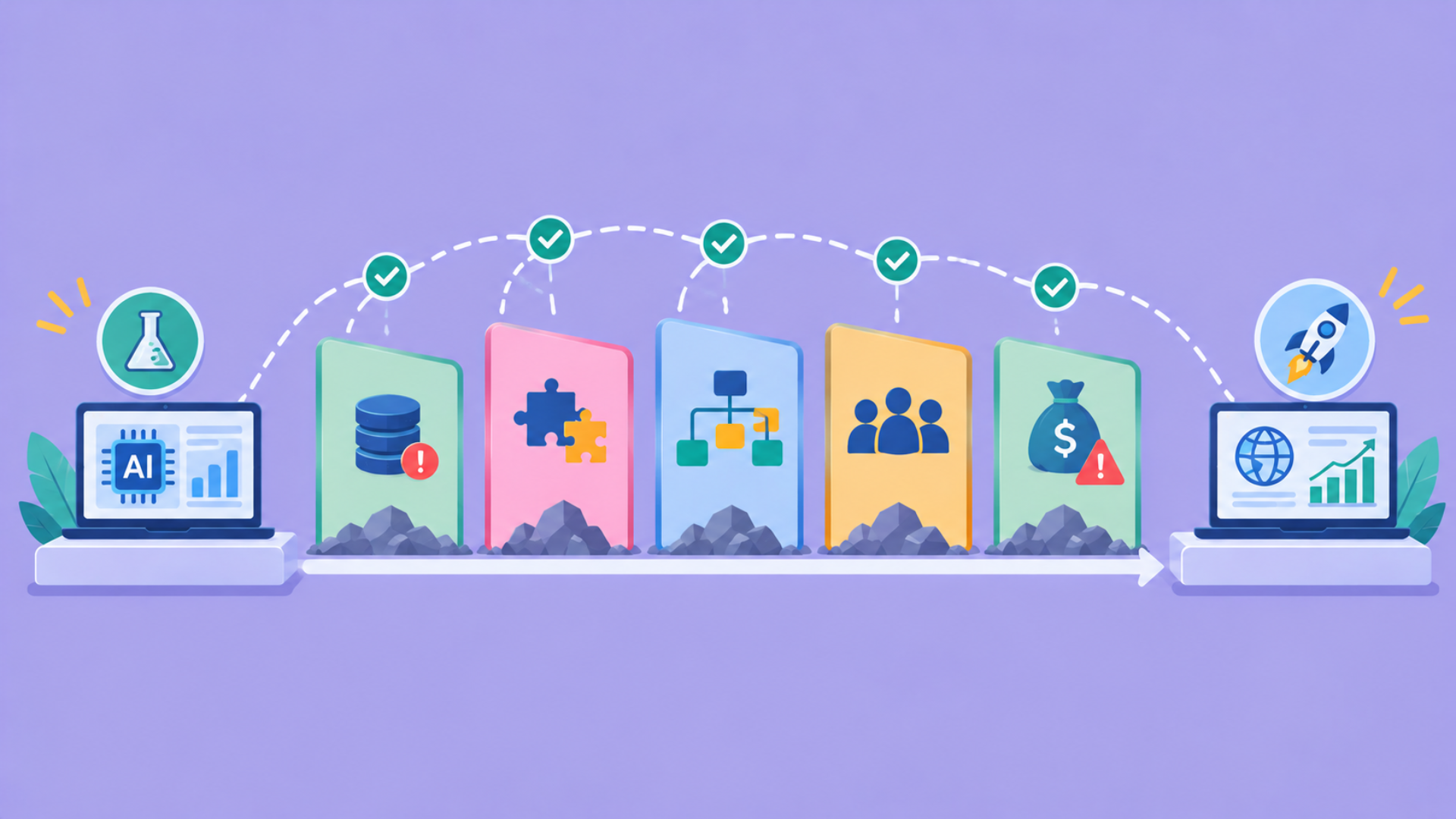
67% of enterprise AI agent pilots never reach production. Only 4 of every 33 pilots graduate to production according to IDC. 95% of enterprise generative AI pilots deliver no measurable business impact.
These numbers are consistent across research sources, geographies, and industries. They are also consistently misread.
The instinct is to treat them as evidence that AI is overhyped. That the technology does not work at enterprise scale. That the ROI claims are exaggerated.
The evidence does not support this interpretation. The pilots that fail to reach production were not failed because the AI stopped working. They failed because the organisation never built what production actually requires around a working AI. The technology is not the bottleneck. The bottleneck is the infrastructure, governance, integration, and change management that production AI demands and that pilots systematically skip.
The organisations crossing the gap in 2026 are not the ones with better models. They are the ones that treated AI as an operating capability to be built with the same discipline they would apply to a new production line. Here is what separates them.
The Five Places AI Programmes Stall
1. The data that worked in the pilot does not exist in production
Every pilot runs on data that has been prepared for the pilot. Cleaned, structured, representative samples curated by the team building the pilot. The AI performs well because the data is good.
Production runs on the data the organisation actually has. Inconsistent, incomplete, distributed across systems that were never designed to interoperate. When the AI encounters production data for the first time it behaves differently from how it behaved in the pilot. Sometimes it degrades gradually. Sometimes it fails immediately on a class of inputs that never appeared in the pilot dataset.
The fix is not cleaning all the data before the pilot. It is building the pilot on data that is representative of what production will actually provide. This means accessing actual production data sources during pilot development, not curated extracts. It means identifying and documenting the data quality gaps that exist in production and building a plan to address them before the production go-live date, not after the pilot succeeds.
2. The integrations that were skipped in the pilot are required in production
A pilot can run in a sandbox. It can read from a CSV export, a test database, or a staging environment. It does not need to integrate with the actual ERP, the actual CRM, or the actual approval workflow that the production system will interact with.
Production cannot skip these integrations. An AI system that recommends a procurement decision but cannot write back to the procurement system has not closed the loop. An AI quality inspection system that detects a defect but cannot send a hold signal to the MES has not changed anything.
The integrations that connect AI to enterprise systems are harder to build than they appear during pilot development. Enterprise systems are complex, partially documented, and behave differently under production load than in staging environments. The integration work that was deferred during the pilot becomes the blocking item when the pilot tries to become production.
Organisations that cross the gap build the production integrations during the pilot, not after it succeeds. The pilot proves the AI works. The integration work proves the AI works in the actual environment where it needs to work.
3. The workflow was never redesigned around the AI
The most common form of AI pilot success that produces no production value is an AI that is layered on top of an unchanged workflow.
The procurement team still follows their existing process. They just have an AI tool they can optionally consult. The quality inspectors still conduct their rounds. The AI dashboard is one more screen they can look at when they have time. The customer service team still handles queries the same way. The AI suggests responses they can accept or ignore.
None of these is transformation. They are AI as an optional add-on to an unchanged operating model. They generate limited value because the workflow they were meant to improve is still running the old way.
Production AI that changes business outcomes requires the workflow to be redesigned around the AI's role. What decisions does the AI make or inform? What do humans do differently because the AI is doing something? What processes are eliminated because the AI handles them? These questions need answers before production deployment, not after.
Organisations that treat workflow redesign as a post-deployment optimisation consistently find that adoption stalls because the AI does not fit how people actually work. Organisations that redesign the workflow as part of the deployment see adoption rates that reflect genuine integration rather than optional use.
4. Nobody owns the path from pilot to production
After the demo, accountability diffuses. The data team thinks the platform team is moving it forward. The platform team is waiting for the business unit to confirm their requirements. The business unit assumes the technology team has it.
A pilot without a named owner accountable from discovery through to adoption is a pilot with a countdown timer. The accountability ambiguity is not unique to AI. It is a common failure mode in any enterprise technology deployment. What makes it particularly damaging in AI is that the path from pilot to production requires decisions that span multiple functions. Data governance. Integration architecture. Workflow redesign. Change management. Budget allocation for production infrastructure. No single function owns all of these. Without a named individual with the mandate to resolve cross-functional dependencies, each dependency becomes a blocking item.
The fix is naming the production owner before the pilot ends. Not a committee. One person. With the authority to make decisions, the accountability for the production outcome, and the mandate to resolve the cross-functional issues that will arise. This person does not have to be technical. They have to be operationally empowered.
5. The cost model was the pilot cost, not the production cost
Pilot-to-production infrastructure gaps consistently cost 2 to 3 times the original pilot build. This is not a surprise to teams that have modelled it. It is a surprise to the boards and executives who approved investment based on the pilot cost.
Production AI requires infrastructure that pilots skip. Observability tools that monitor what the AI is doing in production. Governance frameworks that ensure the AI operates within defined parameters. Cost management architecture that prevents inference bills from exceeding budget. Rollback capability that allows a faulty model version to be replaced quickly. Human oversight mechanisms that allow the AI to be corrected when it is wrong.
None of these appear in the pilot cost. All of them appear in the production cost. The executive who approved the investment based on the pilot budget review discovers a 2 to 3 times cost overrun not because the technology is more expensive than expected but because the production system is a different and more complex thing than the pilot.
Organisations that model the full production cost before seeking approval for production investment avoid this discovery. Those that seek approval based on pilot economics and then present the production cost later create a credibility problem that delays or kills the deployment even when the AI is working correctly.
What Getting It Right Looks Like
The organisations that consistently move AI from pilot to production share a specific approach to the five problems above.
They treat production data access as a pilot requirement. The pilot proves that the AI works on real production data, not on curated pilot data. If the production data is not ready, that is a fact to be established during the pilot, not discovered after the pilot succeeds.
They scope the integration work during the pilot. Not all integrations. The specific integrations that the production system requires to generate the business outcome it was designed for. These are built during the pilot period so that the production go-live is not blocked by integration work that should have been started earlier.
They redesign the workflow before the production go-live. The workflow that exists during the pilot, where the AI is optional and the existing process continues unchanged, is explicitly designed to be replaced. What the workflow looks like with the AI integrated into it is the target state. The production deployment is a workflow change, not just a technology deployment.
They name a production owner before the pilot ends. One person. Accountable from pilot success to full adoption. With cross-functional authority.
They model the full production cost and present it with the pilot results. The pilot proved the AI can work. The production cost model shows what it will cost to make it work at scale. Both pieces of information are needed for a sound investment decision.
The Structural Fix That Changes Everything
The five problems above are each individually solvable. The reason most organisations do not solve them is structural. The pilot phase and the production phase are managed as separate projects by different teams with different accountability.
The team that builds the pilot is optimised for demonstrating that the AI works. They are not optimised for building the production system. When the pilot succeeds, that team's work is done. The production work is handed to a different team that inherits a system it did not build, data it did not prepare, and integrations it did not scope.
The structural fix is the same one that makes the specific problems solvable. Continuous ownership from discovery through to production, by an engineering team that works inside the actual production environment rather than in a sandbox. That team discovers the data quality gaps, the integration complexity, and the workflow requirements as part of building the system rather than after the pilot has been declared a success.
This is the forward deployed engineering model applied to the pilot-to-production problem. Not a team that builds a pilot and hands it off. A team that builds the production system from day one, using a pilot scope to prove the approach before committing to full deployment.
Vishleshan AI's forward deployed engineering (FDE) approach was designed specifically to close the pilot-to-production gap. Our engineers work inside client environments from discovery through to production adoption. We do not build pilots that get handed off. We build production systems that start with a defined scope and expand as each component is proven in the actual operating environment. This is why our deployments reach production rather than joining the 67% that do not. Book a Consultation