


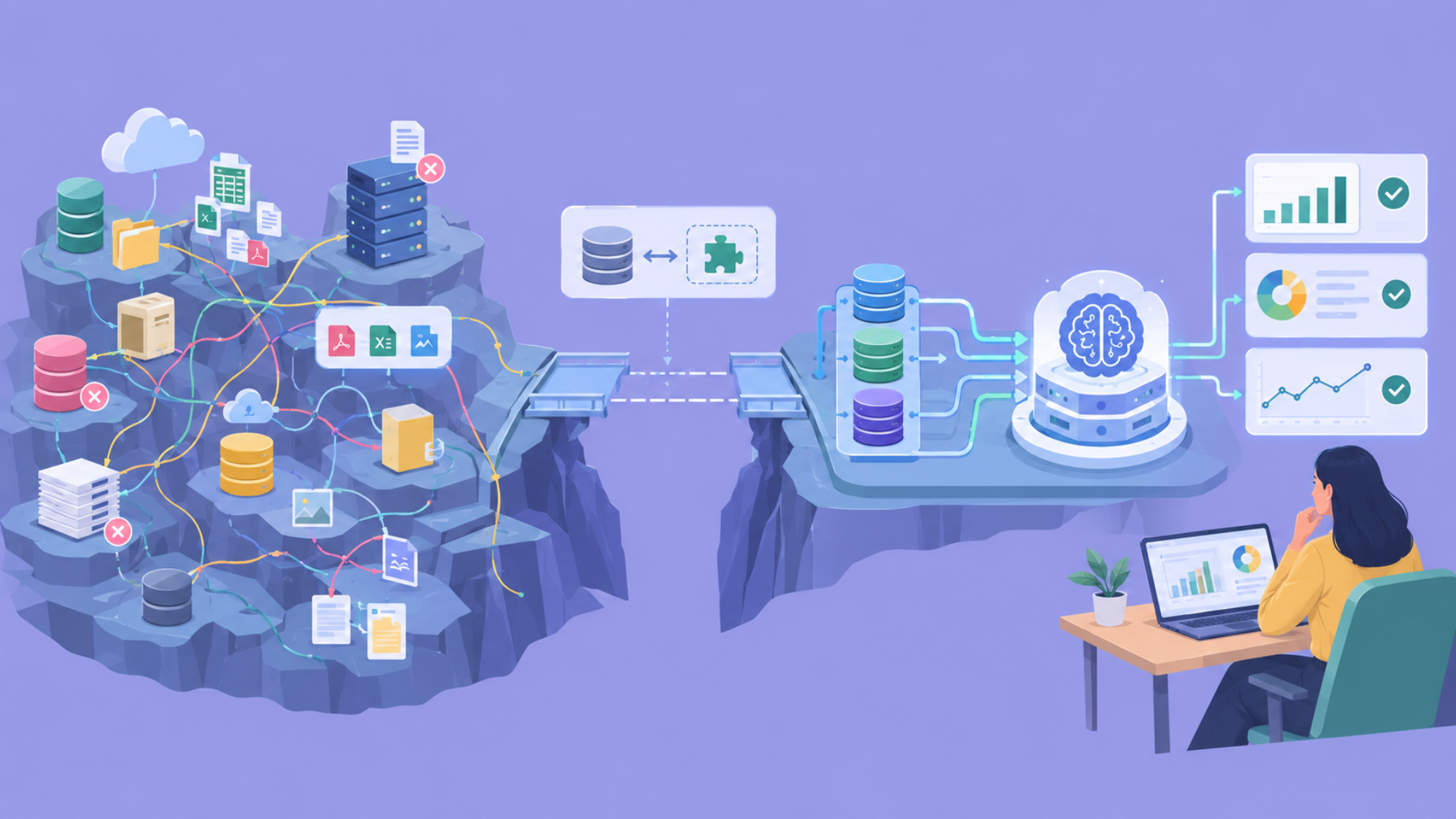
97% of organisations have active AI initiatives. Only 5% say their data is fully ready to support them.
That gap is not a rounding error. It is the defining constraint on enterprise AI in 2026.
A benchmark published this week tested AI data agents on a real enterprise warehouse containing 7.5 billion rows of data. The best-performing model cleared just 34.8% of tasks. The models were capable. The data environment was not.
This is the pattern that shows up everywhere enterprise AI is deployed at scale. The model works in the demo. It fails to reach its projected performance in production. The cause is almost never the model. It is the data the model is operating on.
Gartner projects that through 2026, organisations will abandon 60% of AI projects that lack AI-ready data foundations. Most enterprise data estates fall short on at least three of the five criteria that define AI-readiness. Understanding what those criteria are and what it takes to meet them is the starting point for building AI that works in production.
Why Good Data Is Not the Same as AI-Ready Data
This is the distinction that most enterprise data discussions miss. And it is the reason AI projects fail on data even when the organisation believes its data is in reasonable shape.
Data that works for reporting is structured clearly enough for a human analyst to interpret. Data that works for analytics is consistent enough to support aggregate calculations. Data that works for human review is complete enough for a person to make a judgement on.
AI is different. AI does not get the benefit of human judgment to fill in gaps. It cannot apply the tribal knowledge that says "the sales figures in the Western region system are always reported a week late, so you need to adjust for that." It cannot recognise that a field labelled "revenue" in one system means net revenue and in another means gross revenue. It cannot ask a question when it encounters something ambiguous.
AI reasons over data as it finds it. If the data is ambiguous, the AI produces outputs based on that ambiguity, confidently and at scale. If the data is inconsistent across systems, the AI produces outputs that reflect the inconsistency, without flagging it as a problem.
This is why 74% of data leaders say that trusting the data quality available is what consumes most of their time when working with AI. Not building models. Not designing prompts. Managing the underlying data quality that determines whether the AI can reason reliably.
The Five Things AI-Ready Data Requires
1. Data that AI can find
AI cannot reason over data it cannot discover. This sounds obvious. In most enterprise data environments, it is a real and significant problem.
Enterprise data is distributed across legacy systems, cloud platforms, departmental tools, acquired businesses, and decades of accumulated databases with inconsistent naming conventions and undocumented schemas. AI agents orchestrating data across 15 or more systems in a single workflow, which is now standard for production-grade enterprise AI, need to be able to locate the relevant data reliably and quickly.
Missing this requirement means the AI either fails to find relevant data entirely, or finds data that is not the right data because the naming conventions make the right data invisible to the agent's search.
2. Data quality that AI can trust
Data quality for AI is a higher standard than data quality for human use. A human analyst reviewing a dataset can spot an outlier, make a judgment about whether it reflects a real event or a data entry error, and proceed accordingly. An AI system cannot do this without explicit guidance.
51% of data and analytics leaders cite data quality as their top data integrity priority. 43% cite data readiness as the biggest barrier to AI alignment. These are not separate problems. They are the same problem described from two angles.
Data quality for AI means completeness, accuracy, consistency, and timeliness all meeting thresholds that allow the AI to reason reliably without human correction. In most enterprise environments, at least one of these dimensions fails for at least some of the data that AI needs to operate on.
3. Context that allows AI to understand meaning
Data without context is unusable for AI. This is the dimension that most data quality programmes have not addressed because it was not necessary for reporting and analytics.
A field labelled "revenue" means nothing without knowing whether it is gross or net, whether it includes or excludes returns, whether the currency is standardised, and what accounting period it covers. A human analyst in the business unit knows this because they have context about how the data was collected and what conventions apply. An AI system needs that context to be explicit in the data itself or in accompanying metadata.
35% of organisations cannot close AI feedback loops because semantic layers are absent. The AI can retrieve the data. It cannot understand what the data means. The output it produces may sound confident and specific while being based on a misunderstanding of the data it was given.
Building semantic context into the data layer, through data catalogues, business glossaries, and explicit metadata, is the work that makes data AI-readable rather than just human-readable.
4. Governance that AI systems can enforce automatically
Manual governance cannot keep pace with agentic AI. An AI agent that can read from and write to enterprise systems simultaneously, across multiple workflows, generates governance decisions faster than any manual review process can handle.
AI-ready data governance means policies that are encoded in the data layer rather than enforced by human reviewers. Access controls that determine what data each AI agent can see and what it can do with that data. Quality certification processes that flag which datasets meet the standard for AI use and which do not. Lineage tracking that records where each piece of data came from and how it has been transformed.
Without automated governance, either the AI operates without adequate controls, which creates compliance and operational risk, or the AI is constrained to a pace that human review can manage, which eliminates most of the operational value of deploying AI agents.
5. Data pipelines that are reliable and reproducible
Reproducibility is the hinge between experimental AI and production AI. An AI system that produces different results from the same data on different days is not a reliable production system. Inconsistent data pipelines are the most common cause of this problem.
In most enterprise data environments, data pipelines have accumulated technical debt. They break unpredictably when source systems change. They process data inconsistently depending on when they run. They have undocumented dependencies that create silent failures.
AI-ready data pipelines have automated quality gates that prevent non-conforming data from reaching AI workloads. They have monitoring that detects when data quality degrades. They have documentation and testing that allows changes to be made safely without breaking downstream AI systems.
Why the Problem Is Bigger for AI Agents Than for Earlier AI
Earlier enterprise AI, demand forecasting models, credit scoring systems, recommendation engines, was trained on historical data and deployed to process new data of the same type. The data requirements were specific and bounded. A demand forecasting model needed specific sales history and external signals. A credit model needed specific financial and behavioural data. Preparing that specific data to a sufficient standard was a manageable, if significant, undertaking.
Agentic AI changes the data requirement fundamentally. An AI agent orchestrating a procurement workflow needs to access supplier records, contract terms, inventory data, approval thresholds, budget information, and ERP transaction records, across different systems with different data models, in real time. The data requirement is no longer specific and bounded. It is broad and dynamic.
This is why the 7.5 billion row enterprise warehouse test matters. It is not testing whether AI can process large data volumes. Modern systems can do that. It is testing whether AI can navigate the complexity of a real enterprise data environment, with all its inconsistencies, naming conventions, undocumented schemas, and semantic ambiguities. On that test, the best available models cleared only 34.8% of tasks. The data environment is the constraint.
What to Do First
The full journey to AI-ready data across an enterprise takes 12 to 18 months in most organisations. That does not mean AI deployment needs to wait that long.
The practical approach is to identify the highest-value AI use case in your organisation and make the data for that specific use case AI-ready first. Not all the data. The specific data that the specific AI deployment needs to function reliably.
This is a narrower undertaking than it sounds. A field service AI that allocates jobs to technicians needs clean technician certification data, real-time job status data, customer contract data, and parts inventory data. Making these four data sources AI-ready is a weeks-long project rather than an 18-month programme. The AI deployment can go live on AI-ready data while the broader data foundation work continues in parallel.
The sequence matters. Build the data foundation for the first use case. Deploy the AI. Measure the outcomes. Use the lessons from that deployment to inform the data foundation work for the next use case. Each deployment makes the next one faster because the data infrastructure and the organisational capability to prepare data improve with each cycle.
This is the forward deployed engineering principle applied to data readiness. Start inside the actual data environment. Discover the real quality issues, the real integration gaps, and the real governance requirements. Build the foundation for the specific use case that will generate the first measurable return. Do not wait for perfection before deploying anything.
The Business Case for Treating Data Readiness as an Investment
The organisations that treat data readiness as a cost tend to do the minimum required to deploy the immediate AI use case and move on. The result is that each subsequent AI deployment starts from scratch on data preparation because the underlying data foundation has not improved.
The organisations that treat data readiness as an investment build a data foundation that makes each subsequent AI deployment faster and cheaper. The second deployment takes three months instead of six because the data pipelines, governance framework, and semantic layer built for the first one are already there. The third takes six weeks. The value of the investment compounds across the AI programme rather than being incurred fresh each time.
94% of IT leaders cite data quality as the primary factor in determining an AI project's success. That is not a statement about a nice-to-have. It is a statement about the determinant of whether AI investment generates the returns that justified it.
Vishleshan AI's forward deployed engineering (FDE) approach builds the data foundation alongside the AI deployment, inside the client's actual data environment. We identify the specific data quality gaps, integration gaps, and governance gaps that will prevent the specific AI use case from reaching production performance, and we close them as part of the deployment rather than as a separate programme that runs in parallel and never quite finishes. Book a Consultation